Journal Practice
The slow bleed of executive function has a paper trail
Your journal is a raw logbook for cognitive strain. The actual data is in the forgotten words, the messy handwriting, and the sentences you abandon halfway.
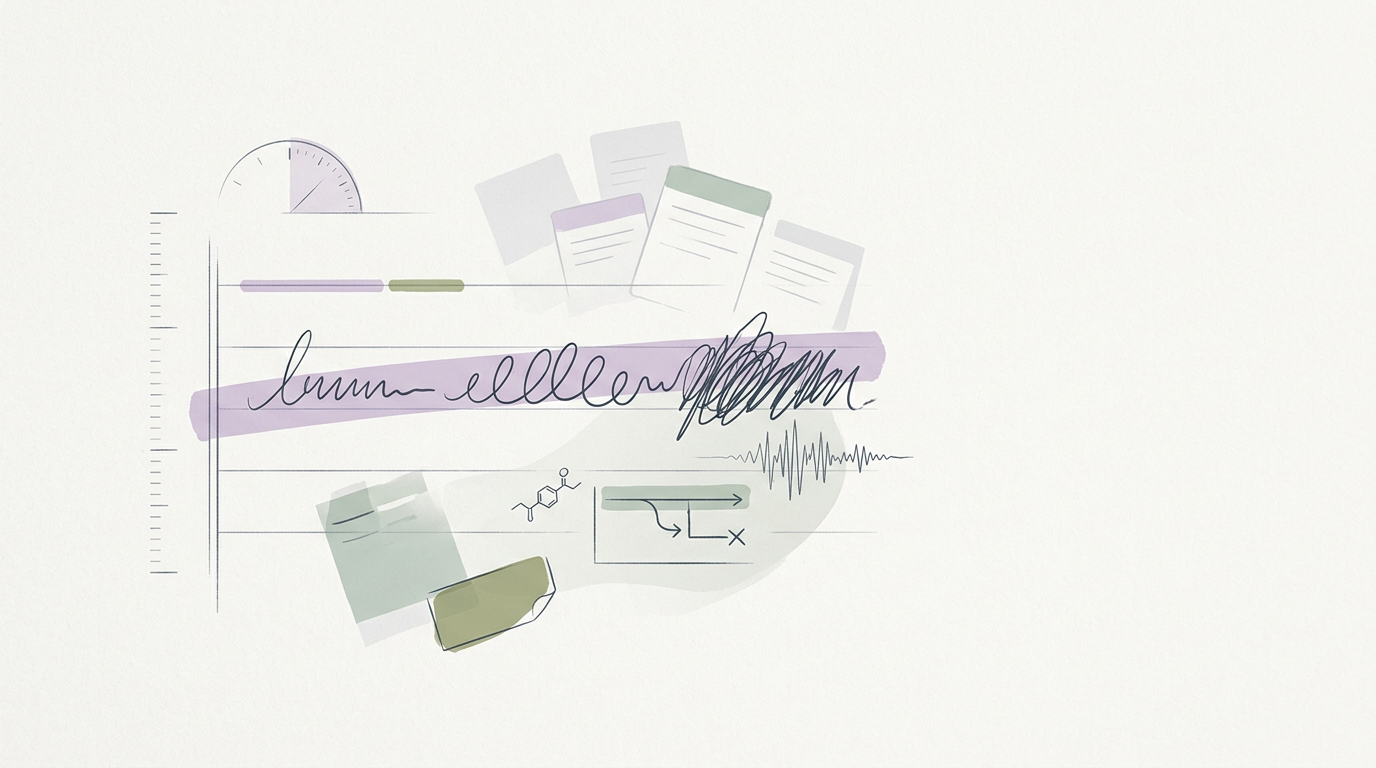
For a long time, I told clients to dump their feelings onto the page after a difficult week. The standard advice assumes writing down an emotional narrative brings clarity and relief. In reality, unstructured venting frequently rehearses a grievance and ramps up autonomic threat detection. The true utility of a notebook is capturing a mechanical, real-time readout of your executive function under pressure.
You're on a 3pm video call, trying to explain the next project phase, and the word for 'deployment' evaporates. You stammer, call it 'the next thing', and feel a flush of heat in your neck. Later, you find yourself reading the same short email four times before the sentences register. You assume you just need a second coffee to push through the haze. People frantically type brain fog after eating into Google, or they lie awake tired but wired at 11:47pm, assuming they just have a bad attitude about work. You can't sleep even though exhausted because your nervous system is stuck on high alert. The physical texture of this state is unmistakable. Your jaw stays clamped, your shoulders refuse to drop in the shower, and the simplest cognitive task feels like wading through wet cement.
A longitudinal study of one
A daily writing habit is a highly reliable way to monitor cognitive capacity. The value lies in the structure of the output, independent of the emotional content. Retrieving specific vocabulary, formulating complex clauses, and holding a thought to the end of a line are all demanding executive functions. They're governed by your prefrontal cortex, the neural machinery responsible for planning, working memory, and moderating your impulses.
Writing by hand forces coordination between motor control, language centres, and visual feedback. Over a few months, this physical action establishes a personal baseline. A sudden shift to simpler vocabulary, repeating the same word, or a sharp decline in the neatness of your script is a biological signal. The resources available for complex thought are becoming scarce.
The physiological record
Those moments of dropping a word mid-sentence are a direct reflection of allostatic load. Your organism constantly allocates energetic resources based on perceived threat. When demands from travel, sleep disruption, or persistent low-grade anxiety stay high, the system routes energy away from metabolically expensive cortical areas. The prefrontal cortex is a heavy consumer of glucose and oxygen. Under chronic strain, it gets throttled back to keep the more ancient, survival-oriented structures online.
I used to think my brain was just failing me on a busy Tuesday. Now I know the glitch itself is the information. The entry you struggle to form after a 12-hour travel day with a delayed flight from Lisbon is an accurate map of your current neurobiological state.
Naming the state changes the state
Affect labeling asks for raw sensory data and bypasses narrative entirely. Naming a sensation or a cognitive glitch forces blood flow back into the prefrontal cortex, which in turn applies a braking mechanism to the amygdala. The goal is to accurately identify the physiological reality of the moment. This engages your observational machinery and dials down the threat response.
The blank page does not care if you found closure. It only requires the data.
Instead of writing an essay about an impossible colleague, you log "jaw tight, shallow breathing, couldn't recall the name of the quarterly report." You step out of the story. You stop rehearsing the grievance. The spiral halts, leaving you with a clean reading of your capacity.
What to record when writing is the problem
The objective is to capture the condition of the machine. When the machine is sputtering, you stop trying to write beautiful prose and start logging fragments. I find the most useful data in the abandoned halves of a sentence.
Note the specific failure. Be a court reporter for your own cognitive stumbles. Log the exact moment you forgot the point of the conversation. Note where the strain shows up in your body, whether that is a hollow stomach or a buzzing sensation behind your eyes. If your thoughts are fragmented, let the ink be fragmented. A page of half-finished thoughts is a far more honest record of a taxed nervous system than a perfectly constructed paragraph.
If words fail entirely, simply hold the pen. Watch what your hand does on the paper. A jagged, heavy spiral pressed so hard it dents the page is a pre-verbal readout of tension. The pattern is the point.
Common Questions
What if my handwriting is naturally messy?
You're tracking deviations from your own baseline, independent of any objective standard of neatness. If your normally legible script devolves into a frantic scrawl during a week of poor sleep, that change is the signal. Consistent messiness is just your handwriting.
Does this mean I should never write about my day?
You can write about your day. The distinction is in whether you're processing the events or merely feeding the outrage cycle. Unstructured venting often amplifies the exact physiological state you're trying to escape.
Can I just type this into my phone instead?
Writing by hand requires fine motor control and provides a much richer dataset. The size, pressure, and legibility of your script add layers of information that a keyboard obscures. Typing is less cognitively demanding and fails to test the system in the same way.
What to do this week
- Buy a dedicated notebook solely for tracking capacity, separate from your task lists.
- Log your first entry at 3pm, noting exactly one physical sensation and one cognitive glitch from the afternoon.
- Review your entries on Sunday to spot the day your handwriting degraded, mapping it to your sleep data.
Where this fits in the Kokorology system
Tracking your baseline capacity is the foundation of the Journal practice. Once you can accurately read the signals of cognitive strain, you can apply targeted micro-practices from the Hacks library to shift your state before you hit the wall. For deeper work on expanding that capacity, this methodology is built into Performance L2.
Tonight's practice
Tonight's practice is for collecting one clean data point. Forget narrative entirely and focus strictly on observation.
Where do you feel today's load in your body, and what was the exact moment your focus fractured?
- Set a timer for five minutes.
- Sit at a desk with your notebook and a pen.
- Write the prompt at the top of a blank page.
- Answer with sensory fragments only: 'buzz behind eyes', 'right shoulder elevated', 'couldn't remember the gate code'.
- Close the book immediately when the timer sounds.
Closing
The goal is to build a more honest, data-informed relationship with your organism's limits. You stop pathologising every dropped word and start respecting the biological reality of your output.
- Start tracking your cognitive load daily with the Kokorology Journal.
- Go deeper into the neurobiology of stress and recovery inside Regulation L1.
- Read the free guide on nervous-system regulation.
TL;DR
Unstructured emotional venting in a diary often amplifies your stress response. A regular handwriting practice is better used as a daily logbook for cognitive strain. The structure of your writing—your word retrieval, sentence complexity, and handwriting legibility—provides a direct readout of your prefrontal cortex capacity. Tracking these mechanical deviations from your personal baseline reveals when your nervous system's total load is too high, giving you a clear biological signal long before you hit total exhaustion.
Sources
- Pennebaker, J. W. (2023). Journaling and the nervous system: from expressive writing to affect labeling. Curated meta-analyses and primary studies (1986–2023).
- Grünewald, B., et al. (2024). Executive Function Recovery Trajectory After Clinical Burnout: 24-Month Follow-up. Journal of Occupational Health Psychology.
- Lieberman, M. D. (2023). Communication with others and oneself: language as a nervous-system intervention. Curated primary studies and meta-analyses (1994–2023).
- Thayer, J. F., et al. (2009). Heart Rate Variability, Prefrontal Neural Function, and Cognitive Performance: The Neurovisceral Integration Model. Journal of Personality and Social Psychology.