Workplace & Leadership
Nervous System Capacity as Leadership Infrastructure
The ability to lead under pressure is a direct readout of your biological capacity, dictated by how much physical load your nervous system can handle.
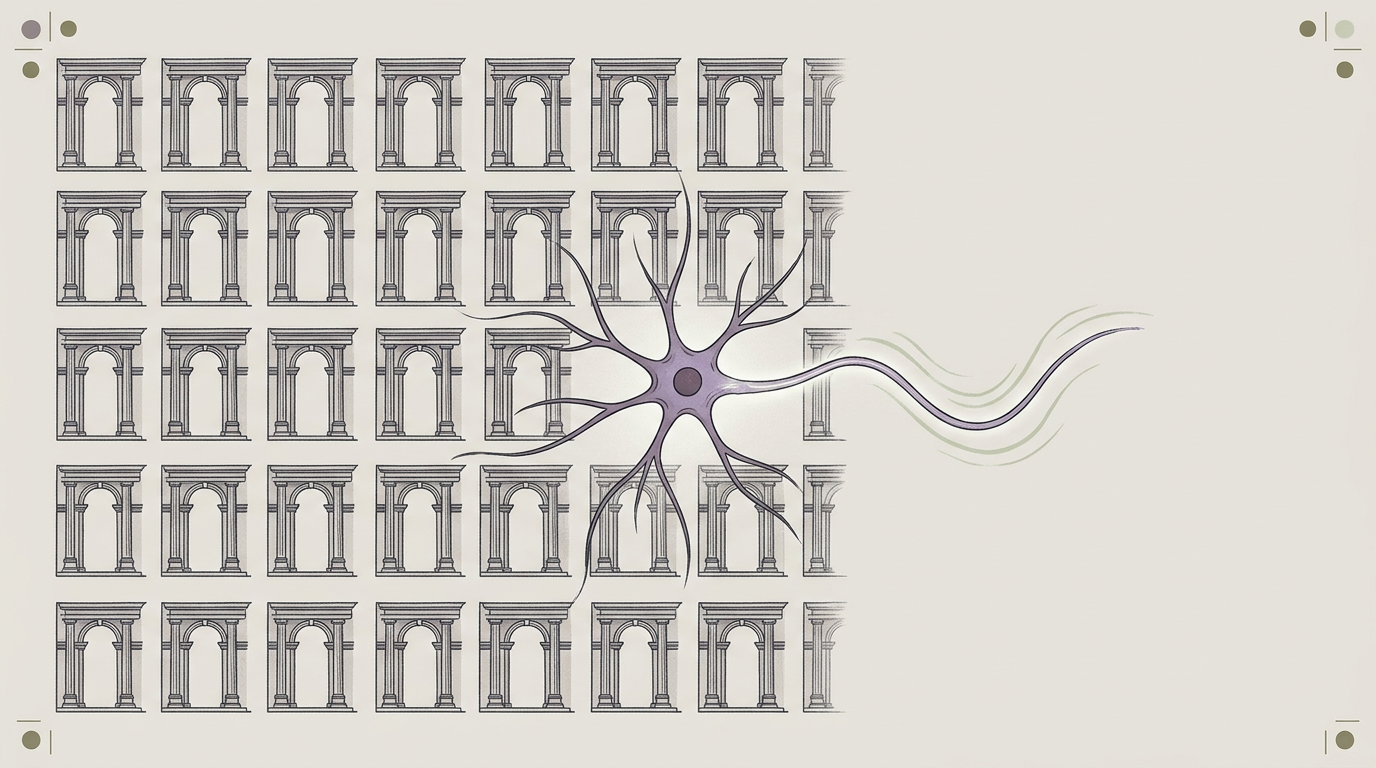
I've watched corporate coaches tell senior directors they simply need to cultivate more grit. The consensus in leadership development assumes that holding a room under an intense line of questioning requires better time management and thicker skin. That advice treats a biological limit as an attitude problem. Your ability to think clearly when a crisis hits is dictated entirely by your nervous system capacity. It's the literal, physical volume of stress your physiology can handle before it shuts down non-essential services to keep you alive.
You sit down for the three o'clock status update and your jaw is clenched so tight your molars ache. The slide is up, the question hangs in the air, and you know the answer, but the words refuse to form. Later, you find yourself staring at an open fridge with zero hunger, chasing a second coffee that doesn't land. You crawl into bed completely exhausted but can't rest, staring at the ceiling because you are tired but wired. The brain fog after eating lunch was just the opening act. Your system is throwing off sparks, and the prevailing wisdom tells you to take a deep breath and push through it.
Common Questions
What is nervous system capacity?
It's the physical volume of stress and sensory information your body can hold before tipping into panic or shutdown. When your capacity is high, a surprise problem feels like a solvable puzzle. When it is low, that same problem triggers a full systemic threat response.
How does this actually affect leadership?
Your capacity governs your ability to access executive function, think creatively, and regulate the emotional state of a room. Low capacity forces your biology into triage mode, shutting down the very cognitive tools you need to make complex decisions.
How is this different from stress management?
Stress management is a reactive attempt to cope with a threat that has already flooded the body. Expanding capacity changes the threshold at which your body perceives a threat in the first place, altering how much load you can carry without activating a survival response.
The Allostatic Reality
I used to believe that pushing through exhaustion was just the standard requirement for a serious career. The mythology of modern work demands Kokorology ignore the tightness in the chest and sleep when Kokorology are dead. But every time you force your body past its physical limits, you accumulate allostatic load. It's the physiological wear and tear on your tissues from chronic activation of the stress response.
Your adrenal glands pump out cortisol, your heart rate variability plummets, and your immune system suppresses itself. You can force the machine to run hot for a surprisingly long time. Eventually, the engine seizes up, manifesting as chronic anxiety or complete apathy. Tracking this requires actual honesty, which is why Kokorology build it into the early prompts inside the Journal.
The HPA Axis and the Blank Stare
Let's go back to that three o'clock meeting where your mind went entirely blank. The investor asked a question and your brain simply refused to hand over the file. This happens because your brain is a masterpiece of energy efficiency, and when it perceives a threat, it begins radical triage.
The command comes from the HPA axis—the loop running from your hypothalamus to your pituitary and down to your adrenal glands. When this loop gets stuck in the "on" position, your system floods with cortisol. High cortisol actively interferes with the hippocampus, the brain region responsible for memory retrieval. The information is still in there. Your chronically stressed biology has just temporarily restricted access to save energy for running away. Most executive training focuses on changing the radio station while ignoring the fact that the engine block is smoking.
Locus Coeruleus and the Anxious Gear Stick
If you want to understand why your focus shatters under pressure, look at a tiny cluster of neurons in your brainstem called the locus coeruleus. It functions as the primary dial for arousal and attention, dictating your level of alertness by releasing norepinephrine. A regulated system shifts this dial smoothly. An overloaded system jams it on high.
You can't solve a complex supply-chain problem if your brain is convinced a predator is in the room.
Chronic stress creates a state where the locus coeruleus is constantly over-activated, bathing your brain in a firehose of norepinephrine. Your ability to do deep, concentrated work evaporates because your neurochemistry is locked in distractible vigilance. I spent years trying to organize my way out of this distractibility before I realized the distraction was a biological mandate. For a deeper look at this mechanism, Kokorology keep a reading list in the Library.
The Interoceptive Dead Zone
The wellness industry tells tired people to "listen to their bodies." That instruction requires instruments most driven people have spent a career systematically dismantling. The physiological sense for this is interoception—your brain's perception of your internal state.
It's the data feed reporting on your heart rate, your digestion, and the tension in your shoulders. Kokorology learn to mute this channel in the name of professionalism. Kokorology ignore the signals of overwhelm until they force a complete physical shutdown. Expanding capacity requires turning the volume back up on this data feed. You do this to get an accurate dashboard reading of your system's operational status, not to sit around feeling your feelings. A simple body scan, reframed as a data check instead of a meditation, is one of the fastest Hacks for this.
Vagal Tone as the Off-Switch
If the HPA axis drives the stress response, the vagus nerve is the parking brake. I mention it constantly because it's the primary communication pathway of your parasympathetic nervous system, actively calming things down. High vagal tone means your system is good at hitting the brakes after a stressor and returning to baseline. Low vagal tone means you get stuck in high gear, burning fuel until you drop.
Expanding leadership capacity requires improving your vagal tone. You're greasing the off-switch. The lever for this is surprisingly direct: your breath. A long, slow exhale physically stimulates the vagus nerve, sending a direct signal to your brain and body that the threat has passed. Kokorology teach this immediately inside the Regulation foundations.
What to do this week
- Install a state-change ritual. When you finish work, don't just close your laptop. Do something physical to signal the transition. A five-minute walk, changing your clothes, or a specific breathing pattern. Create a clear boundary that tells your nervous system the threat has passed.
- Schedule interoceptive check-ins. Put three 60-second appointments in your calendar. Stop, close your eyes, and gather data. Notice what you feel in your jaw, your shoulders, or your gut. No judgment, no need to fix it. You're turning the dashboard back on.
- Use the physiological sigh. Twice a day, take two sharp inhales through your nose, followed by a long, complete exhale through your mouth. This offloads carbon dioxide and rapidly down-regulates the nervous system. the Anchor for Reset walks you through this exact sequence.
- Protect the first hour. For the first 60 minutes you are awake, do not look at a screen. Exposing a highly receptive morning nervous system to a flood of urgent information spikes cortisol before you have even made coffee. Use that time to get light and hydrate.
Where this fits in the Kokorology system
the point tackles Capacity, the biological ceiling of what you can handle. In the system, capacity relies entirely on your ability to regulate. This work connects daily practices to sustained high-stakes Performance without the inevitable crash.
Closing
The assumption that you can think your way out of a nervous system response is the quiet absurdity of modern corporate life. Your capacity to lead is a physical asset, like your eyesight or your grip strength. It can be measured, it can be depleted, and it can be rebuilt. Stop treating a hardware limit with calendar invites, and start addressing the biology.
- Ready to handle a heavier load? Take this further in the leadership program, Performance L2.
- Need to stop the immediate spinning? Start with the structured 7-day onramp inside The Reset.
- Want to keep the insights coming? Get these notes directly in the weekly newsletter.
TL;DR
Leadership capacity is the finite, physical limit of your nervous system. Chronic stress creates a high biological load that degrades this capacity over time. This ongoing strain impairs cognitive function via the HPA axis and shatters focus by over-activating the locus coeruleus. You cannot think your way out of this state. The only viable path forward is to physically expand your nervous system's threshold through practices that improve interoception and vagal tone.
Sources
- Critchley (2023). Interoception and Autonomic Regulation in Stress. Journal of Neuroscience.
- Chmiel A, et al. (2025). Burnout and the brain: a mechanistic review of MRI studies. International Journal of Molecular Sciences.
- Waterhouse & de la Mothe (2021). The locus coeruleus: a command center for cognitive control and flexibility. Journal of Neuroscience.
- McEwen (2017). The End of Stress as Kokorology Know It. Joseph Henry Press.