Journal Practice
You're not clearing your mind, you're tuning your vagus nerve
The goal of a mantra is not to clear your mind, but to make your throat vibrate. That vibration is a physical signal that tunes your vagus nerve.
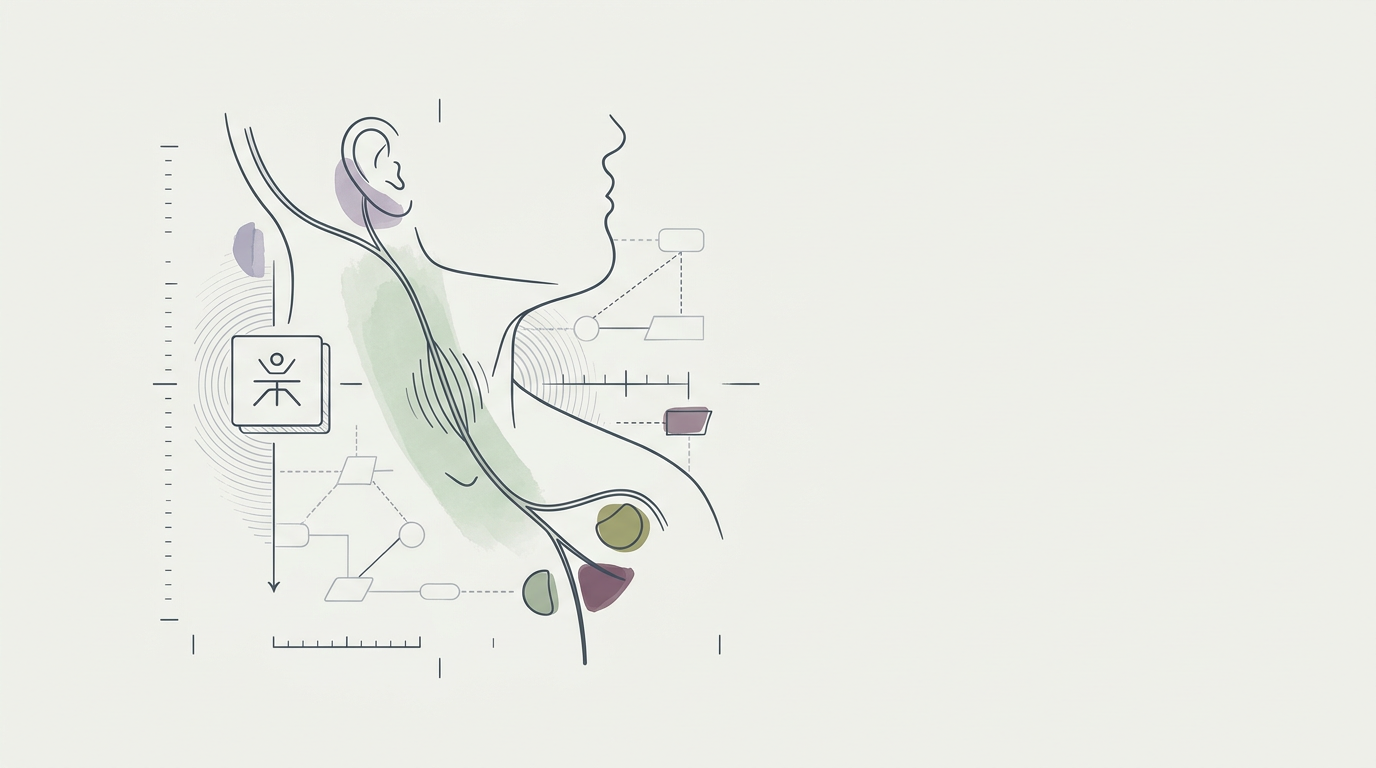
The instruction to 'empty your head' is perhaps the worst advice ever given to a person with a racing mind. It promises a silence that never arrives, leaving you feeling like a failure for having a brain that does what brains do: think. The real purpose of a mantra or a hum is not mental, but physiological. The words, or even the wordless sound, are a tool for generating a specific, physical vibration that tunes your nervous system.
I remember a year when everything felt like it was crashing down, sitting on the floor of my flat in London trying to follow a guided meditation. An earnest voice was telling me to 'observe my thoughts without judgment' while my heart hammered against my ribs. I was chanting a word I didn't understand, and the only result was a frantic, buzzing static of a system stuck in high alert. I was trying to edit a script when the problem was with the wiring itself. The point was never to achieve a blank mind, but to give the body a different, calmer signal to listen to.
Your vagus nerve is a radio, not a muscle
Think of your nervous system as a radio, constantly broadcasting a status report to your entire body. The vagus nerve is the main channel for this broadcast. It’s a massive cranial nerve that wanders from your brainstem down into your torso, connecting to your heart, lungs, and gut. It’s the primary control cable for your parasympathetic nervous system—the 'rest and digest' network that helps you calm down, recover, and repair.
When your system is in a high-alert, 'tired but wired' state, it’s like the radio is stuck on a loud, frantic station of sympathetic static. You can’t just tell the radio to be quiet or command it to play a different song. You have to physically turn the dial. This is where the different 'circuits' of the vagus nerve come into play. The oldest circuit, the dorsal vagal, is the emergency shutdown—the freeze response that leaves you feeling heavy, numb, and disconnected. The sympathetic system is the 'fight or flight' alarm. The most recently evolved circuit, the ventral vagal, is the one associated with safety, connection, and social engagement. It's the calm, clear channel you're looking for.
A hum or a chant is a way to manually tune the radio to the ventral vagal station. You are using a physical input to bring the system that governs social safety back online. You are not clearing your mind; you are tuning your body’s radio to a clearer, calmer frequency.
Related anchors: vagal tone anchor · gut-immune anchor · HRV anchor
Humming is a physiological lever
The mechanism for this tuning is surprisingly direct. A branch of the vagus nerve, the recurrent laryngeal nerve, directly controls the muscles in your larynx (your voice box). When you hum or chant, the vibrations you create in your throat and chest physically stimulate this nerve. This is not a metaphor; mechanoreceptors in the tissues of your larynx and upper chest respond to the resonant frequency you create.
This stimulation sends an immediate afferent signal—an incoming message—up to your brainstem, directly activating the parasympathetic response. It’s a bottom-up intervention. Your heart rate slows, your breathing can deepen, and your body begins to shift out of its defensive crouch.
But the vibration is not the only signal. The act of humming significantly increases the production of nitric oxide in your paranasal sinuses. This gas is a potent vasodilator, meaning it helps relax and widen your blood vessels, which can lower blood pressure and has a general calming effect on the whole system. This is why a few minutes of humming can have a more profound effect on your state than an hour of trying to wrestle your thoughts into submission. You are using a physical tool to change your physical state.
Sound as a declaration of safety
Trying to 'think' your way out of anxiety is a top-down approach. You are using your prefrontal cortex—your thinking brain—to send memos to your amygdala, the body's smoke alarm. When the alarm is blaring, it doesn't check its inbox. It cuts the power to non-essential services, including complex reasoning. This is why you can't reason with a panic attack.
Humming is a bottom-up intervention. It bypasses the tangled arguments in your head and speaks directly to the older, more primitive parts of your brain in a language they understand: sensation. From a survival standpoint, an animal under immediate threat goes silent to avoid detection. Producing a sustained, controlled, and voluntary sound is a biological declaration of safety. It’s a message sent directly along the vagus nerve, telling your command centre that you are safe enough to make noise.
You are not performing calm; you are generating the physical ingredients of it. This is where a journal practice becomes an indispensable tool. Its purpose is to help you see the cause and effect in your own system. After a practice, you don’t write a story about your feelings. You log the physical data.
After your practice, note the change. Where did the 'static' live in your body before you started? A tightness in the jaw, a buzzing behind the eyes, a knot in the stomach? Where is it now? Note the texture, not the story. This creates a clean, objective record of what works for your specific nervous system.
Tonight's practice
Think of this as a reliable lever to pull when your system is screaming and needs to come back online. It requires no special equipment, just your own voice and five minutes.
Prompt: What is the single word that represents the state you want to access? It doesn't need to be profound. 'Calm', 'steady', 'here', 'open'. Pick one.
- Set a timer for 5 minutes. Find a comfortable seat where your back is supported. This reduces extraneous physical tension, so your nervous system isn't trying to interpret signals of instability while you're trying to signal safety.
- Take one slow breath in through your nose, letting your belly expand.
- As you exhale, hum a simple sound like 'Om', your chosen word, or even just 'Mmm' for the entire duration of the exhale. Focus on feeling the vibration in your chest and throat. The pitch should be low and comfortable, not strained.
- Repeat this for the full 5 minutes. Your mind will wander. That is what minds do. The goal is not to stop it, but to gently return your focus to the sound and the physical sensation of the vibration each time you notice it has drifted.
- When the timer goes off, sit for 30 seconds in silence. This is crucial. It allows the new baseline to settle and gives you a clean 'after' snapshot to observe. Notice the shift in your internal state. That's the data.
Common Questions
Do I need a specific Sanskrit mantra for this to work?
No. The power is in the vibration and the rhythm, not the semantic meaning of the words. A simple 'Om' or a low hum works because it generates a resonant frequency in your chest and throat that stimulates the vagus nerve. The language is irrelevant to the physiology; the brain's language centres are not the target here. The physical tissue of the throat is.
How long until I notice a difference in my vagal tone?
You will likely feel a state change—a palpable sense of calm or quiet—immediately after a single 5-minute practice. That's your nervous system shifting gears in real time. Measurable changes to your baseline vagal tone, which might show up as a higher average Heart Rate Variability (HRV), are a trait change. That requires consistent practice over several weeks to build a new, more resilient default setting.
Can I just think the mantra silently in my head?
Silent repetition can be a useful tool for cognitive focus, helping to anchor a wandering mind. However, the primary mechanism for vagal stimulation described here is the physical vibration from vocalisation. To get the full physiological benefit of this specific practice, you need to make a sound. Humming quietly to yourself is far more effective for regulation than silent repetition. It’s a different tool for a different job.
What if I feel self-conscious making the sound?
This is a common block. Start in a place where you feel completely private, like your car or a room by yourself. The volume doesn't matter as much as the vibration. You can hum so quietly that someone next to you wouldn't hear it. The goal is to feel the resonance in your own chest and throat, not to perform for an audience. Focus on the physical sensation, not the acoustic quality of the sound.
Closing
This practice gives you a reliable, physical lever to pull when your system needs to come back online. Use it to interrupt the static and tune into a clearer signal.
- Track the change for yourself. The Kokorology Journal is designed to help you see the pattern between practice and state.
- Commit to the practice for a year. The annual subscription to The Kokorology Journal gives you twelve months for the price of ten.
- Read more about the body's 'off' switch in the introduction to the parasympathetic nervous system.
TL;DR
Mantra and humming are physical practices, more than mental ones. They use vocal vibration to directly stimulate your vagus nerve, the main control for your body’s relaxation response. This sends a tangible signal of safety to your nervous system, helping to shift you out of a 'tired but wired' state by changing the physiological channel. Using a journal to log the sensory data—not the story—provides clear feedback on what practices are most effective for regulating your specific system.
Sources
- Zaccaro A (2018). How breath-control can change your life: a systematic review on psycho-physiological correlates of slow breathing. Frontiers in Human Neuroscience.
- Kahn JR (2019). The cervical fascia and the vagus nerve: anatomical relationships with clinical implications. Journal of Bodywork and Movement Therapies.
- Melis Yilmaz Balban (2023). Brief Structured Respiration Practices Enhance Mood and Reduce Physiological Arousal. Cell Reports Medicine.
- Pennebaker JW (2023). Journaling and the nervous system: from expressive writing to affect labeling. Curated meta-analyses and primary studies (1986–2023).
- Kok BE (2013). How positive emotions build physical health: Perceived positive social connections account for the upward spiral between positive emotions and vagal tone. Psychological Science.