Nervous System
Journal Prompts for Nervous System Regulation
Most advice on journaling for nervous system regulation treats your brain like a suggestible child who just needs to be told a nicer story. Write three things you're grateful for. List your wins. Reframe your negative th
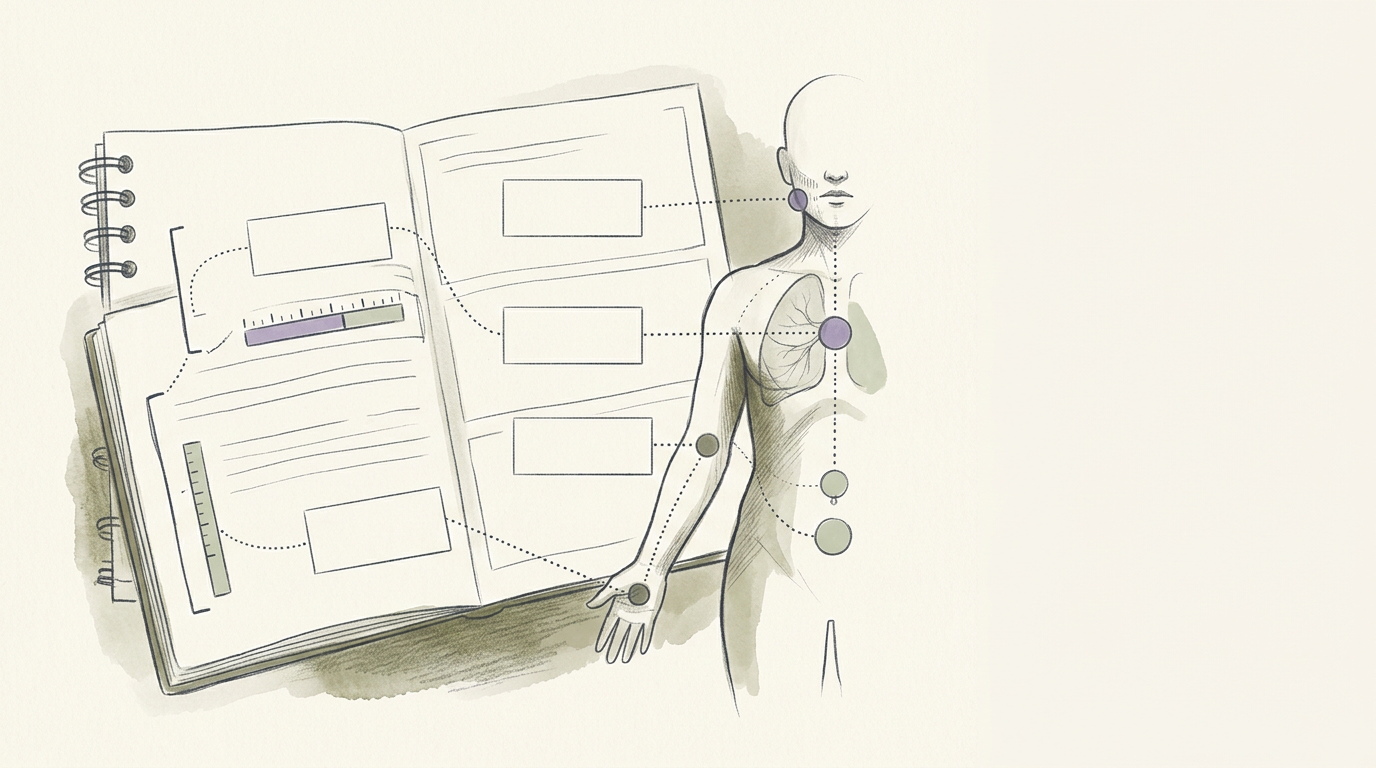
I've spent years treating my notebook like a complaints department. The wellness aisle insists that the best journal prompts for nervous system regulation ask you to list three things you're grateful for or reframe your negative thoughts. That advice treats the human brain like a suggestible child who just needs a nicer bedtime story. A regulated state does not arrive through narrative willpower.
You sit down at 9pm with a nice pen, expecting relief, but you just feel tired but wired. The 3pm jaw clench has followed you into the evening. You stare at the paper feeling anxious for no reason, trying to manifest peace while your shoulders refuse to drop and your breath stays trapped high in your chest. The page asks what you learned today, but you have brain fog making it hard to focus, with half-finished sentences looping behind your eyes and you are exhausted but can't rest. Your system doesn't want a moral to the story. It wants to know if the threat has passed.
Common Questions
What is journaling for nervous system regulation?
It's a practice of building interoception—your brain's ability to read your physical state. You document raw data like a tight jaw or shallow breathing rather than venting about your feelings. This trains the machinery to notice subtle signals of dysregulation before they escalate into panic.
How does writing about sensations affect stress?
Putting a precise, neutral word to a physical sensation engages the prefrontal cortex. That engagement naturally turns down the volume in the amygdala, your brain’s primary threat-detection center. The physical act of naming the sensation acts as a mechanical brake on the stress response.
How long do I need to journal for?
Five minutes. A short daily check-in creates a reliable data stream for your brain to learn from. You are logging a baseline of your physiology to find patterns.
The Rumination Trap
Kokorology're taught to use notebooks for stories. Kokorology write down who Kokorology're angry at, what went wrong in the meeting, and what Kokorology wish were different. Expressive writing has a place, but when you're already hovering near your capacity, detailing your frustrations just re-runs the same stressful code. I used to think detailing every office injustice in my notebook was productive processing, until I realized my resting heart rate violently disagreed.
The inbox has never once been impressed by your heart rate, and your notebook doesn't care about your grudges. A regulation-focused journal operates as a sensor array. The primary job is to gather data on the internal state of the system. This practice builds interoception, centered in the insular cortex, giving you a daily read on the nervous system regulation you actually need.
Translating the Threat
Saying "I feel stressed" is practically useless information for your nervous system. That label is a messy bundle of physical sensations, office politics, and future anxieties. The work of regulatory journaling is to unbundle the physical reality from the plot.
The body doesn't speak fluent English; it communicates in the blunt language of a clenched stomach and a shallow breath.
Instead of writing about your looming presentation, you log the actual architecture. The jaw is locked. The breathing is shallow. The hands have a slight tremor. The focus is painfully narrow. By learning to translate sensation into plain language, you gain the ability to intervene. Language is a direct intervention on the circuitry that manages your arousal, something Kokorology dive into deeply inside the Library.
Predictive Interoception
Here's the mechanism nobody talks about in the stationery aisle. Your brain doesn't passively receive signals from your body. It actively predicts them. The central processor runs a constant simulation of your physiological state, attempting to anticipate requirements before they become critical. It uses past experience to generate a body budget, distributing resources like glucose, water, and cortisol to meet forecasted demands.
A sense of impending doom is frequently a prediction error. Your brain predicted one state, but the incoming sensory data reports something else entirely. Chronic prediction error drives up allostatic load—the physiological wear and tear of sustained activation. The machine keeps guessing wrong and spending its budget on emergencies that don't exist.
Feeding your brain a steady stream of high-quality, real-time data about your internal state provides the source material it needs to make better predictions. You are mechanically improving its ability to allocate resources.
Moving from Top-Down to Bottom-Up
The blank page feels like an interrogation under a bare bulb when you're already overwhelmed. Unstructured writing prompts usually fail because they ask for an insight when you barely have the capacity to form a sentence. The point of a prompt is to direct your attention.
Targeted questions act as guardrails. They steer you away from spiraling narratives and toward tangible data points. You move from top-down storytelling to bottom-up sensation tracking. Instead of asking why you're so upset—an invitation to invent a narrative—you ask where the activation lives in your body. This grounds the circuitry in the physical reality of the moment. That grounding is a necessary step to de-escalate the HPA axis (the stress-hormone loop that runs from your brain to your adrenal glands and back) and quiet the alarm bells.
What to do this week
Forget the gratitude lists for a few days. Collect data instead.
- Set a hard boundary: Five minutes maximum. Same time every day.
- Draw three columns: Head them Physical, Mental, and Environmental.
- Log the raw data: Under each heading, list three specific observations using bullet points. Do not use full sentences. Under Physical, write "warm hands" or "high shoulders." Under Mental, use a weather condition like "cloudy" or "still." Under Environmental, name what your senses actually detect, like "fan noise" or "hard chair."
- Walk away: Close the book. Do not analyze the data or try to fix the tension.
Where this fits in the Kokorology system
Targeted tracking is a foundational practice for building interoceptive awareness. It serves as one of the most reliable Anchors for stabilizing a system that is running hot. Kokorology teach this as a core skill inside the broader framework of capacity management.
Tonight's practice
What is one physical sensation in my body right now that I have been ignoring since lunchtime, and what happens to its temperature when I take two slow breaths?
- Sit on the edge of your bed without your phone.
- Set a timer for three minutes.
- Do a slow mental scan from your jaw down to your stomach, noting any areas of constriction.
- Inhale through your nose for a count of four, and exhale through your nose for a count of six.
- Repeat the breath cycle five times, keeping your attention entirely on the physical feeling of the air moving.
TL;DR
Effective journal prompts for nervous system regulation bypass emotional storytelling to collect raw physiological data. Naming physical sensations engages the prefrontal cortex and naturally down-regulates the amygdala, reducing your overall allostatic load. This practice builds interoception, training the brain to accurately predict and manage its internal state rather than reacting to phantom threats. The practice serves as a diagnostic tool for your physiology.
Closing
The objective is a legible internal world. When you can read the machinery's own diagnostic reports, you stop guessing at what you need. You notice what is already true.
- Practice it daily inside the Journal.
- Learn the exact mechanisms in Regulation L1.
- Use the 60-second tools in Hacks when you need an immediate shift.
Sources
- Lieberman, M. D. (2023). Communication with others and oneself: language as a nervous-system intervention. Curated primary studies and meta-analyses.
- Pennebaker, J. W. (2023). Journaling and the nervous system: from expressive writing to affect labeling. Curated meta-analyses and primary studies (1986–2023).
- Feldman Barrett, L. (2017). How Emotions Are Made: The Secret Life of the Brain. Houghton Mifflin Harcourt.
- McEwen, B. S. (1998). Stress, adaptation, and disease: Allostasis and allostatic load. Annals of the New York Academy of Sciences.
- Craig, A. D. (2009). How do you feel—now? The anterior insula and human awareness. Nature Reviews Neuroscience.