Journal Practice
Journal Prompts for Emotional Regulation That Actually Work
Most emotional regulation prompts just trap you in the exact thought loop you are trying to escape. A useful practice logs the physical data instead.
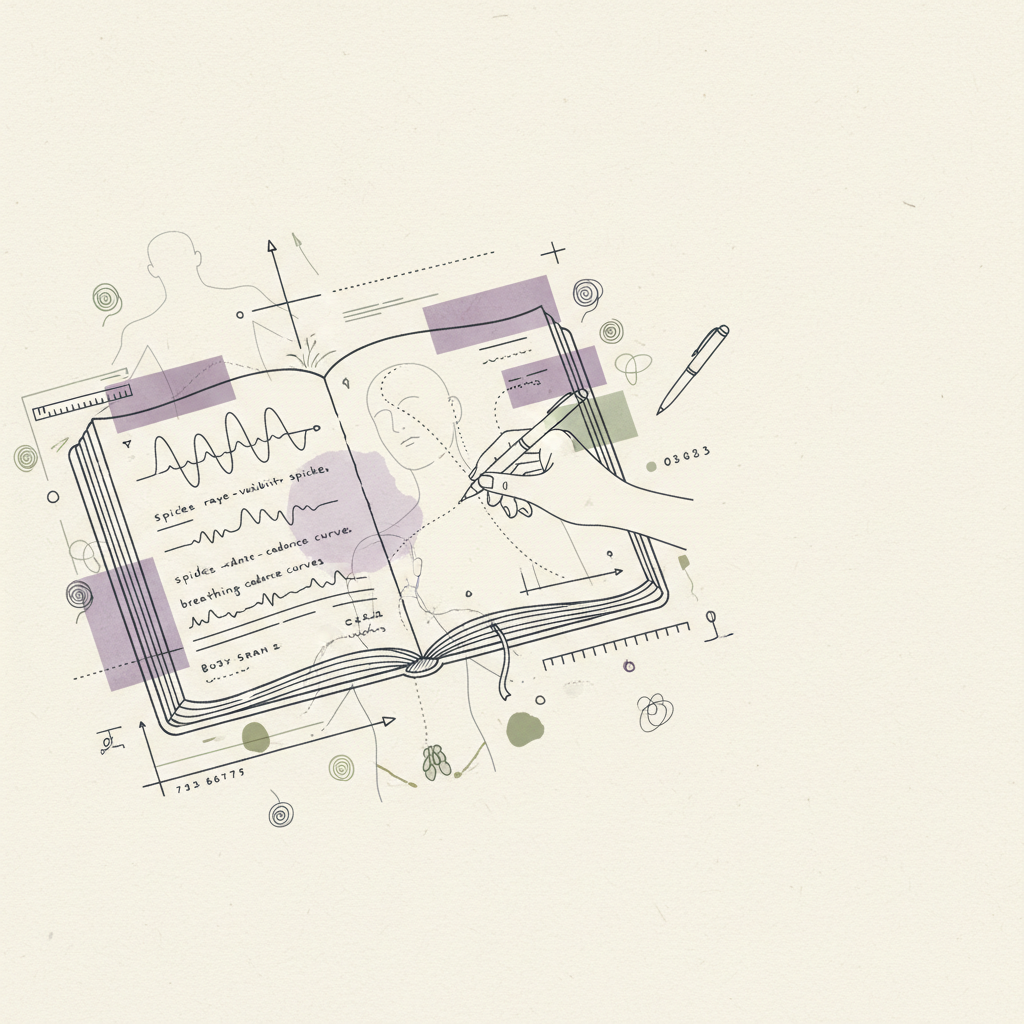
I used to believe the goal of journaling was to document exactly how upset I was, in chronological order, until the feeling went away. The wellness industry has built an entire sub-economy around this. They sell the promise that if you just find the right introspective prompt, you'll finally untangle your emotional state. I've stopped recommending introspective prompts altogether. Asking "why do I feel this way" when your nervous system is fully flooded guarantees you'll stay flooded. It forces the brain to manufacture a narrative for a purely physiological threat response.
You sit down with a blank page, ready to process the day, but the room feels too bright and your shoulders refuse to drop. You stare at the paper while experiencing the familiar sensation of being anxious for no reason, tracing the hum of tension from your chest to your throat. Your mind feels like a browser with a hundred tabs open. Trying to summarise the chaos into a neat paragraph is paralyzing. You're tired but wired, pushing a pen around while your jaw stays locked. The attempt to relax has somehow morphed into another high-stakes task. You feel disconnected from your body, an exhausted head floating in space, unable to rest even when the work is done.
Common Questions
Why do most journal prompts fail to help?
They ask "why," which forces your brain into intellectual analysis. This keeps you entirely in your head. Prompts that actually regulate the system ask "where" and "what." They point your attention to the physical sensation in your tissue.
How often should I journal for emotional regulation?
Daily, for three to five minutes. The goal is a consistent, low-friction habit of checking in with your physical state. Consistency builds the neural pathways for interoception. Writing for an hour usually just builds a high tolerance for rumination.
Can journaling make anxiety worse?
Absolutely, especially if it becomes a dedicated rehearsal of your worry. Documenting the exact same anxious thought fifty times is just repetition. The mechanism of relief comes from noticing the physical signature and labeling the somatic data.
The Trap of the Story
The internet is currently screaming about finding your authentic self through guided journaling, as if the right notebook will cure your hypervigilance. Most journaling advice is just rumination with better handwriting.
When you're agitated, your HPA axis—the loop running from your brain to your adrenal glands—is already pumping out stress hormones. Asking your prefrontal cortex to analyze a childhood wound while your system is actively preparing to fight a bear is terrible timing. Every time you write down the narrative of who wronged you today, you reinforce the signal. You're actively practicing the stress response.
The Nerd Beat: Affect Labeling
The only prompt I actually use inside the Journal completely bypasses the storytelling department. The instruction is to locate the signal in the body and describe its physical texture. When you take a vague feeling of overwhelm and pin it to a specific physical location—like a hot tightness in the upper chest—you perform an act called affect labeling.
This small observational move decreases activity in the amygdala, the threat-detection center, and increases activity in the prefrontal cortex. You're using language to quiet the alarm.
This practice builds interoception, which is your nervous system's capacity to read its own internal signals accurately. Without interoception, nervous system regulation remains a theoretical concept. You can't shift a state you can't feel. Over time, repeatedly finding the physical sensation improves the flexibility of your autonomic nervous system. Your system gets better at shifting gears from highly aroused to rested, a capacity measurable via heart rate variability (HRV).
Identifying the Input
Once you locate the physical static, the next step is identifying the immediate trigger. I ask myself what last moved the signal. I used to think the source of my tension was always a deep psychological crisis. Half the time, it's just the espresso I drank on an empty stomach at 2pm.
This practice ignores your trauma and focuses entirely on plain cause and effect. Did the tightness start during a meeting? Did the hum behind your eyes arrive after 45 minutes of doom-scrolling? Naming the input changes you from a passive victim of your mood to an active observer of your own machinery.
The trouble with analyzing your feelings is that the brain will always invent a compelling story for a physiological state.
If you want to read deeper into the neurobiology of interoceptive assessment, the Library holds the complete breakdown.
What to do this week
- The Five-Minute Log. For seven days, open a notebook. Set a timer for five minutes. Answer only this: 'Where is the signal in my body right now? What does it feel like (e.g., buzzing, tight, warm, hollow)?' Do not analyze the cause.
- Label the Transition. Pick one daily pivot point: closing your laptop, walking in the door, or the first sip of water. Pause for 60 seconds and simply name the state you're in ('Wired,' 'Drained,' 'Jittery,' 'Calm').
- Ask 'What Colour?'. When a strong emotion hits, ask yourself, 'If this feeling had a colour, what would it be?'. It sounds absurd. That's the point. It engages a different neural network and interrupts the rumination loop. You can find more micro-interruptions like this in the Hacks collection.
Where this fits in the Kokorology system
Journaling serves as the baseline diagnostic tool of the Kokorology method. The physical data you gather dictates which practical lever you need to pull next, whether that means applying a targeted breathing protocol from the Anchors or scheduling a total Reset.
Tonight's practice
This practice replaces thought loops with physical data logging. You will map body sensations instead of analyzing your feelings.
Where do you feel physical tension in your body right now, and what was the last thing that changed it?
- Sit quietly for two minutes and scan your physical state from jaw to gut.
- Write down the exact body location and sensation, then name the last input that altered it.
- Track these two data points every night for four days to compare your body locations.
- Use the recorded inputs to identify what consistently shifts your physical state.
Closing
This practice trains you to read your own physical dashboard before the warning lights start flashing.
- Practice it daily inside the Kokorology Journal.
- Go deeper on the mechanisms inside the foundational course, Regulation (L1).
- Get the weekly nervous-system dispatch with the free guide to regulation.
TL;DR
Most journal prompts for emotional regulation fail because they encourage more thinking, trapping you in a cycle of rumination. Effective journaling relies on a brief, daily sensory check-in to log physical data. Asking where you feel a sensation in your body practices affect labeling, which builds interoception—the ability to read your internal state accurately. This process strengthens prefrontal-amygdala connections, improves autonomic flexibility, and gives you the raw physiological data needed to regulate your nervous system. You log the data, and you skip the story.
Sources
- Pennebaker, J. W. (2023). Journaling and the nervous system: from expressive writing to affect labeling. Curated meta-analyses and primary studies (1986–2023).
- Khalsa, S. S., et al. (2018). Interoception and mental health: a roadmap. Biological Psychiatry: Cognitive Neuroscience and Neuroimaging.
- Thayer, J. F. (2012). A meta-analysis of heart rate variability and neuroimaging studies: Implications for heart rate variability as a marker of stress and health. Neuroscience & Biobehavioral Reviews.