Journal Practice
Conflating body signals with anxiety and how to journal for it
Anxiety is a physiological signal long before it's a story. Stop asking your brain to write a story about a signal it doesn't understand.
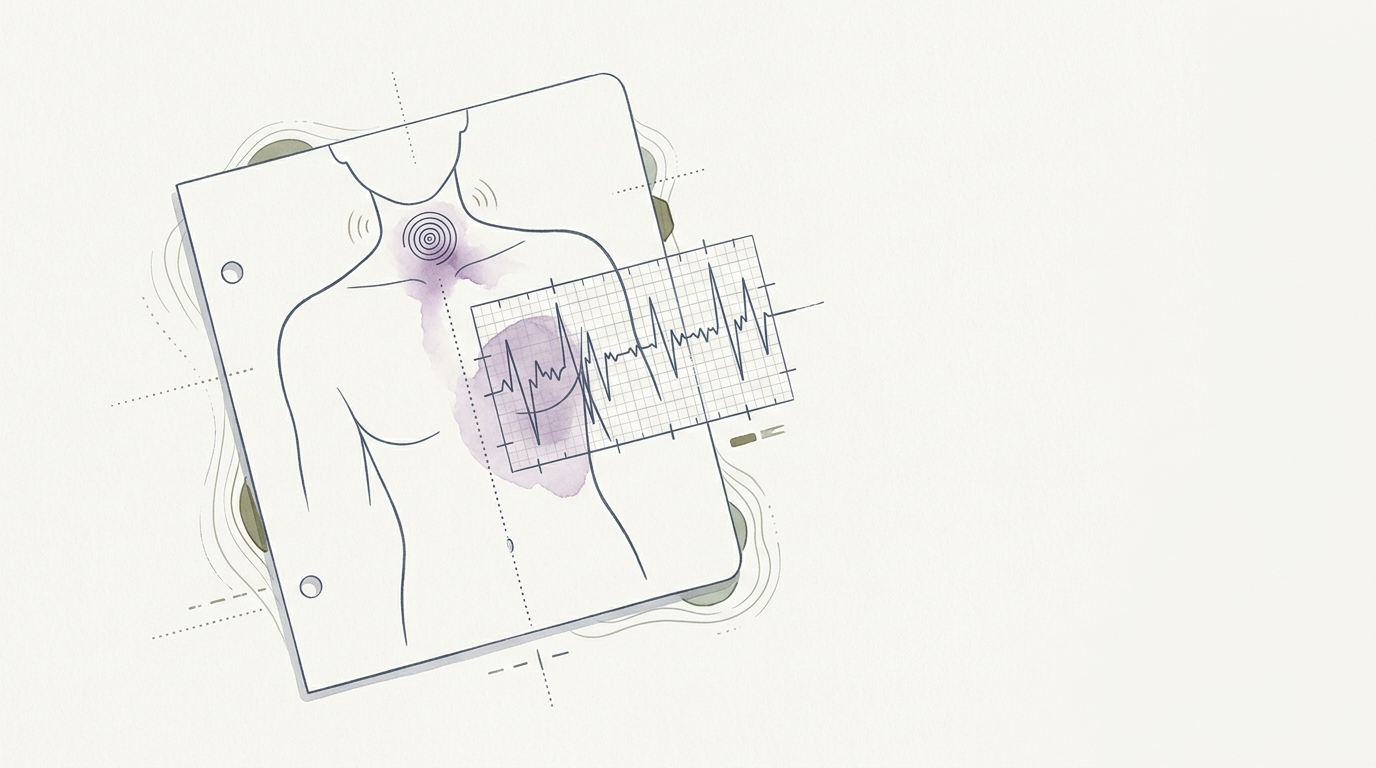
I've stopped recommending brain-dumps to clients who are vibrating at a high frequency. The wellness industry treats journaling as an exorcism, operating on the delusion that if you confess your worries neatly enough, they'll pack their bags and leave. I don't buy it. When the nervous system is flooded with threat signals, asking the prefrontal cortex to draft a coherent narrative about journal prompts for anxiety is like asking someone to write poetry while they're being chased by a dog. The body is in crisis, and the brain can't logic its way out.
You feel the static before you have a name for it. It usually starts as a dull, mechanical ache in the jaw around 3pm, or the way you find yourself standing in front of an open fridge with absolutely no hunger. You scroll through your phone at midnight, desperately seeking a dopamine hit that never quite lands, leaving you tired but wired as the hours tick by. Your breath catches high in your chest, shallow and rapid, and your heart races when you lie down in the dark. It is a state of agitated exhaustion where you feel anxious for no reason at all, completely disconnected from your body. In this state, a blank page asking 'how do you feel?' is an actively hostile proposition. The physical sensations are screaming, but you don't possess the sensory vocabulary to decipher them, let alone write an essay about them.
Common Questions
What are journal prompts for anxiety that start in the body?
They are questions that bypass the narrative and tune into physical sensation first. Instead of asking why you feel terrible, they ask where the tightness lives in your chest or jaw. They serve as practical tools for tracking physical state changes rather than recording your endless worries.
Why does writing about my feelings sometimes make my anxiety worse?
Ruminating on the story of your stress often loops you right back through the same cognitive grooves, amplifying the threat response. Grounding your attention in present physical reality gives your thinking brain a concrete, non-threatening task. It actively interrupts the spin cycle.
How is this different from a gratitude journal?
Gratitude journals attempt to change your thoughts. A body-first practice changes your physical state by building awareness of the biological signals your nervous system is actually sending. You simply can't gratitude your way out of a physiological state you can't yet feel.
The narrative obscures the signal
I spent years in my twenties filling notebooks with frantic, looping thoughts, genuinely believing I was processing my stress. I was actually just taking my panic for a walk. When your nervous system locks into a high-threat state, your prefrontal cortex goes practically offline. The autonomic system is entirely consumed by managing the immediate crisis, leaving zero bandwidth for nuanced emotional reflection.
The actual trouble with cortisol is that everyone has heard of it, and nobody knows what it feels like in the jaw at 3pm. Kokorology desperately try to solve the cognitive story—the looming deadline, the unread messages, the ambiguous text—while completely ignoring the underlying physiology driving the bus. Most prompts assigned by wellness influencers are just homework given by your inner critic. They demand a tidy resolution to a messy biological event. The goal of a body-first practice is to get a clean read on the raw physical signal. You're building the basic capacity to distinguish the physical sensation of tightness in the throat from the abstract panic of the day.
The interoceptive drop-off
Your brain contains specific biological machinery dedicated to reading your internal state. The insular cortex acts as an interoceptive hub, constantly integrating raw data from your organs, muscles, and tissues into a cohesive sense of how you feel right now. It reads the inputs from your vagus nerve and your HPA axis—the stress-hormone loop running from your brain to your adrenal glands—to determine your current level of safety.
When you experience chronic stress, this sensory loop gets downregulated. The physical signal continues to fire, but the brain actively turns down the volume to keep you functioning through the workday. You gradually become signal-deaf. The reason for the panic is there, your body is screaming it, but you no longer possess the sensory acuity to decode the message. You lose the ability to feel the early warnings of burnout, along with the subtle cues of safety, rest, and connection.
The real work happens the moment you stop asking why you feel terrible and start asking exactly where the terrible lives.
Rebuilding that connection requires slow, unglamorous repetition. The process forces you to sit with the physiological truth of your state without the false promise of a miraculous morning routine. For those who want to trace the deeper mechanisms of this sensory loop, I explore the literature heavily in the Library.
Numbing is a logical adaptation
This sensory muting operates as a highly predictable response to overload. The body adapts to excessive demand by cutting the feed. Whether you're dealing with the pressure of American PTO guilt, the Friday-Saturday work rhythm in the Gulf creating late social nights, or just the damp, heavy fatigue of an endless inbox, your system prioritizes survival over nuance. Your inbox is remarkably indifferent to your resting heart rate.
Every time you pause to track a physical sensation, you send a demand signal back to that interoceptive hub. You're forcing the brain to acknowledge the body. I've found that the simple act of locating tension physically drops the intensity of the panic, because it gives the hypervigilant brain a concrete, present-moment task. It pulls you out of the imagined catastrophic future and drops you squarely into the physical present.
Tracking the physical shift
This practice relies entirely on data collection. You're mapping what regulates and dysregulates your specific nervous system on a Tuesday afternoon. When you notice that a five-minute walk drops the knot in your stomach by half, you've gained a piece of usable leverage. You're writing a personal manual for your own autonomic shifts, which forms the exact foundation of effective nervous-system regulation.
You'll notice the difference immediately. Cognitive prompts ask you to judge your life, while sensory prompts ask you to observe your biology. The latter proves infinitely more useful when you're overwhelmed. Once you establish the baseline, you can begin introducing targeted tools to widen your capacity.
What to do this week
- Track one specific sensation. Instead of your mood, track your jaw tension for three days. Notice when it clenches and when it releases. Note the data without judgment.
- Run a state-change experiment. When you feel the familiar hum of panic, stand up, walk to a window, and look at something far away for 60 seconds. Note the physical shift in your body. This is a basic 60-second hack.
- Name the 'where' before the 'why'. Before you try to solve the looming crisis, name the location of the tension. Chest, throat, stomach. Just locate it.
Where this fits in the Kokorology system
This practice represents the diagnostic floor of the entire Kokorology methodology. Building interoceptive awareness in the Journal is the prerequisite for effectively using the targeted Anchors when things go sideways. Without a clear signal from the body, any intervention is just blind guesswork. If you're completely overwhelmed and need a structured onramp, start with the Reset.
Tonight's practice
Map where your body holds the tension instead of writing a novel about your stress tonight.
Where exactly in your body do you feel tightness right now, and what specific physical action shifted it today?
- Sit on the edge of your bed at 9pm and scan your body from your feet to your jaw for exactly 2 minutes.
- Locate the single spot holding the most tension, ignoring the thoughts demanding your attention.
- Write down that exact bodily location and rate its intensity from 1 to 5.
- Take 10 slow nasal breaths, extending the exhale, and note if that rating drops.
Closing
The point of this work is to inhabit a body you can actually hear. When you stop demanding a coherent story from a system in crisis, you finally get the real data you need to change your state.
- Start mapping your physical signals with a guided entry inside the Journal.
- Practice the foundational tools to shift those signals in the Regulation course.
- Understand the underlying interoceptive mechanisms with the free guide to the nervous system.
TL;DR
Most journal prompts for anxiety keep you stuck in your head, looping through the same cognitive worries that spiked your stress in the first place. The effective alternative is to use prompts that start in the body, bypassing the narrative to focus directly on physical sensation. This practice builds interoception—your ability to accurately sense your internal state. By shifting your focus from the 'why' of your stress to the 'where' of its physical location, you gather the actual physiological data required to change your state.
Sources
- Pennebaker JW (2023). Journaling and the nervous system: from expressive writing to affect labeling. Curated meta-analyses and primary studies (1986–2023).
- Khalsa SS (2018). Interoception and mental health: a roadmap. Biological Psychiatry: Cognitive Neuroscience and Neuroimaging.
- Balban MY (2023). Brief structured respiration practices enhance mood and reduce physiological arousal. Cell Reports Medicine.