Journal Practice
Anxiety is a physiological event, not a script to edit
Stop asking an exhausted brain to rewrite the story. The body ran a threat calculation first — the sentences arrived later, borrowing its budget.
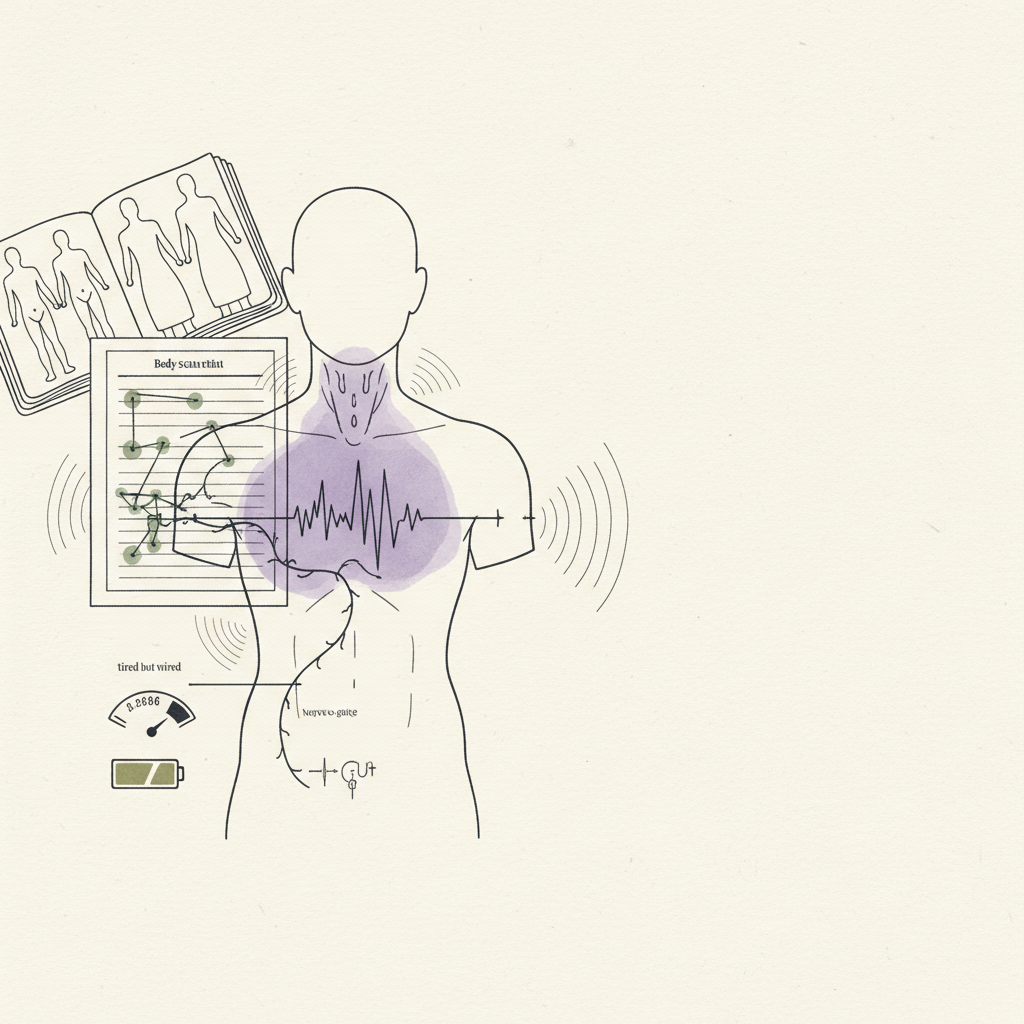
I spent a solid two years treating my notebook like a hostage negotiator for my own brain. The wellness industry insists that if you feel anxious, you must write down your worries, interrogate them, and politely list three things you are grateful for. Writing out thoughts is a terrible way to manage a high-arousal state. The body runs a threat calculation first, and the anxious sentences arrive later to borrow the budget.
The sensation arrives long before you have words for it. It is the shallow breath catching at the top of your chest, or the phantom urge to open the fridge at 3pm even though you have zero hunger. You feel the buzz behind your eyes. You scroll on your phone at midnight, exhausted but can't rest. The physical system is revving, looking for an exit valve, leaving you tired but wired. You try to force yourself into bed, only to find your heart racing when you lie down. The inbox is closed, the house is quiet, and yet you feel anxious for no reason. Telling someone in this state to logically analyze their feelings is like asking them to describe the color of the wind. The threat-detection system is actively misfiring. A cognitive-behavioral dissection of your intrusive thoughts will only throw more fuel on the fire.
Common Questions
What are journal prompts for anxiety that start in the body?
They bypass the cognitive story and tune directly into physical sensation. They ask where a feeling lives in your tissue, what temperature it is, and how it shifts your breathing. These questions build interoception, the physical sense of your internal state.
Why does writing about my feelings make my anxiety worse?
When you are already in a state of high autonomic arousal, cataloging your worries creates a loop. You are using an agitated brain to inspect agitated thoughts. Shifting your attention to neutral physical data breaks the cycle by removing the narrative.
How is this different from a gratitude journal?
A gratitude list tries to force a change in your thoughts. A body-first journaling practice reads the actual state of your nervous system. One is a cognitive exercise. The other is biological tracking.
The exhaustion of emotional admin
I've stopped recommending traditional gratitude prompts. The wellness aisle has turned journaling into another form of emotional admin, handing you a to-do list for your feelings. You sit there trying to logically unpack why you feel tense, treating yourself like a project to be solved. Anxiety is a physiological event long before it becomes a script you need to edit. It's a shift in autonomic tone. Your heart rate increases, gut motility slows, and your pupils dilate. The feeling of dread is simply your brain's best guess at explaining those physical changes. Arguing with the feeling is a waste of time.
The sensory relay
The human brain relies on a sensory feed called interoception. This is the constant stream of physical data traveling from your viscera—heart, lungs, gut, muscles—up the vagus nerve and into the insular cortex. Targeting this specific pathway is the core work inside the Anchors. The insula acts as a sensory relay. It tells you when you are thirsty, when you need the toilet, and when a threat is present. I used to think I could out-think my physical state, until I learned how this pathway actually works.
Under chronic stress, the HPA axis gets stuck in an open position. The sensory relay loses its calibration. It starts flagging a 10am email with the same severity as a physical attack. The inbox has never once been impressed by your heart rate, but your physiology reacts as though your life is on the line. The anxiety feels like it comes out of nowhere. Your body actually sent the memo hours ago, and your brain just read it late.
Dumping the cognitive load
Expressive writing works, but only when it's deployed correctly. Sitting with a blank page and spiraling into your worst-case scenarios just reinforces the neural pathways for worry. It strengthens the exact loop you are trying to break. I learned the hard way that writing down every anxious thought just makes me an expert at being anxious.
You cannot edit a feeling out of existence with a nicer pen.
The shift happens when you move from narrative to affect labeling. Naming the raw physical sensation—heavy, sharp, cold, tight—engages a different part of the prefrontal cortex. You are no longer living inside the feeling. You are observing it. This moves the brain out of threat detection and into processing. Kokorology teach this specific pivot early in the Regulation (L1) course because it is the prerequisite for everything else.
The cheap state shift
It's no coincidence that the urge to buy things on your phone spikes when you feel dreadful. This looks like a lack of discipline. In reality, it's a misfiring regulation strategy. Your nervous system is sitting in high arousal and demands a shift in state. A dopamine spike from a new sweater or a 30g protein bar is a cheap, temporary way to alter your internal chemistry.
When you track these urges in the Journal, you start to notice the gap between the physical tension and the behavior. You intercept the jaw clench two hours before it turns into a doom-scroll. You realize that the problem is a lack of accurate internal data. Collecting that data changes how you respond to the flat hour after lunch.
The mechanical offload
You have to change the state of the tissue before you ask the brain to reflect. This is why mechanical interventions matter before you pick up a pen. A physiological sigh manually offloads carbon dioxide and down-regulates the nervous system in seconds. It forces the autonomic tone to shift. When you combine that with a prompt that asks about temperature or location rather than narrative, you give the threat-detection machinery a totally different input. It is reading the meter instead of arguing with the dial. You can practice this rapid state-shift using tools from the Hacks library whenever the noise gets too loud.
What to do this week
- Set a timer for three random times a day. When it goes off, stop and ask: ‘What is one physical sensation I am aware of right now?’ Write it down. No analysis, just the raw data.
- Before you open a shopping app or the fridge this week, pause. Notice the physical urge in your body driving the action. Name the sensation—tightness, heat, buzzing—before you act.
- Pair your writing with a physiological sigh. Take two sharp inhales through your nose, then a long, slow exhale through your mouth. Do this twice before opening your notebook to manually lower your heart rate.
Where this fits in the Kokorology system
This awareness practice is the diagnostic tool that informs the rest of your system. Once you accurately read the signal in the Journal, you know exactly which Anchor protocol to run, or when to begin a deeper reset of your baseline capacity inside the Performance (L2) course.
Tonight's practice
Tonight's practice tracks physical sensation before your brain turns it into a story. You will locate where the feeling lives and record its physical traits.
Where in my body is the epicenter of this physical sensation right now, and is it sharp, heavy, hot, or cold?
- Sit quietly on your bed for 2 minutes with your attention on your breath.
- Locate the strongest physical tension in your body and rate its intensity on a scale of 1 to 5.
- Write down the body location, temperature, and intensity score.
- Repeat this every night for 5 days.
- Compare your logs to see if naming the physical feeling lowers the intensity rating over time.
Closing
The point is not to have a prettier diary, but to build a more accurate map of your own nervous system.
- Practice it daily inside the Kokorology Journal.
- Start a deeper rebuild of your baseline with Regulation (L1).
- Run the protocols to shift your state in the Hacks library.
TL;DR
Standard journal prompts for anxiety fail because they engage with thoughts, which are symptoms, not the source. Anxiety is a physiological signal generated by your threat-detection machinery. Effective journaling starts by asking the body where and how it feels the signal, a practice of interoception. This builds awareness of your nervous system's state, allowing you to respond to its needs directly instead of getting trapped in cycles of worry. You are running biological tracking. Leave the emotional archaeology behind.
Sources
- Pennebaker JW (2023). Journaling and the nervous system: from expressive writing to affect labeling. Curated meta-analyses and primary studies (1986–2023).
- Khalsa SS, et al. (2018). Interoception and mental health: a roadmap. Biological Psychiatry: Cognitive Neuroscience and Neuroimaging.
- Critchley HD & Garfinkel SN (2017). Interoception and emotion. Current Opinion in Psychology.