Research
The data point that has no dashboard
Interoception is the biological capability to sense your internal physical state directly, and it functions perfectly well without a premium app subscription.
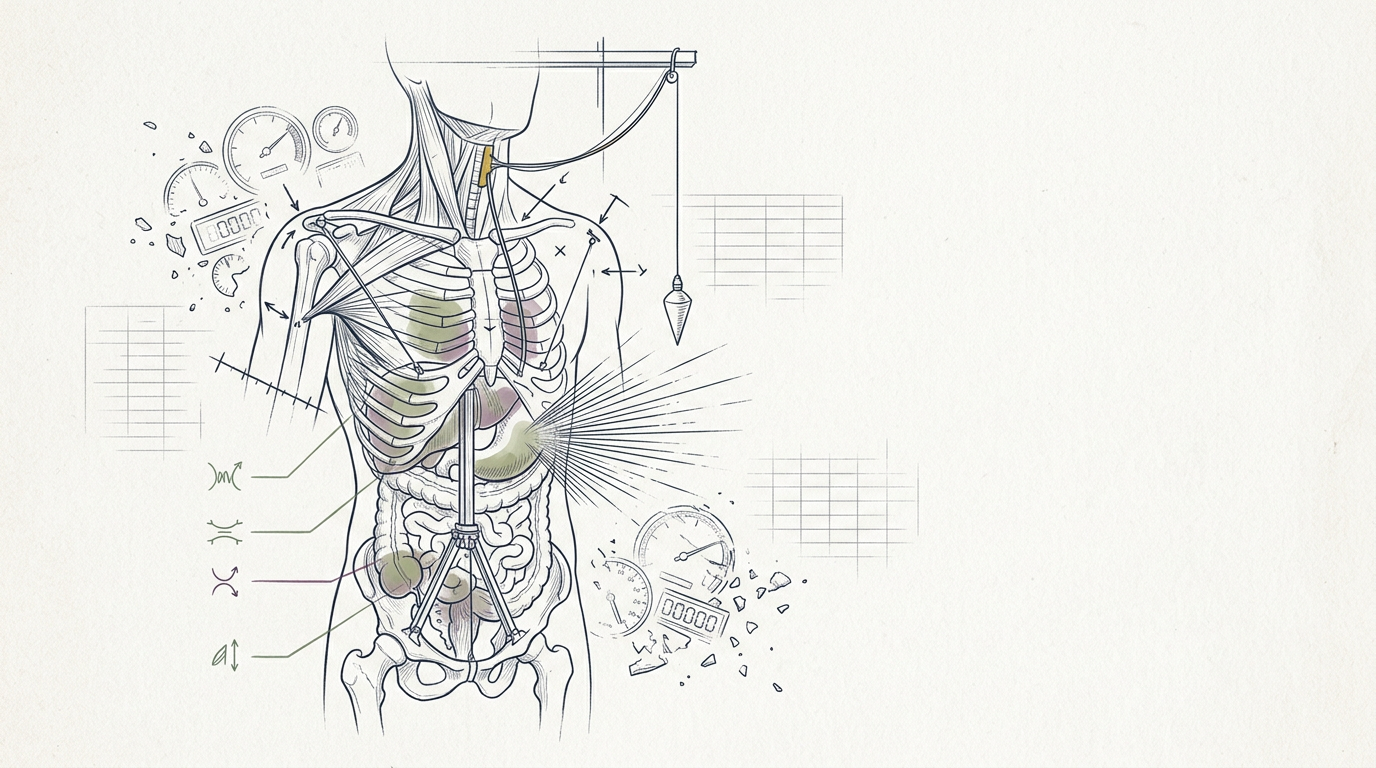
The fitness tech industry wants to put a dashboard on every physiological function you possess. Kokorology strap 1.85-inch screens to the wrists and wait for an algorithm to tell the system if Kokorology feel rested enough to send an email. Interoception is the actual biological skill of sensing what is happening inside your body, running on equipment you already own. The nervous system inherently possesses a routing layer, sensing your internal state long before your phone buzzes to announce a stress event.
You know what poor interoception feels like even if you've never used the term. It's the open fridge at 3pm with absolutely no physical hunger, just a vague, buzzing need for stimulation. You feel tired but wired at 11:47pm, staring at the ceiling because your brain insists a predator is in the bedroom. You experience brain fog after eating, a jaw that won't unclench in the shower, and the strange sensation of being entirely disconnected from your body while simultaneously hypersensitive to every sound in the house. Your heart is racing when you lie down. The body frantically broadcasts its state, but the receiver is turned off, leaving you anxious for no reason and relying on a third cup of coffee to force a system that is begging you to stop.
Common Questions
What is interoception?
It is the continuous stream of sensory data traveling from your organs to your brain. This sense tracks temperature, heartbeat, breath pace, and digestion. It tells the brain exactly what state the body is currently occupying so the system can adjust accordingly.
How does interoception affect the nervous system?
The nervous system uses interoceptive signals to decide whether you're safe or under threat. When these signals are clear, the autonomic system shifts smoothly between action and rest. When the signals are ignored or muffled, the system defaults to a baseline state of high vigilance.
Why do wearables fail to replace interoceptive awareness?
A device measures secondary outputs like heart rate and skin temperature after the biological shift has already happened. Relying entirely on a screen trains you to look outward for permission to rest, rather than recognizing the physiological signals your body generates in real time.
The Outsource Problem
I used to believe I could track my way out of exhaustion. If I just dialed in the exact macros and logged every millisecond of deep sleep, my nervous system would surely comply. I've since stopped trying to manage biology like a supply chain. Stacking metrics on top of a dysregulated state creates a highly documented disaster. You check your Oura ring to confirm you slept terribly, which is information you already had when you woke up dreading the sunrise. Most metric-chasing is just dissociation with a premium subscription.
Kokorology outsource the physical awareness to hardware because feeling the actual biology is too loud. The inbox has never once been impressed by your heart rate, yet Kokorology pretend that knowing the exact recovery score will somehow protect the system from a frantic Tuesday schedule. It never does.
The Actual Machinery
Let's look at the actual machinery. Interoception runs heavily through the anterior insula, processing signals from your heart, lungs, and gut. It functions as the sensory branch of your autonomic regulation. When the brain receives these inputs, it generates a prediction about what the organism needs next to maintain a steady baseline.
If your internal state is chaotic—driven by an erratic cortisol rhythm, heavy caffeine intake, or unmanaged sleep pressure—interoception becomes noisy. You misinterpret a sudden drop in blood sugar as existential dread. You confuse the physical need to stand up and stretch your legs with a sudden urge to quit your job.
The body gives you the data directly, long before the smartwatch has time to sync.
Bringing the Signal Back
Every protocol I teach, I tested on myself first, and the most reliable ones are shockingly low-tech. You have to pause and notice the temperature of your hands or the pace of your breathing before you look at a screen. Kokorology've developed nervous system regulation tools for this exact purpose, but the simplest version starts with refusing to check a device for a verdict on your own fatigue.
I've watched too many smart people try to hack their vagal tone while ignoring the blatant fact that their jaw is locked tight enough to crack a walnut. The nervous system doesn't care about your sleep graphs. The intervention requires tuning back into the physical layer.
What to do this week
- Run a 60-second baseline check before breakfast. Notice your physical temperature, breath pace, and muscle tension before you ingest any caffeine or look at any data.
- Walk for 15 minutes after your heaviest meal. Leave the phone inside. Let the system process the physical movement without digital input.
- Introduce a hard stop on screens at 9:30pm. Sleep pressure accumulates naturally when you stop shining bright light directly into your eyes.
- Track your state manually. Write down one physical sensation at 3pm every day to reestablish the habit of direct observation.
Where this fits in the Kokorology system
Kokorology treats the nervous system as a physical reality, not a conceptual trend. Kokorology emphasize direct physical awareness because you can't regulate a state you cannot feel. The practices inside the Hacks library offer immediate micro-interventions to shift your state in real time. If your interoceptive signals are constantly overwhelmed by a chaotic schedule, the Reset program provides a structured seven-day ramp back to a regulated baseline. Kokorology also dive into the deeper mechanisms of this sensory loop in the Research Library.
Closing
The goal is to feel the state of your own body before a piece of hardware tells you about it. Find a quiet minute today to notice your actual physical signals, and start treating them as legitimate information.
- Start tracking your actual bodily sensations using the Journal.
- Work with these mechanisms under pressure in the Performance course.
- Sit with this topic deeper by reading the free guide on baseline regulation.
TL;DR
Interoception is the direct biological capability to sense your internal state, and outsourcing it to a wearable device breaks your natural regulation loop. By paying attention to the anterior insula's actual signals—like breath pace, temperature, and muscle tension—you can recognize the system's needs before they escalate. Drop the dashboard, listen to the direct physical input, and stabilize your baseline.
Sources
- Khalsa SS, & Lapidus RC (2016). The pros and cons of interoception (awareness of the internal state of the body). Frontiers in Psychology.
- Barrett LF, & Simmons WK (2015). Interoceptive predictions in the brain. Nature Reviews Neuroscience.
- Craig AD (2009). How do you feel—now? The anterior insula and human awareness. Nature Reviews Neuroscience.
- Critchley HD (2023). Interoception and Autonomic Regulation in Stress. Journal of Neuroscience.