Workplace & Leadership
HRV is a leadership signal, not a wearable badge
Heart rate variability is a direct memo from your nervous system about your physical capacity to handle the reality of your day.
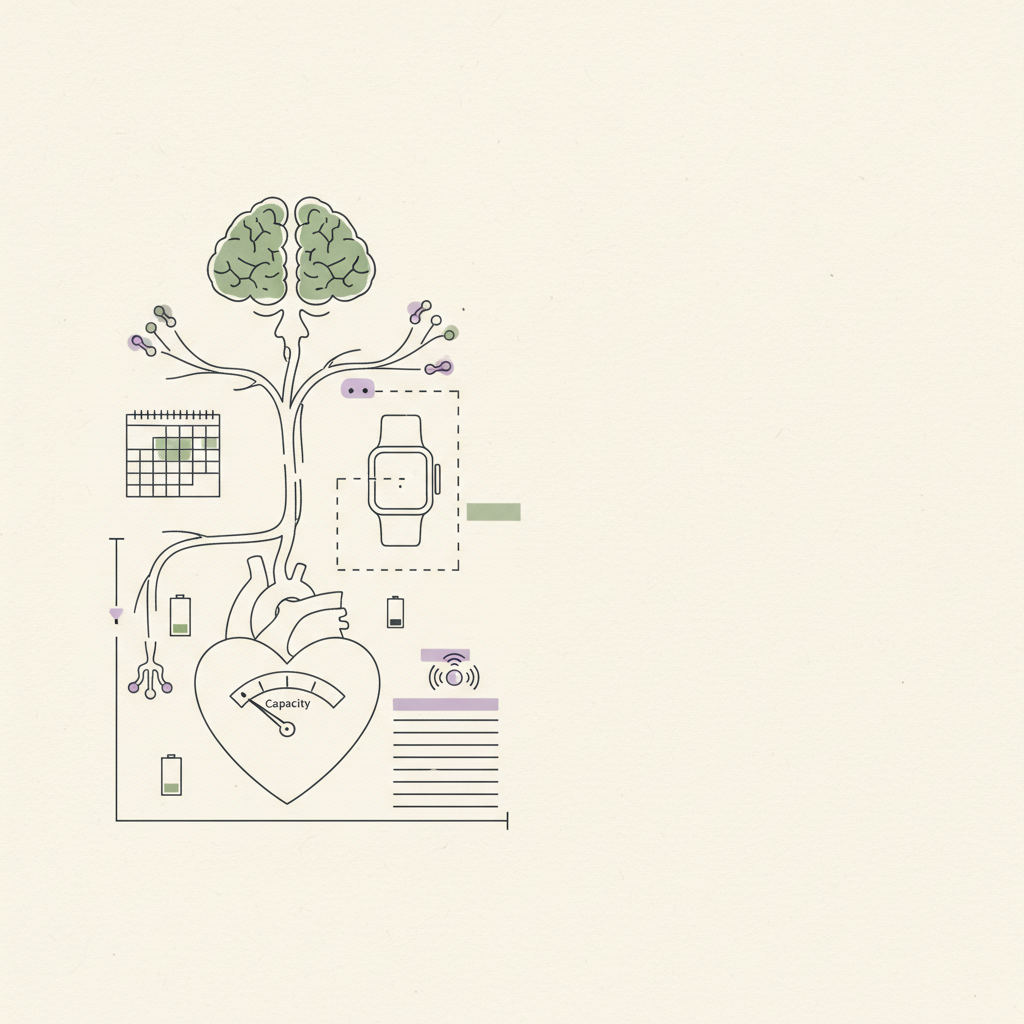
I used to believe that tracking a biometric on my wrist would automatically make me healthier. The wearable industry sells heart rate variability as a video game you can beat through sheer willpower and a cold plunge. I am calling it. That approach turns a biological constraint into a daily test most people are losing. HRV is a direct measurement of your nervous system's capacity, dictated by your vagal tone, and it simply tells you how much stress your body can absorb today.
The alarm goes off, your watch vibrates to tell you your recovery is poor, and your jaw immediately tightens before your feet hit the floor. You spend the morning physically present but mentally brittle, snapping at a harmless email and unable to hold a complex thought for more than twelve seconds. By three in the afternoon you are staring at a blinking cursor, feeling completely tired but wired, knowing another espresso will just make your hands shake. You crawl into bed at ten, utterly depleted, yet you are exhausted but can't rest. You scroll blindly through your phone in the dark, anxious for no reason, wondering why the breathing exercises you tried at lunchtime didn't magically fix the red bar on your app. The data is simply confirming what your heavy shoulders already know.
Common Questions
What is HRV, in plain English?
It is the measured time variation between consecutive heartbeats. A high variation means your autonomic nervous system is flexible and recovering well from stressors. A low variation means your system is locked in a state of high alert and running on fumes.
Why does leadership require physiological capacity?
Navigating uncertainty and managing a room full of people requires immense regulation. If your own system is depleted, your prefrontal cortex dials down. You cannot make strategic, empathetic decisions when your body believes it is fighting a bear.
Can I quickly raise my heart rate variability?
Short-term breathing techniques can create a temporary shift in the metric. Long-term baseline improvements require consistent changes to your daily load. The metric responds to adequate sleep, proper pacing, and actual time spent in a parasympathetic state.
The Biometric Illusion
The obsession with wearable data has completely severed the ability to actually feel the own bodies. I sit across from perfectly intelligent operators who look at a screen to decide if they are tired. They view a low number on their app as a personal flaw that needs to be optimized away with a new pill or a complicated morning routine. I've stopped recommending continuous tracking for anyone who is already stuck in hypervigilance.
That mindset misunderstands the biology. The metric on your wrist is a reflection of allostatic load. That is the cumulative physiological wear from chronic stress. Whether you are managing a product launch at a tech startup, arguing with your co-founder, fighting off a minor virus, or navigating the sheer volume of a Tuesday school run, your system is registering a demand.
The data is simply a mirror showing you the demand. When you stare at the mirror and panic about what it shows, you are adding another layer of threat to a system that is already overwhelmed.
The Autonomic Negotiation
Let's look at the actual machinery. Your heart doesn't beat like a metronome. The speed is constantly negotiated by two branches of your autonomic nervous system. The sympathetic branch acts as the accelerator, driving your heart rate up to meet a challenge. The parasympathetic branch pulls the brake, slowing things down to repair and digest.
Heart rate variability is the measurable result of this tug-of-war. Specifically, it acts as a proxy for vagal tone. The vagus nerve is the parking brake of the nervous system; pull it, and the engine quiets. When your system is well-regulated, this brake is highly responsive, creating subtle, healthy variations in the milliseconds between beats. That neurological flexibility is exactly what you want. It means your body can pivot rapidly from a state of high arousal back to a calm baseline.
When you are under chronic stress, the accelerator is stuck to the floor. The heart beats rigidly, the variation drops, and the metric plummets. The tank is not empty. The pipe is narrower. The system simply has no room left to accommodate a new stressor. For a deeper study of these pathways, Kokorology keep the literature in the Library.
The Physiology of the Room
That flexibility is the exact mechanism required for effective leadership. You need it to toggle between the intense, narrowed focus of crisis management and the open, peripheral state required for strategic thought. It allows you to absorb a piece of bad news without immediately throwing a tantrum in a Slack channel.
Consistently low variability is linked to a less-engaged prefrontal cortex. When that executive center goes offline, you lose access to nuance. The entire organism runs on panic and instinct.
The inbox has never once been impressed by your heart rate.
Your nervous system is constantly broadcasting its state to everyone around you through physiological contagion. You can say all the right, calm words in a meeting, but if your internal state is tightly wound, your team will unconsciously mirror that tension. They will leave the room feeling on edge. Managing a team means managing the physiological state of the room. You can't do that if your own vagal brake is worn out.
The Reality of the Load
The internet is full of people selling shortcuts for this state. You can't trick your central nervous system into believing it is safe while you continue to subject it to endless, unregulated demands. A quick round of box breathing might alter the math for five minutes, but it won't change your baseline if you immediately go back to holding your breath while reading emails.
Kokorology have to look at the actual inputs. Sleep pressure, circadian rhythm, and glymphatic clearance are the real mechanisms of recovery. When you cut your sleep short to catch an early flight, or doom-scroll until midnight, you disrupt those processes. Your system registers the lack of recovery as a threat. The sympathetic accelerator stays engaged.
I spent years ignoring this mechanism, assuming I could just push through the friction. I believed my drive would override my biology. The result was a spectacularly low variability and a jaw that never unclenched. Sustainable improvement requires looking at the actual inputs driving your state. It means addressing the daily, invisible stressors that keep your nervous system locked on.
The Daily Practice
Kokorology treat the body as a biological reality. The intervention is genuine recovery. It is a walk without a podcast. It is a Tuesday evening where you actually turn off your notifications and allow your prefrontal load to dissipate. It is recognizing the early signs of dysregulation and stepping away from the keyboard before you send an email you will regret tomorrow. It requires a fundamental shift in how you relate to your own capacity. You start by noticing the physical sensations of stress before the wearable alerts you to them.
That shift changes everything about how you show up. When your vagal tone is strong, you have a buffer. You can walk into a chaotic room and anchor the space, rather than being swept up in the collective panic. You lead from a place of regulated capacity. For the step-by-step tools to build that buffer, Kokorology use the Anchors.
What to do this week
- Stop looking at the screen first. Before checking your wearable, take 60 seconds in bed. What does your body actually feel like? Rested, tense, heavy, buzzing? Note it down. Then look at the data. The goal is to calibrate your internal sense of your state with the external metric.
- Schedule one silent recovery block. Twenty minutes. No goal. No podcast. No productive reading. Stare out of a window. Lie on the floor. Listen to one album all the way through. Find micro-practices to build this habit inside the 60-Second Hacks.
- Run a physiological audit. In your next team meeting, notice the room's energy. Who calms the collective state? Who spins it up? Notice what happens to your own breathing when the tension rises.
Where this fits in the Kokorology system
Heart rate variability is a core biometric Kokorology track inside the Kokorology system to measure your underlying capacity. It is a foundational signal in the Regulation L1 course and a key indicator for leaders inside the one-to-one Coaching programmes.
Closing
The most valuable thing you can do this week is stop treating your biology as a problem to be solved.
- Start with the Performance L2 programme to rebuild your capacity.
- Work with the system directly in 1:1 Coaching if you are stuck in a hypervigilant pattern.
- Practice tracking your state, more than your stats, inside the Kokorology Journal.
TL;DR
Your wearable's HRV measurement is a direct readout of your nervous system's capacity to handle stress and make complex decisions. Low variability is a sign of high allostatic load and chronic stress. The goal is to build a more resilient, flexible system through genuine recovery, which in turn creates the physiological bandwidth required for effective leadership.
Sources
- Thayer, J. F. (2012). A meta-analysis of heart rate variability and neuroimaging studies: Implications for heart rate variability as a marker of stress and health. Neuroscience & Biobehavioral Reviews.
- Shaffer, F., & Ginsberg, J. P. (2017). An Overview of Heart Rate Variability Metrics and Norms. Frontiers in Public Health.
- Lehrer, P. M., & Gevirtz, R. (2014). Heart rate variability biofeedback: how and why does it work?. Frontiers in Psychology.