Research
HRV as a Capacity Metric: What the 2024–2025 Evidence Actually Says
Heart rate variability is the most over-claimed and under-understood metric in wellness. Here is what the recent literature establishes, and how to use it without overfitting.
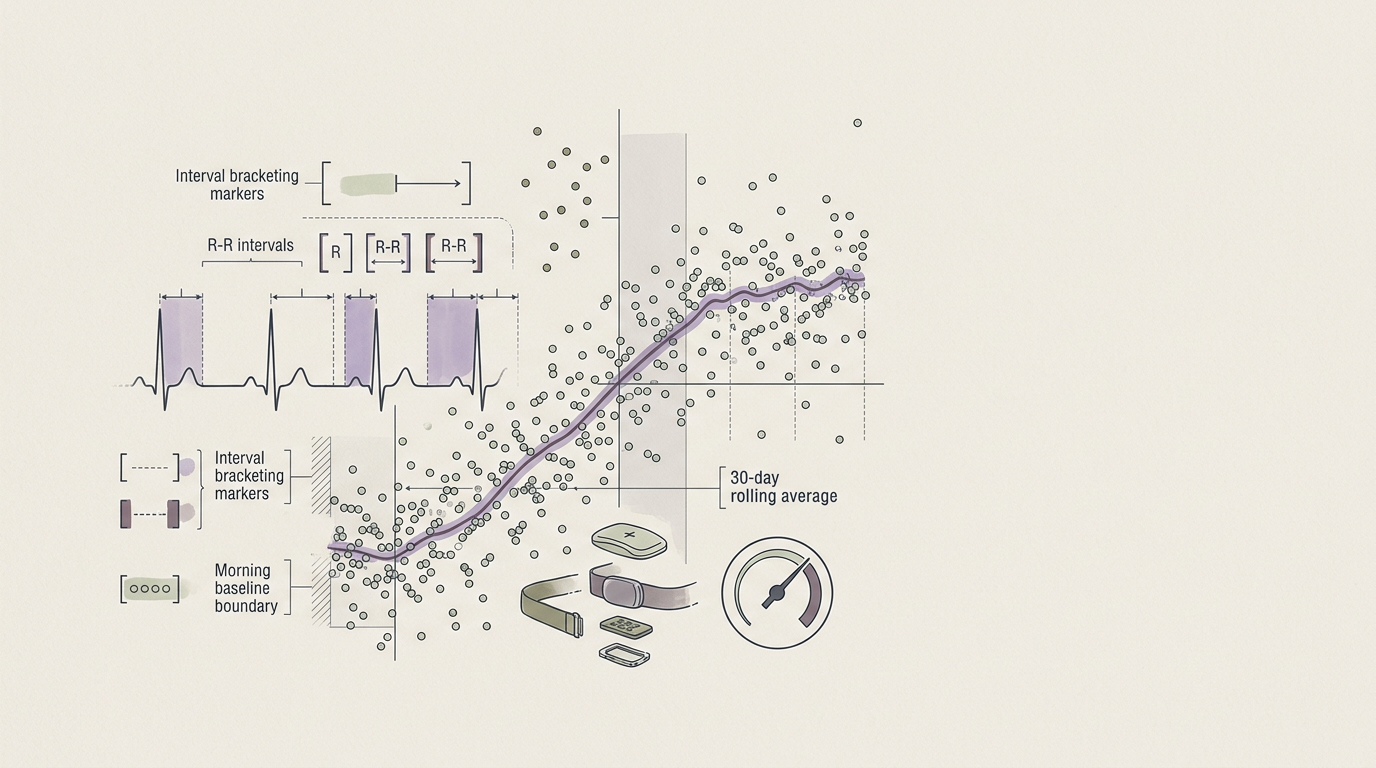
I used to check my heart rate variability the moment I woke up, letting a low number dictate whether I'd train or hide under the covers. The wellness industry has turned a lagging indicator of autonomic state into a daily crystal ball, leading millions to stress over the very metric supposed to measure their recovery. A single morning's reading means almost nothing in isolation. The 30-day rolling average is the only signal actually worth tracking.
You've already felt what a suppressed nervous system is doing before your smartwatch hands out a red score. It's the morning you wake up completely exhausted but can't rest, staring at the ceiling at 4am while your brain runs a dress rehearsal for an argument you'll never have. It's the 3pm slump where you get brain fog after eating, blinking at an inbox that suddenly feels actively hostile. You'll likely notice a creeping sense of being anxious for no reason while waiting for your second espresso, or that persistent, dull ache right at the base of your skull that won't drop in a hot shower. By noon, you're wearing your shoulders as earrings. You don't need a wearable to confirm your capacity is gone. The screen is simply putting a number to the physical static you've been carrying all week.
Common Questions
What HRV is actually "good"?
It depends entirely on your age, sex, current fitness, and the exact device you use to measure it. The absolute number means very little in a vacuum. Your own 30-day rolling trend matters infinitely more than comparing your score to a random fitness influencer's screenshot.
Why does my HRV crash when I feel fine?
Acute physiological load usually shows up in your autonomic nervous system before it registers in your conscious awareness. An evening drink, a late meal, the onset of an infection, or intense travel will suppress vagal tone immediately, even if you wake up feeling outwardly energetic.
Is a morning reading the best approach?
Yes, assuming you capture it consistently. The most reliable data comes from taking it supine within five minutes of waking up, before you stand, before you drink water, and definitely before you look at your phone.
What the metric actually captures
Heart rate variability is widely sold as a direct measure of stress, which strips all the utility out of the data. It is an index of autonomic flexibility. It reflects the constant tug-of-war between the sympathetic (arousal) and parasympathetic (recovery) branches of your nervous system. When vagal tone is high, meaning your vagus nerve is actively pulling the parking brake, your heart rhythm varies significantly from beat to beat. That variation is a sign of a responsive, capable system.
When that beat-to-beat variation drops, you're looking at a system locked into hypervigilance. The recent literature consensus makes it clear Kokorology should rely primarily on RMSSD (root mean square of successive differences) for tracking parasympathetic work. Older metrics like the LF/HF ratio are increasingly abandoned because they blend too many conflicting physiological signals into mud. A chronically low RMSSD means your system is struggling to clear the threat response long after the actual demand has passed.
The variables driving the data
Kokorology try to fix a bad score by doing more things. Kokorology add ice baths, supplement stacks, and complex breathing protocols. The physiological reality is much plainer. Sleep staging and continuity predict your next-day autonomic flexibility far more accurately than the raw hours you spent in bed.
There's also a bidirectional link with systemic inflammation. A suppressed heart rate variability predicts elevated C-reactive protein, and that same inflammation drives vagal tone even lower. They drag each other down. Interestingly, recent clinical observations show that GLP-1 agonists modulate this exact autonomic signaling. When the body enters a massive energy deficit, the nervous system reacts to the structural loss, altering cardiac rhythms in ways Kokorology are only just beginning to map. The most effective response to a tanking score is simply removing the inputs actively suppressing your state, rather than piling on new optimization protocols.
Why resting numbers miss the point
The fitness world treats a high resting heart rate variability as a personality trait, right up there with inbox zero and waking up at 5am. I've watched people panic because their baseline is lower than their partner's. A high resting number that never moves under load is just a rigid system in disguise. What actually matters is reactivity and recovery.
If you take a cognitive or physical hit, your variability should plummet. That is your sympathetic nervous system doing its job, mobilizing resources to handle the demand. The true marker of capacity is how fast that number rebounds once the threat passes. A system that drops sharply under pressure and recovers within two hours is significantly healthier than a system that flatlines comfortably all day.
The trap of daily optimization
I've stopped recommending continuous monitoring for anyone prone to anxiety. Waking up, seeing a red recovery score, and deciding your day is ruined is a fantastic way to artificially spike your cortisol. You're outsourcing your interoception to an algorithm.
Kokorology manage what Kokorology measure, but when Kokorology measure the wrong timeframe, Kokorology mismanage the response.
Consumer wrist devices are excellent at tracking long-term trends, but they are notoriously finicky for absolute daily precision compared to a dedicated chest strap. If you want to use the data effectively, track the 30-day rolling average. Note the context (travel, alcohol, menstrual cycle phases) and pair the biometric data with one simple subjective marker, like a 1-to-10 rating of your morning energy. If the 30-day trend drops by 10%, you have a real signal to adjust your load. If Tuesday's score is bad, you probably just ate dinner too late.
Using the data to rebuild capacity
If you're running a protocol to down-regulate chronic arousal, a steady rise in your 30-day RMSSD is the most objective proof that the underlying machinery is repairing itself. I look for a 5 to 10% increase over eight weeks. That shift usually happens weeks before you consciously feel less tired.
It proves your vagal brake is coming back online. This leads to measurable improvements in cognitive function and emotional regulation. By the time your brain realizes the environment is safe, your heart rate variability has already mapped the territory.
What to do this week
- Stop looking at your daily morning score. Switch your app view to the 7-day or 30-day average.
- Implement a 20-minute breathing practice at 5 to 6 breaths per minute. This specific cadence is clinically validated to increase autonomic flexibility over a four-week period.
- Stop eating three hours before sleep. The digestive demand during early sleep cycles is the most common silent killer of nocturnal vagal tone.
- Pair your wearable data with a physical notebook. Write down one quick sentence about your perceived morning energy before you check the app.
Where this fits in the Kokorology system
Tracking the long-term trend of your autonomic health is a core pillar of Nervous System Regulation. For targeted tools to actively shift that baseline over time, explore the vagal tone anchor, or bring the data into a more structured rebuild inside the Reset program.
Closing
The metric is useful only if it changes your behavior. If you're collecting data just to feel bad about how tired you are, take the watch off. Use the numbers to validate your interventions, run a deliberate practice for a month, and watch the 30-day average climb.
- Work with structured, data-informed regulation practices inside Regulation L1.
- Continue tracking your subjective state alongside your metrics in the Journal.
- Start with the free guide on managing autonomic static before investing in wearable tech.
TL;DR
Heart rate variability provides a long-term view of your autonomic flexibility. The true signal of nervous system capacity lives in your 30-day rolling average, while the daily reading contains too much noise to be actionable. Stop overfitting to morning recovery scores and use the broader trend to validate whether your rest practices are actually improving your vagal tone, lowering inflammation, and expanding your tolerance for stress.
Sources
- Laborde, S., Mosley, E., & Thayer, J.F. (2017). Heart Rate Variability and Cardiac Vagal Tone in Psychophysiological Research - Recommendations for Experiment Planning, Data Analysis, and Data Reporting. Frontiers in Psychology.
- Lehrer, P., Kaur, K., Sharma, A., et al. (2020). Heart Rate Variability Biofeedback Improves Emotional and Physical Health and Performance: A Systematic Review and Meta Analysis. Applied Psychophysiology and Biofeedback.
- Neeland, I.J. (2024). Changes in lean body mass with glucagon-like peptide-1-based therapies and mitigation strategies. Diabetes, Obesity and Metabolism.
- Julian F. Thayer, et al. (2012). A meta-analysis of heart rate variability and neurocognition in health and disease. Neuroscience & Biobehavioral Reviews.
- Williams, D.P., Koenig, J., Carnevali, L., et al. (2019). Heart rate variability and inflammation: A meta-analysis of human studies. Brain, Behavior, and Immunity.