For Coaches
How to Assess a Client Nervous System State in 90 Seconds
Most client intake forms are exercises in historical fiction. You ask about childhood, past traumas, current stressors, and the client dutifully fills in the blanks, crafting a narrative. It's useful information, but it'
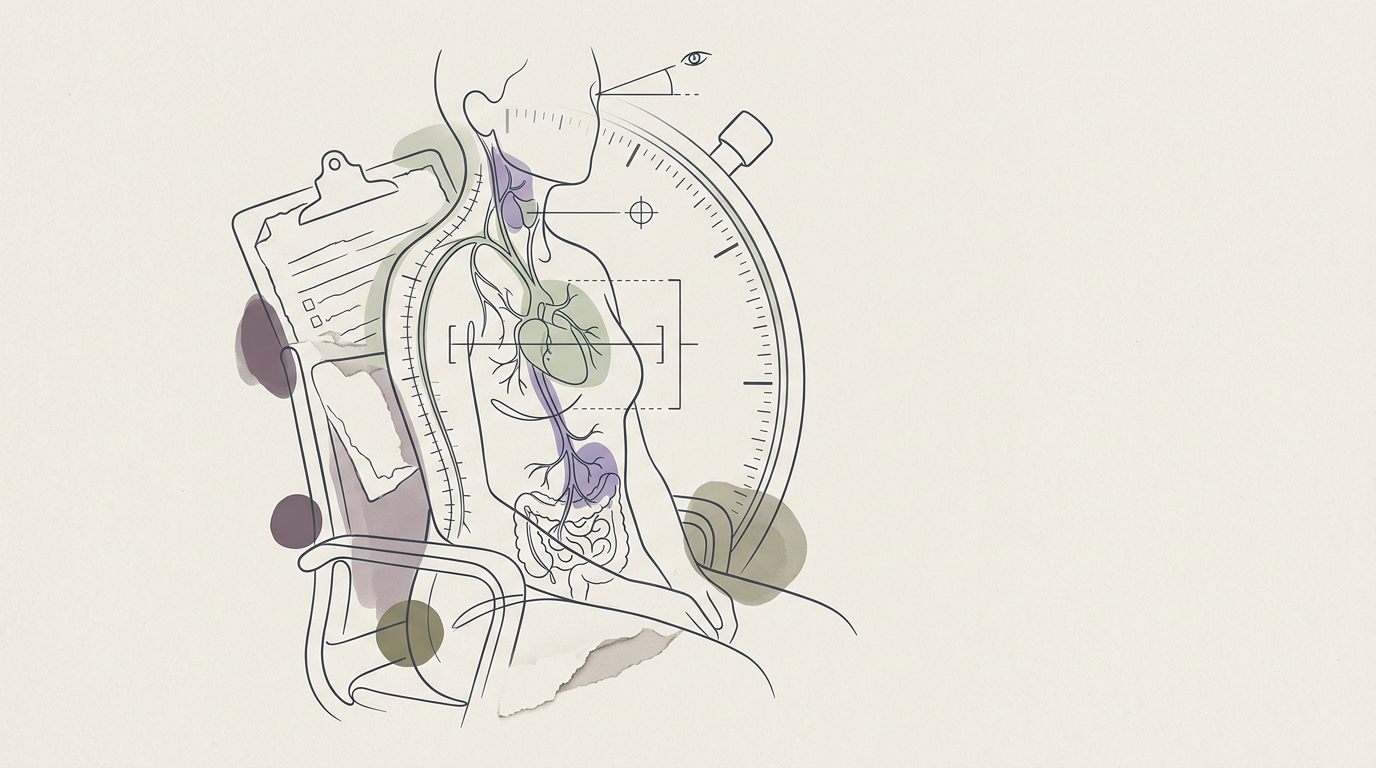
I used to spend the first ten minutes of a new relationship staring at an intake form, believing the paperwork held the map. But an intake questionnaire is just historical fiction written from a settled place, heavily edited for an audience. To actually work with someone, you have to assess a client’s nervous system state in 90 seconds, reading the physiological data they are broadcasting right now. The paperwork tells you what happened; the body tells you how they are surviving it today.
When a client sits down across from you, or their square pops up on Zoom, you can feel the state they brought with them before they even say hello. You recognize the subtle markers because you have lived them. It is the person who shows up entirely tired but wired, speaking rapidly about their goals while their eyes dart around the screen. It is the 3pm jaw clench they carry into the room, the half-finished sentences, the tight shoulders that refuse to drop even when they claim they are completely relaxed. Sometimes it is the heavy stillness of someone who is exhausted but can't rest, sitting perfectly rigidly while their system hums with a baseline hum of threat. They might describe feeling anxious for no reason, completely disconnected from the fact that they haven't taken a full breath since Tuesday.
Common Questions
What am I assessing in a client's nervous system?
You are taking a snapshot of their present-moment autonomic state. You are looking to see if their system is mobilized for threat, conserved and shut down, or regulated and capable of connection. This read dictates how you pace the session.
Why only 90 seconds?
This initial scan trains you to pick up on the most salient cues before the client’s conscious mind constructs a performance. It is a rapid, embodied check-in that captures the raw physiology before they remember how they are supposed to act in coaching.
Is this a replacement for a thorough client history?
Absolutely not. The history gives you the timeline; the 90-second scan tells you the weather right now. You need both to navigate effectively. Think of it as a core competency in nervous system regulation for yourself and the person sitting opposite you.
The Trap of the Detective
Coaches tend to fall into one of two extremes. They try to become junior clinicians armed with complex diagnostic criteria, or they ignore the body entirely and stick to setting goals. Leave the pathology hunting to the doctors. Your only task is to check the autonomic baseline. I have yet to meet a tight jaw that could be relaxed by a SMART goal.
In the first 90 seconds of any interaction, you do a perceptive sweep across three channels: Breath, Body, and Banter. This requires tracking your own state first. A dysregulated practitioner cannot accurately read a dysregulated client.
Your job is to notice the nervous system, name the state, and meet it where it is.
The Command Line
The breath is the most direct line Kokorology have into the autonomic control center. It is the only function Kokorology can consciously control that also runs on autopilot, making it an honest, real-time reporter of inner capacity.
Watch where the air lands. If their breath is high and fast in the chest, that apical breathing pattern signals sympathetic arousal. It tells the brain's alarm center, the locus coeruleus, to release noradrenaline and keep the system hypervigilant. Observe if they are holding their breath, or if the exhale is clipped and short. That is bracing. These respiratory patterns are direct outputs of neural circuits preparing the human animal for a physical threat. If a client is breathing into their clavicles, trying to do demanding cognitive work is a waste of an hour. The prefrontal cortex is effectively offline. You have to change the respiratory rhythm first.
The Shape of a State
Before a client says a word, their physical guarding broadcasts their capacity. Kokorology are trained to look for bad posture and correct it, but the body does not randomly slump. It organizes itself around an autonomic state.
Look for the subtle markers. Shoulders hiked up near the ears and a concave, protective quality to the chest are physical readouts of a nervous system under heavy load. Notice the micro-movements. Fidgeting, tapping, and picking at cuticles signal sympathetic energy looking for a release valve. A profound stillness often masks a heavy dorsal conservation state, where the parking brake is pulled hard. Through the pathways of interoception, the brain constantly receives these bodily signals and interprets them as emotion. The body mumbles, and your job is to learn its dialect. Tracking your own physical shifts in the Kokorology Journal is the fastest way to develop this literacy.
The Music of the Vagal Brake
This is the most overlooked and data-rich channel. Pay less attention to what your client says in the opening pleasantries and more attention to how they say it. The prosody—the rhythm, tone, and musicality of their speech—is a direct indicator of their vagal tone.
A voice that is flat, monotonic, and lacking in inflection marks a system that has moved into conservation mode. The rich vocal variety that signals safety and social connection is metabolically expensive, and a depleted system simply cuts the funding to save energy. The same neural pathways that control heart rate variability also regulate the vocal cords; a flat voice is a low-capacity system. Speech that is fast, pressured, and high-pitched points to sympathetic arousal. A warm, melodic vocal tone is the sound of a regulated nervous system, online and feeling safe. This is the state where actual therapeutic work can happen. Kokorology build this precise assessment capability inside the certifications program, moving practitioners from theory to embodied observation.
What to do this week
Practice the 90-second scan on the world around you to calibrate your senses.
- Listen to the prosody: Put on a podcast. Ignore the content and listen only to the speaker's vocal variation. Is it melodic, or flat and monotonic? What does that tell you about their likely state?
- Watch the baseline: Observe a meeting for two minutes with your microphone and camera off. What do you notice about their jaw tension, their stillness, or their fidgeting? Form a hypothesis based entirely on the body.
- Check your own breath: The moment you open your laptop for your next client call, before they even appear, notice your own breathing pattern. If you catch yourself holding your breath, run a 60-second tool from the hacks library to tune your own instrument first.
Where this fits in the Kokorology system
This assessment is a foundational skill within the Kokorology system of regulated leadership. It sits at the intersection of the performance training and the advanced skills for practitioners, allowing you to build genuine capacity rather than just pushing through resistance.
Closing
Learning to read the state beneath the story shifts your entire practice. It moves you from holding narratives to partnering in physiological regulation. The next step is to get consistent repetitions, first on yourself and then with the people sitting across from you, until this read becomes an automatic part of how you work.
- Continue your training inside the Kokorology Coach Certification.
- Sit with this practice daily inside The Kokorology Journal.
- Start with the free guide on The Five Nervous System States.
TL;DR
You can assess a client’s nervous system state in 90 seconds by observing three channels: breath pattern, bodily posture, and vocal prosody. This real-time scan bypasses the edited narrative of an intake form and reads the raw autonomic physiology directly. By identifying whether a client is in sympathetic arousal, dorsal conservation, or a regulated state, a practitioner can meet the client's actual capacity, more than the story they tell, creating an effective session from the very first minute.
Sources
- Critchley, H. D., & Garfinkel, S. N. (2017). Interoception and emotion. Current Opinion in Psychology.
- Feldman, J. L., & Del Negro, C. A. (2006). Looking for inspiration: new perspectives on respiratory rhythm. Nature Reviews Neuroscience.
- Lanius, R. A., et al. (2014). The neurobiology of traumatic dissociation: a new framework for therapeutic interventions. Chronic Stress: Neurobiology and Clinical Consequences.
- Thayer, J. F., & Lane, R. D. (2000). A model of neurovisceral integration in emotion regulation and dysregulation. Journal of Affective Disorders.