Workplace & Leadership
How Kokorology Audits a Workplace: the 9-point Assessment We Run Before Quoting a Contract
Understand the Kokorology workplace wellbeing audit: a 9-point assessment to elevate human capacity beyond fluffy corporate wellness programs.
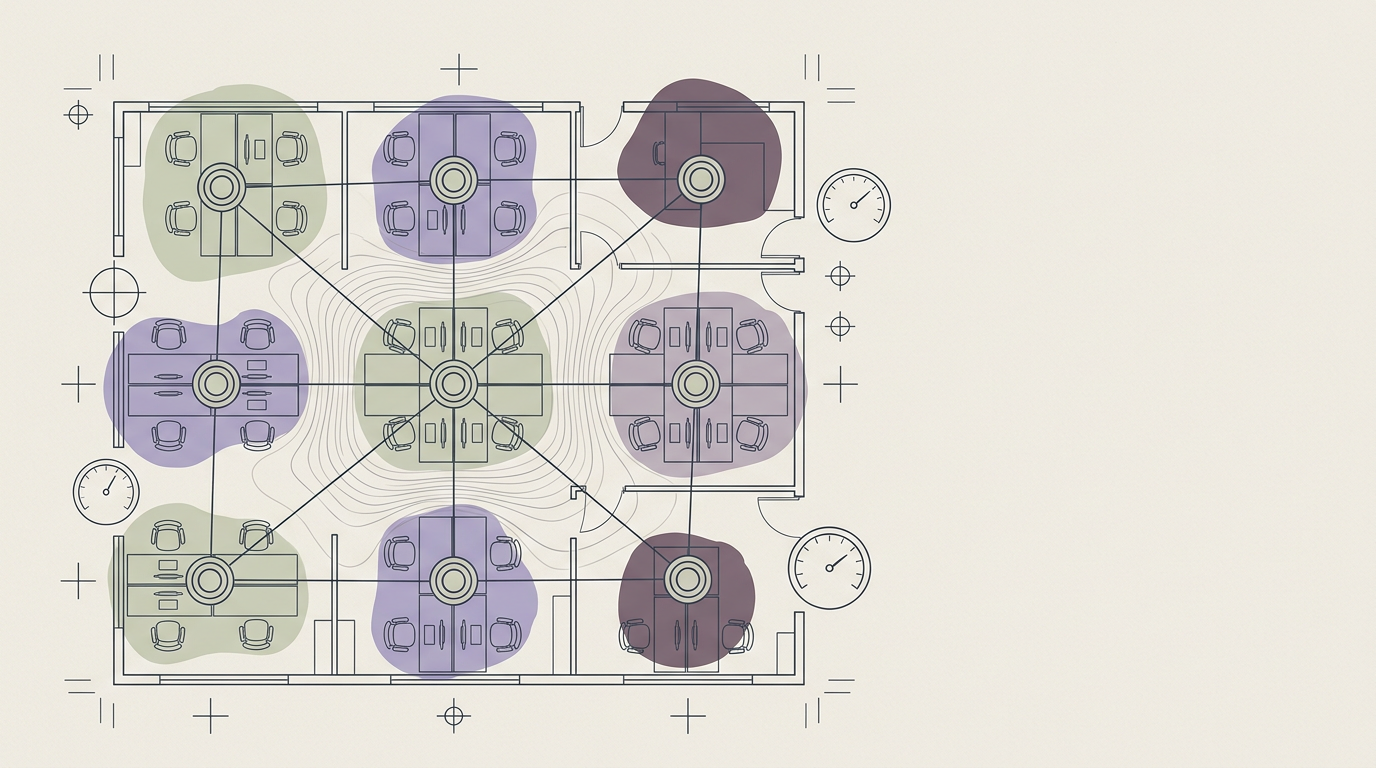
Every time a company asks me for a workplace wellbeing audit, they expect a survey about work-life balance and a 1-to-10 scale of how everyone is feeling. I refuse to send those out. Subjective questionnaires measure mood, but the true determinant of a team's capacity is the autonomic nervous system—specifically, how well the collective workforce handles threat detection and recovers from prefrontal load. Asking a perpetually hypervigilant group of employees to rate their stress level completely ignores the physiological reality of what the environment is doing to them.
You already know what a dysregulated workplace feels like in your own body, even if your HR department calls it a culture issue. It's the jaw that won't unclench during the 3pm status update, or the way you stare at an open fridge with no hunger because you're just seeking a dopamine hit to survive the afternoon. You log off at 6pm feeling entirely drained, yet by midnight you are tired but wired, scrolling mindlessly because your nervous system can't safely downshift. You might wake up at 3am every night cycling through tomorrow’s inbox, or sit down at your desk on Tuesday morning already fighting brain fog. The environment sends constant, low-level alarms, and your body is simply responding to the inputs.
Common Questions
What is allostatic load?
Allostatic load is the physiological wear and tear the body accumulates when repeatedly exposed to stressors. It happens when the nervous system gets stuck in a cycle of high arousal without sufficient periods of recovery, leading to systemic dysregulation across immune, metabolic, and cardiovascular functions.
Why do subjective stress surveys fail?
Subjective surveys capture a temporary mood or a cognitive appraisal of a situation, not a biological reality. A person can report feeling perfectly fine while their autonomic nervous system is running entirely on adrenaline and cortisol to maintain that baseline of performance.
What does HRV tell the system about a team?
Heart rate variability (HRV) acts as a proxy for vagal tone and autonomic flexibility. When an entire leadership team shows suppressed HRV baselines, it indicates a pervasive state of chronic engagement where the physiological brakes are offline.
The physiological cost of chronic adaptation
I used to believe that if you gave employees enough space to vent in a structured interview, you could isolate the cultural issues and fix them. I completely missed the biology. Venting just rehearses the sympathetic arousal without resolving it. The only metric I care about now is allostatic load.
When chronic demands force the autonomic nervous system to constantly adapt without completing a recovery cycle, the body's physiological baseline fundamentally shifts. Kokorology measure that shift. Kokorology look for the physiological wear and tear—how the HPA axis is functioning, how sleep staging gets delayed by evening hypervigilance, and how nervous system regulation is actively suppressed by daily workflows. A seminar on resilience does absolutely nothing for a workforce whose cortisol rhythm is inverted. You have to address the actual load.
Unconscious threat detection and the anterior insula
Kokorology're wired to scan for safety and threat constantly, usually far below the level of conscious thought. This unconscious processing alters interoception, which is how your anterior insula reads the internal state of your body to regulate everything from heart rate to hunger.
If a workplace environment is full of unpredictable communication, opaque feedback loops, and managers who email at 11pm, the nervous system registers a constant threat. Interoceptive awareness gets blunted. People lose the ability to read their own signals for fatigue, pushing through the afternoon dip with caffeine and assuming the resulting tachycardia is just ambition. I see teams implementing meditation rooms while their fundamental communication structures are sending active distress signals to the vagal tone.
If a workplace environment requires a hypervigilant nervous system just to survive the week, no amount of yoga is going to regulate it.
HRV, autonomic flexibility, and the norepinephrine drip
Kokorology pull objective data and correlate it with operational reality. Kokorology look at collective, anonymised Heart Rate Variability (HRV) trends to understand the autonomic flexibility of the team. High HRV means the vagus nerve is functioning as a responsive parking brake, allowing an individual to downshift after a stressor.
Low HRV across an entire department means the collective brake line is cut. Every incoming Slack message triggers a micro-release of norepinephrine from the locus coeruleus, keeping the brain in a state of continuous partial attention. When the body is stuck in this low-grade sympathetic arousal, it loses the capacity to perform deep, consolidated work. You end up with a team that is universally exhausted but producing very little actual value.
Cognitive load accumulation in synchronous meetings
Kokorology analyse the meeting cadence meticulously. Back-to-back synchronous interactions spike cognitive load accumulation and degrade the prefrontal cortex's ability to regulate emotion. Every time you require an employee to switch contexts, process the micro-expressions of eight people on a video grid, and formulate a coherent response, you're demanding a massive metabolic output from the brain.
the audits map these communication flows to identify where ambiguity or sheer volume acts as a chronic stressor. Kokorology observe how leadership models the physiological transition from effort to rest. Most leadership advice is just napping with extra steps, but actually demonstrating a regulated state to your team requires genuine physiological capacity. If the executive team answers messages during a town hall, the nervous systems of everyone watching will mirror that exact hypervigilance.
Why Kokorology charge for the diagnostic
Companies frequently reach out wanting to casually explore options for their teams over a free coffee. I politely decline. A proper diagnostic requires looking at the actual biological state of the workforce, mapping the environmental cues, and identifying exactly where the collective vagal brake is failing.
It takes time, specific methodology, and an understanding of human neurobiology to accurately map why a team is failing to repair faster than they burn out. You don't ask a specialist to run a full panel of tests and map the results to your daily habits for free just to see if you like their vibe. The inbox has never once been impressed by your heart rate, and generic perks won't fix a broken environment.
What to do this week
- Check your own HRV baseline for three consecutive mornings before opening a single work application.
- Move one recurring synchronous meeting this week to an asynchronous update to immediately reduce collective cognitive load.
- Block 15 minutes on your calendar directly after your most demanding interaction purely for sensory down-regulation.
- Silence notifications on your phone between 8pm and 8am to allow your HPA axis to complete a full recovery cycle.
Where this fits in the Kokorology system
Kokorology use this audit as the diagnostic entry point for any corporate intervention. If you're a leader looking to regulate your own baseline before managing a team, start with the Performance tier. For individuals trying to map out how their workday is affecting their physiology, use the daily tracking in the Journal to rebuild your interoceptive awareness.
Closing
A dysregulated workplace cannot be fixed by teaching people to breathe through the dysfunction. You have to locate the exact mechanisms driving the load and change the inputs.
- Work with the system to assess your team in Coaching
- Rebuild your personal capacity inside the Reset
- Practice micro-regulation during your workday with Hacks
TL;DR
A true workplace wellbeing audit cannot rely on subjective mood surveys that only capture how people feel about their jobs. It must measure the physiological reality of the environment, specifically looking at allostatic load, autonomic flexibility, and threat detection. By analysing objective data like collective HRV trends, cognitive load from meeting structures, and environmental cues, leaders can identify exactly where the workplace is suppressing recovery. You have to address the nervous system’s physiological response to the environment rather than treating symptoms with generic wellness perks.
Sources
- Chmiel A, et al. (2025). Burnout and the brain: a mechanistic review of MRI studies. International Journal of Molecular Sciences.
- Sonuga-Barke EJS (2024). Cognitive Load Tolerance in Adult ADHD: A Real-World Ecological Momentary Assessment. Molecular Psychiatry.
- Craig, A. D. Bud. (2009). How do you feel--now? The anterior insula and human awareness. Nature Reviews Neuroscience.
- Walton GM (2024). Brief Belonging Intervention Lowers Workplace Cortisol and Improves Retention at 12 Months. Nature Human Behaviour.