Nervous System
Grounding Techniques That Actually Work (The Architecture, Not The Cocktail Napkin)
Eight somatic grounding exercises from polyvagal theory, Somatic Experiencing, EMDR and DBT — with the mechanism underneath each, so you stop guessing which door back into your body to use.
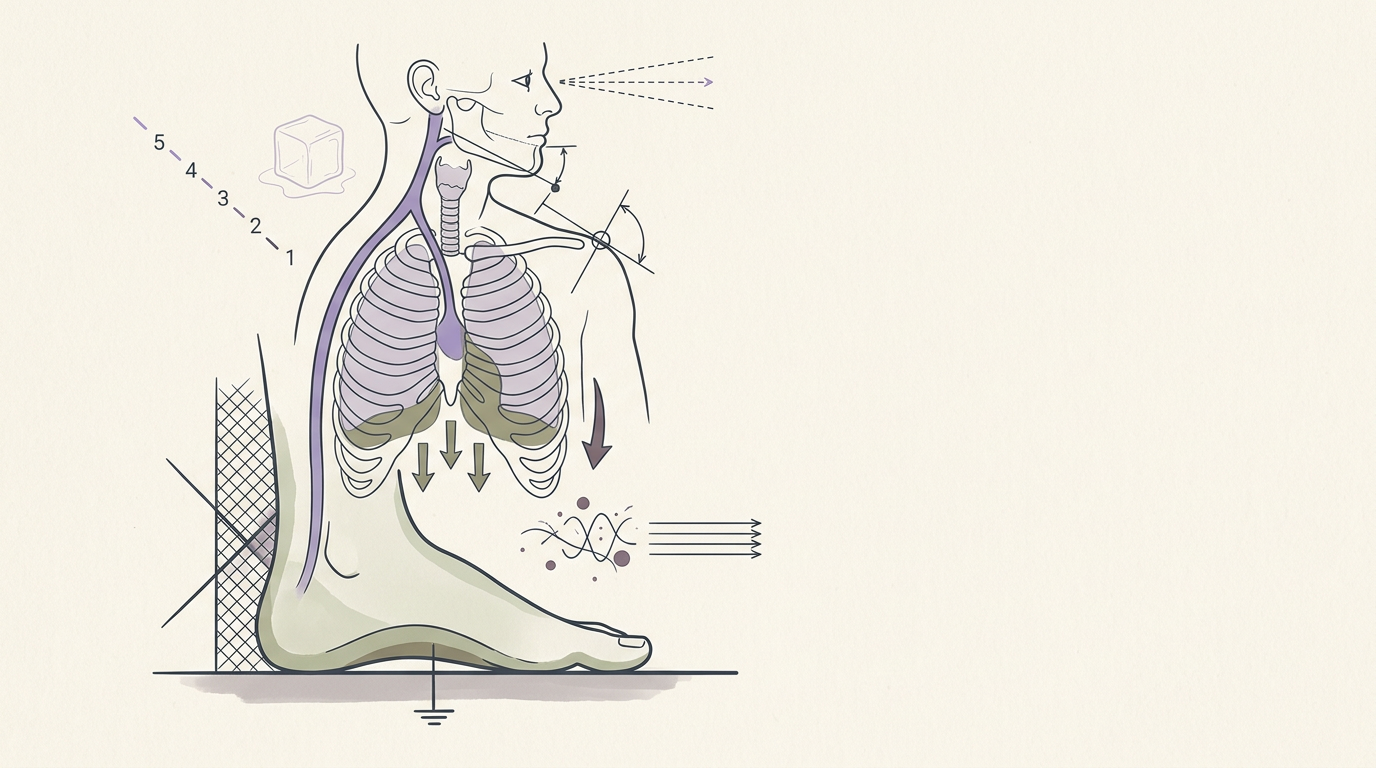
Most "grounding techniques" lists read like a yoga teacher's cocktail napkin: name five things you see, hold an ice cube, breathe through one nostril, you're welcome. It works, sometimes, the way slapping a thermostat works. But if you've ever had a panic spike at 2 a.m. and tried to remember whether it was four things you can touch or three things you can smell, you already know the problem. Grounding isn't a trick. It's a load-bearing wall in your nervous system architecture, and most of the internet is selling you a tea light.
I want to do this properly. Grounding is what happens when your body re-establishes contact with the present — feet, breath, eyes, gravity — and your vagus nerve stops broadcasting "danger" to every organ downstream. The exercises below are the structural ones: vetted in trauma clinics, used by polyvagal therapists, and short enough that you'll actually do them in the supermarket queue when your chest goes tight.
Before any of it lands, the felt picture: your jaw is set a millimetre forward, your shoulders have crept toward your ears without telling you, your breath is parked in the top third of your ribs, your eyes are scanning faces faster than you're tracking words, your gut has gone quiet in that specific way that isn't hunger and isn't fullness, and there's a low metallic taste somewhere behind your back teeth. That's the readout. Not "anxiety." A nervous system whose threat-detection has out-voted its present-moment-detection. Grounding is the renovation that puts the second one back in charge.
What grounding actually is (the architecture)
Your autonomic nervous system runs on a hierarchy described by Stephen Porges (1994) as polyvagal theory. The newest branch — the ventral vagal complex — is the one that runs your face, voice, middle ear, and the muscles that let you make eye contact without flinching. When it's online, you feel here. When threat or chronic load knocks it offline, the older sympathetic ("mobilise") and dorsal vagal ("collapse") branches take over, and "here" becomes "anywhere but here."
Grounding techniques are interventions that re-recruit the ventral branch through one of four doors: interoception (sensing inside the body), exteroception (sensing outside), proprioception (sensing position and weight), and co-regulation (borrowing another nervous system's calm). Every exercise below is one of those four doors. None of them are decorative.
Related anchors: vagal tone anchor · gut-immune anchor · HRV anchor
The exercises, in the order I'd teach them
1. Orienting (exteroception, 60 seconds)
This is the first one I'd hand a stranger. Slowly turn your head — actually slowly, like you're reading a long shelf — and let your eyes find six points in the room. Not "name five things you see." Let your gaze land, soften, and move on. Peter Levine built Somatic Experiencing around this because the optic nerve has a direct line into the brainstem's threat-detection circuit. When your eyes confirm "no predator," the amygdala downshifts before your prefrontal cortex even gets a memo.
Do it in lifts. Do it the second you sit down at your desk. The reason it works in a supermarket queue is precisely that nobody can tell you're doing it.
2. Feet on the floor, weight check (proprioception, 90 seconds)
Press both feet flat. Notice which one is taking more weight. Shift until it's even. Now press your big toes down, then the little toes, then the heels. Name, silently, the temperature of the ground through your soles. That's it.
Proprioceptive input recruits the cerebellum and vestibular system, and there's solid work from Bessel van der Kolk's group at Boston University showing that body-based attention reduces hyperarousal scores faster than cognitive reframing in trauma populations. The mechanism is unglamorous: your brain cannot simultaneously model "I am falling through space" and "my left heel is cool against the tile."
3. Physiological sigh (interoception, 30 seconds)
Two inhales through the nose — one long, one short top-up — then one long exhale through the mouth. Repeat three times. That's it. Andrew Huberman and Karl Deisseroth's Stanford lab (Balban et al., 2023, Cell Reports Medicine) put this head-to-head with box breathing and mindfulness meditation across a 28-day trial. The physiological sigh won on mood and reduced respiratory rate the fastest, by a meaningful margin.
The why: the double inhale re-inflates collapsed alveoli, the long exhale dumps CO₂ and triggers parasympathetic dominance via the vagus. You are, mechanically, telling your brainstem the emergency is over.
4. The half-salamander (vagal tone, 60 seconds)
From Stanley Rosenberg's clinical work on cranial nerves. Without turning your head, look as far to the right as your eyes will go. Hold for 30 seconds, or until you yawn, sigh, or swallow — all signs the vagus has come online. Return to centre. Repeat to the left.
This one looks absurd and feels miraculous. The suboccipital muscles at the base of your skull share fascia with the vagus nerve; lateral gaze without head rotation creates a tiny stretch that resets vagal tone. Tension headache people: this is also your move.
5. Voo (vibration, 90 seconds)
Inhale through the nose. On the exhale, make a low "voooooo" sound — foghorn pitch, chest-deep, longer than feels natural. Three rounds. Levine's signature exercise.
The vocal cords and the larynx are innervated by the vagus. Sustained low-frequency vibration on the exhale stimulates the nerve directly and engages the diaphragm in its full excursion. You will feel slightly ridiculous and then, abruptly, much calmer. The ridiculousness is part of the dosage.
6. Butterfly hug (bilateral stimulation, 2 minutes)
Cross your arms over your chest, hands on opposite shoulders or biceps. Alternate gentle taps — left, right, left, right — at roughly the pace of a slow walk. Developed by Lucina Artigas for EMDR after Hurricane Pauline in 1997, now standard in disaster trauma protocols.
Bilateral, rhythmic, predictable input lowers amygdala reactivity (van der Kolk's fMRI work shows the effect clearly). For people who go numb or floaty under stress, this is the door back in. Pair with the physiological sigh and you have a 3-minute reset that works in airport bathrooms, before difficult conversations, and at funerals.
7. Cold water on the face (mammalian dive reflex, 20 seconds)
Bend over a sink, hold your breath, splash cold water (below 15°C) on the area from your upper lip to your forehead, focusing on under the eyes. Or press a cold pack there for 20 seconds. This is in the DBT skills manual under TIPP for a reason: the mammalian dive reflex drops heart rate, redirects blood centrally, and pulls you out of a panic spike faster than any breath exercise.
Use it for acute states — panic, rage, dissociation that won't lift. Not as a daily practice; the goal is to know it's in the toolkit so you stop fearing the spikes.
8. The 90-second rule, applied (interoception, 90 seconds)
Jill Bolte Taylor, the Harvard neuroanatomist who had a stroke and wrote about it, popularised this: from the moment a strong emotion is triggered, the chemical cascade — adrenaline, cortisol, the lot — flushes through your bloodstream and clears in about 90 seconds. Anything past 90 seconds is you re-triggering it with thought.
Grounding move: when the wave hits, name it ("this is fear, this is rage, this is grief") and watch the body sensation for 90 seconds without acting, narrating, or fixing. Hand on chest helps. You are not suppressing. You are letting the chemistry complete its arc, which is what it was always going to do if you stopped feeding it.
Common Questions
How long until grounding "works"? The acute exercises (physiological sigh, cold water, half-salamander) shift state in under a minute. Building baseline tone — the kind where you stop needing them for routine stress — takes about six weeks of daily practice. The window is consistent across the polyvagal literature.
Which one should I start with? Orienting and the physiological sigh. They're the lowest effort, work anywhere, and stack with everything else.
Does grounding help dissociation or just panic? Both, but you need different doors. Panic is sympathetic over-firing — use cold water, sigh, voo. Dissociation is dorsal vagal collapse — use proprioceptive input (feet, butterfly hug, gentle movement). Cold water on a dissociated nervous system can deepen the shutdown.
Why does naming five things I see never work for me? Because cognitive scaffolding is the last door to come back online when threat physiology is active. You're asking the part of you that's offline to do the rescuing. Start with the body (door 1, 2, 3 above) and let the cognitive part come back on its own.
What about grounding mats and earthing? Different mechanism, weaker evidence. The exercises above are about ventral vagal tone, which is the actual lever. If a grounding mat helps you remember to take your shoes off and stand on the earth for 10 minutes, fine. The 10 minutes outside is doing the work.
What I'd actually do with this
Pick two: one for state-shift in the moment (physiological sigh, half-salamander, or cold water), and one for daily baseline (orienting or feet-on-floor, ninety seconds at a fixed anchor point in your day — coffee, lunch, lights-out).
The Kokorology Journal was built specifically to track which of these moves shifts your state and which ones don't, so you stop guessing. The morning and evening prompts log the felt-sense before and after, and the system surfaces your personal pattern after about two weeks. That's the architecture in motion: not "do more grounding," but "know which intervention is load-bearing for your specific nervous system."
If you want the longer arc, the Self-Regulation Anchor is the 90-day protocol I'd build around these exercises — daily cues, the spiral of practice, and the metrics that tell you it's working before your conscious mind catches up. Or if you're holding load for other people — clients, teams, family — the Capacity & Leadership pillar covers the co-regulation door, which is the one that scales.
The seven-thing list at the top of Google isn't wrong. It's just incomplete. Grounding is structural, not decorative. Build it like a wall.
Sources
- Porges, S. W. (1994). Orienting in a defensive world: Mammalian modifications of our evolutionary heritage. Psychophysiology.
- Balban, M. Y., Neri, E., Kogon, M. M., et al. (2023). Brief structured respiration practices enhance mood and reduce physiological arousal. Cell Reports Medicine, 4(1).
- van der Kolk, B. A. (2014). The Body Keeps the Score. Penguin.
- Levine, P. A. (2010). In an Unspoken Voice: How the Body Releases Trauma and Restores Goodness. North Atlantic Books.
- Rosenberg, S. (2017). Accessing the Healing Power of the Vagus Nerve. North Atlantic Books.
- Artigas, L., & Jarero, I. (2014). The Butterfly Hug Method for Bilateral Stimulation. Journal of EMDR Practice and Research.
- Bolte Taylor, J. (2008). My Stroke of Insight. Viking.
- Linehan, M. M. (2014). DBT Skills Training Manual (2nd ed.). Guilford Press. — TIPP skills, cold water / dive reflex.