Workplace & Leadership
From Crisis to Calibration: How HRV-Informed Leadership Builds Resilient Teams
Heart rate variability offers a real-time window into collective team capacity, guiding proactive workplace strategies that actually prevent burnout.
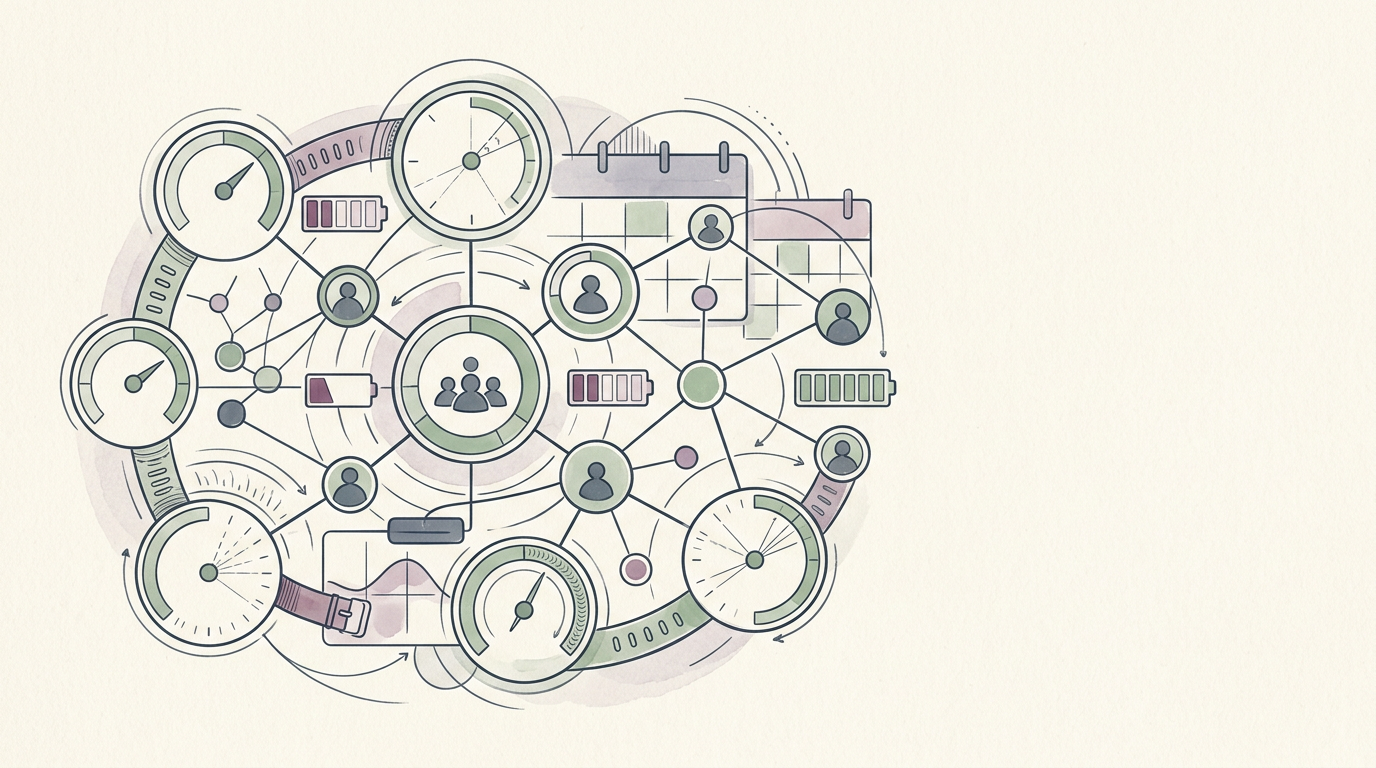
The standard corporate playbook waits for an engagement survey to tell leadership that people are burning out. By the time those results are tabulated in a slide deck, the damage to the team's nervous system is already six months deep. HRV leadership tracks the actual physiological capacity of a group in real-time, intervening when the strain first registers in the autonomic nervous system rather than waiting for the exit interviews.
You know exactly what it feels like to work on a team running in a collective sympathetic state. It's the 3pm jaw clench that travels around the Zoom grid. It's the shared sense of being tired but wired, where everyone is firing off Slack messages at 11:47pm but no actual deep work gets done. You finish a product sprint completely exhausted but can't rest, staring at the ceiling because your system is stuck in threat detection. People start misreading neutral emails as hostile. The open fridge with no hunger becomes the afternoon ritual. Everyone is anxious for no reason, bracing for the next notification ping.
Common Questions
What is heart rate variability?
Heart rate variability is the measurable fluctuation in milliseconds between your consecutive heartbeats. A higher variation indicates a responsive autonomic nervous system that can easily shift between focus and recovery, while a low variation suggests a system locked in chronic stress.
How does team HRV work?
Team HRV aggregates anonymized physiological data to track the collective baseline of a group. It provides a real-time dashboard of collective capacity, showing leadership when a department is running on fumes before performance drops or interpersonal friction spikes.
What is allostatic load?
Allostatic load is the physiological wear and tear that accumulates when the body is exposed to repeated or chronic stress. When the nervous system constantly activates its threat response, the physical strain eventually degrades cognitive function and immune health.
The delay in the dashboard
I used to believe that anonymous feedback forms were the gold standard for checking team health. I spent years in corporate HR meetings reviewing sentiment data, convinced Kokorology were getting ahead of the curve. I was entirely wrong. Sentiment surveys are lagging indicators. They measure how people feel about the pressure they endured three months ago.
When a team is dysregulated, they don't have the interoceptive awareness to accurately fill out a survey anyway. Interoception is your brain's ability to perceive physical sensations inside the body. When the nervous system is overwhelmed, it mutes those signals. People push through the brain fog and the racing heart, assuming they're just having a busy week, until their capacity abruptly drops to zero.
The machinery of collective flow
Let's look at the actual mechanism of resilience. Heart rate variability is primarily governed by vagal tone—the activity of the vagus nerve, which serves as the primary braking system for your autonomic responses. When vagal tone is high, the heart rate slows rapidly after a stressor passes.
If a team is facing constant artificial urgency, their collective vagal tone drops. The sympathetic nervous system dominates. Heartbeats become metronomic and rigid. This rigidity fundamentally alters human behavior. A sticky nervous system, less capable of fluid transitions, makes collaborative tasks harder. When individuals are physiologically bracing against stress, they lose access to the prefrontal cortex. Empathy, creative problem-solving, and psychological safety disappear. You can't mandate collaboration when the biochemistry of the room is signaling a predator is nearby.
You cannot out-manage a biological threat response with a pizza Friday.
Sensing the climate
Using HRV data at work requires a strict, opt-in privacy boundary. It involves looking at aggregated, anonymized trends across a department. If the engineering team's collective HRV plummets every Tuesday, you don't need to pull people into one-on-ones to ask them about their feelings. You need to look at what happens on Tuesdays.
Usually, it's a structural issue. It's a back-to-back meeting block that removes all recovery time. It's a specific project manager who creates artificial panic. When you have the data, you can adjust the environment. I've stopped recommending resilience training for employees; the intervention belongs at the level of the schedule.
The contagion of calm
What I notice in consulting sessions is how quickly physiological states spread across a group. Coregulation is a biological imperative. If one leader enters a room in a state of hyperarousal, the heart rates of the people around them will subtly shift to match that threat level. The opposite is also true.
When you design a schedule that respects human nervous system regulation, you allow people to recover their capacity. They show up grounded. They process friction without escalating it. They actually hear what their colleagues are saying.
What to do this week
- Look at your team's recurring meeting schedule and locate the longest unbroken block of synchronous time. Insert a 15-minute buffer in the middle of it.
- Track your own HRV for five days using a wearable device, noting the specific hours where your variability drops.
- Identify one artificial deadline currently elevating your team's threat response and move it back by 48 hours.
Where this fits in the Kokorology system
Understanding the biology of your team sits inside the Performance curriculum for leaders. For individual tracking, you can monitor your daily physiological state using the Journal. If the whole department is stuck in a chronic stress loop, the Reset protocol offers a structured week to bring the collective baseline back to neutral.
Closing
The inbox has never once been impressed by your heart rate. Your team's capacity is a finite biological resource, and treating it as an infinite one guarantees collective collapse. Look at the structure of the work before you question the resilience of the people doing it.
- Work with the system to audit your organizational capacity inside Performance.
- Practice dropping your own sympathetic arousal using the Anchors.
- Read the free guide on managing workplace allostatic load.
TL;DR
Traditional workplace engagement surveys measure burnout months after the damage is done. HRV leadership uses aggregated heart rate variability data to track a team's actual physiological capacity in real-time. By monitoring the autonomic nervous system's response to workplace stressors, leaders can adjust schedules and workloads before chronic strain degrades cognitive function and team collaboration.
Sources
- Craig, A.D. (2002). How do you feel? Interoception: the sense of the physiological condition of the body. Nature Reviews Neuroscience.
- Holt-Lunstad, J. (2010). Social Relationships and Mortality Risk: A Meta-analytic Review. PLOS Medicine.
- McEwen, B.S. (2017). Neurobiological and Systemic Effects of Chronic Stress. Current Opinion in Behavioral Sciences.
- Thayer, J.F. (2007). A meta-analysis of heart rate variability and neuroimaging studies. Neuroscience & Biobehavioral Reviews.
- Tracey, K.J. (2007). Physiology and immunology of the cholinergic anti-inflammatory pathway. Journal of Clinical Investigation.