Nervous System
Freeze Response Stuck in Shutdown
The chronic freeze response is a profound state of metabolic conservation where the nervous system powers down to survive an overwhelming environment.
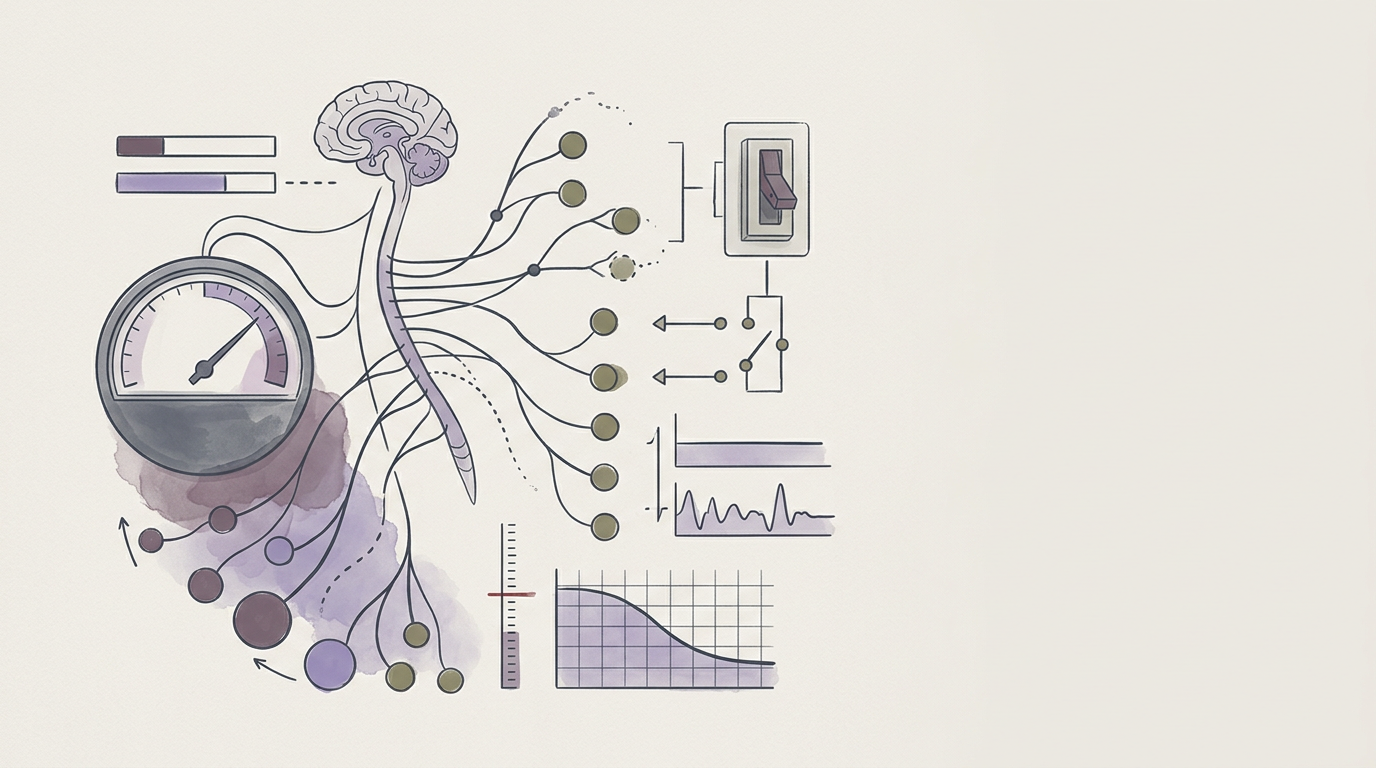
The wellness industry treats the freeze response like a temporary glitch—a brief deer-in-the-headlights moment you can just breathe your way out of. When the threat feels inescapable, the nervous system deploys a much heavier lever. It cuts power to the entire organism. This state of profound immobilisation is a deliberate survival strategy driven by the autonomic nervous system to conserve metabolic energy.
You already know what the inside of this conservation mode feels like. It’s the heavy, wet-cement feeling at 3pm when you stare at an open inbox and can't force your hand to move the mouse. You feel disconnected from your body, watching yourself fail to do basic tasks from somewhere near the ceiling. You crawl into bed at 9pm hoping to finally recover, only to find yourself exhausted but can't rest, your jaw clamped shut while the hours tick by. This is the physiological reality of a system that has pulled the emergency brake.
Common Questions
What triggers a chronic freeze state?
A prolonged mismatch between the demands placed on your body and your physiological capacity to meet them. When active responses like fight or flight fail to resolve a threat over months or years, the autonomic nervous system shifts into a low-energy conservation mode to ensure basic biological survival.
Why does my brain feel so slow during this?
The autonomic nervous system deliberately throttles resources away from the prefrontal cortex during profound immobilisation. Complex problem-solving, strategic planning, and emotional regulation require massive amounts of glucose, which your body is actively hoarding for basic, non-negotiable survival functions.
How long does metabolic shutdown last?
It remains the default state as long as the environment continues to signal overwhelming demand. Shifting out of it requires actively changing the sensory inputs the brain receives from the body, proving through physical sensation that the immediate environment is safe enough to resume normal autonomic operation.
The Logic of Immobilisation
I used to believe that pushing through exhaustion was just a matter of adequate caffeine and discipline. I spent most of my late twenties treating my body like a machine that didn't require maintenance, completely oblivious to the allostatic load I'd accumulated. The reality is that your biology doesn't care about your deadlines. When the nervous system calculates that you can't fight your way out of a brutal work environment and you can't outrun it, it initiates a profound shutdown.
The organism shuts down. It is deliberately starved of available energy. When active responses fail to resolve a threat over months or years, the nervous system shifts into a low-energy conservation mode to keep you alive. It depresses heart rate, lowers blood pressure, and limits oxygen intake. This is an ancient, highly effective program designed to keep you alive during prolonged famine or inescapable predation. Your body hasn't broken. It has simply made a brutal, logical calculation based on the environment you've placed it in.
Interoception Goes Offline
The feeling of numbness functions as a literal data signal that a primary sensory pathway has been taken offline. Interoception is your brain’s ability to sense and interpret the internal state of your organs, muscles, and viscera. When a system is locked in immobilisation, the brain dampens the volume on these afferent signals to prevent sensory overload.
The map goes blurry. Key hubs for interoception, specifically the insular cortex, show reduced activity on fMRI scans when a person is locked in this state. The data feed from your viscera is throttled to near zero. You stop feeling hunger, you stop feeling physical boundary lines, and you start watching your life happen from a distance. You can slowly restore this sensory mapping with intentional awareness, which is the exact mechanism Kokorology train inside the Journal.
The Physiological Toll of Conservation
Living in a state of metabolic decline takes a massive physiological toll. Digestion slows to a crawl, immune surveillance drops, and the daily brain fog makes cognitive functions entirely inaccessible. Your inbox hasn't once been impressed by your heart rate, yet Kokorology expect ourselves to draft coherent strategy documents while the biology is preparing for a six-month winter.
You cannot reason with a nervous system that has cut the power.
The system is diverting glucose and oxygen away from growth and repair simply to maintain minimal baseline functions. Wading through that wet cement every day leaves a mark on your baseline capacity. You can't wait this out. A system left in conservation mode eventually accepts that state as its permanent set-point.
Bottom-Up Signalling
The path out of this state runs from the bottom up, through the feeling body. You have to send small, gentle packets of sensory data back to the brain to prove the immediate physical world is safe enough to resume normal operations. I tested these re-regulation protocols on myself first when my own system flatlined during a trip to Lisbon. I know this firsthand.
A ten-mile run will only drive an exhausted organism further into the ground. Restoring the connection between brain and body requires specific somatic anchors that prove sensation is safe. Kokorology curate these tiny interventions inside the Hacks library, and they sit at the core of true nervous system regulation.
What to do this week
- Micro-dose movement. For five minutes at 11am, engage in gentle, repetitive motion. Rocking in a chair or slowly rolling your ankles. The goal is to create gentle sensation, not to elevate your heart rate.
- Find your physical edges. Gently press your feet into the floor. Push your hands against a solid wall for 30 seconds. Proprioceptive feedback sends a powerful signal of presence to a disconnected brain.
- Temperature shifts. Run your wrists under cold water for 60 seconds. Notice the sensation. Temperature is a primitive, potent signal that cuts through the numbness and forces the brain to register the present moment.
Where this fits in the Kokorology system
This state of chronic immobilisation is a classic sign of a dysregulated system operating with a significant load. The first step is to stabilise your daily inputs using dedicated protocols. This work sits inside the foundational modules of the Reset program and is addressed specifically for high-capacity operators in Performance.
Closing
The feeling of being stuck is real because the biological state is real. Your body made a brutal, logical decision based on the sensory data it had. The work is to gently give it new data—proof of safety, of sensation, of small and possible movements.
- Start your recovery inside the Reset program.
- Continue building your capacity inside Performance.
- Get the free Nervous System Regulation Guide.
TL;DR
The chronic freeze response is a profound physiological state of metabolic conservation. It is triggered by high allostatic load, causing the autonomic nervous system to power down and intentionally mute interoception to survive an overwhelming environment. The brain deliberately throttles your access to physical sensation and complex thought. Emerging from this profound immobilisation requires small, bottom-up physical and sensory inputs to slowly restore autonomic function.
Sources
- Khalsa, S. S., & Lapidus, R. C. (2016). The pros and cons of interoception (awareness of the internal state of the body). Frontiers in Psychology.
- Craig, A. D. (2009). How do you feel—now? The anterior insula and human awareness. Nature Reviews Neuroscience.
- Sapolsky, R. M. (2017). Behave: The Biology of Humans at the Best and Worst. Penguin Press.
- McEwen, B. S. (2017). Neurobiological and Systemic Effects of Chronic Stress. Chronic Stress.
- Chmiel, A., et al. (2025). Burnout and the brain: a mechanistic review of MRI studies. International Journal of Molecular Sciences.