Workplace & Leadership
The Founder Nervous-System Capacity Audit
Founder capacity is a biological constraint driven by daily inputs. Auditing your nervous system allows you to accurately measure and manage your actual stress load.
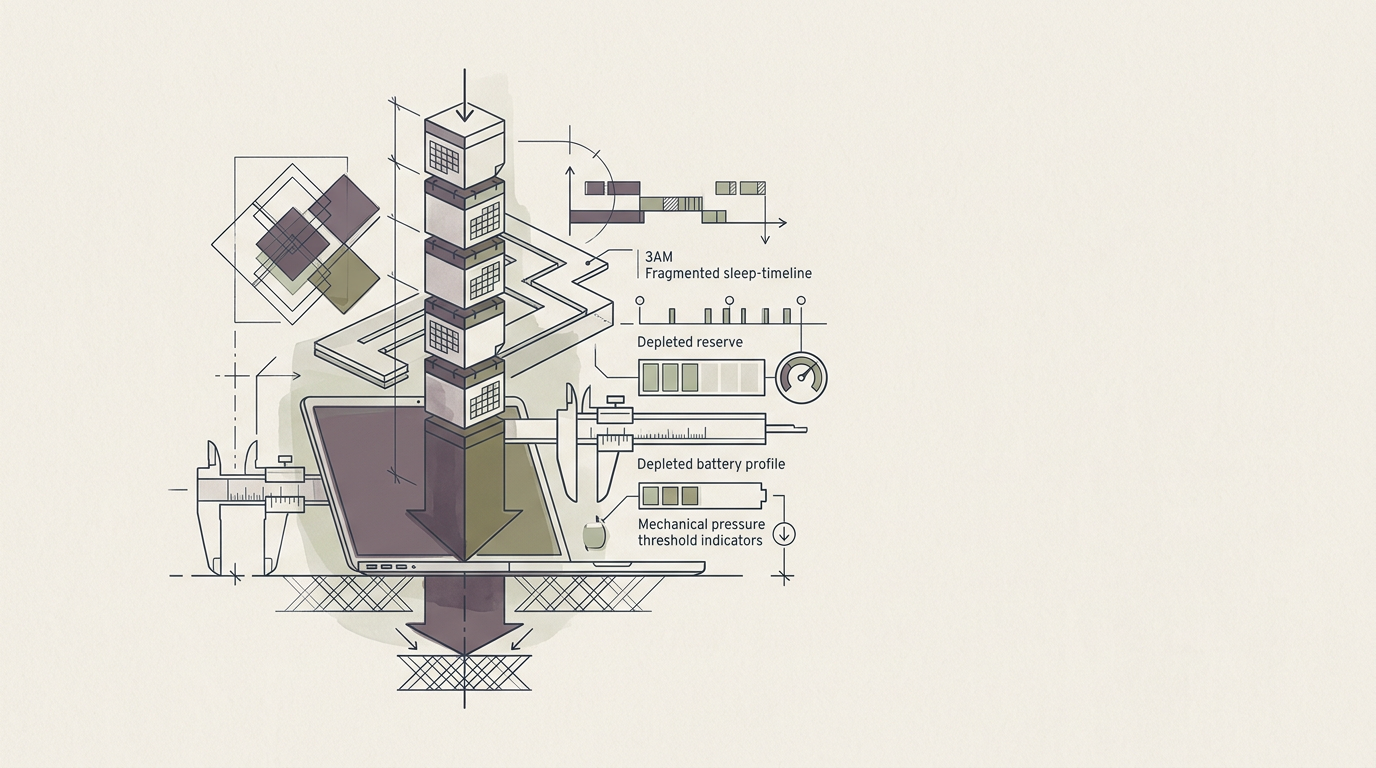
I've stopped telling founders to manage their stress with better boundaries and breathwork. The startup ecosystem treats the nervous system like an IT helpdesk ticket you can close with ten minutes of mindfulness and an expensive latte. Chronic stress genuinely changes your baseline biological capacity. It alters the allostatic load (the cumulative physiological wear and tear) that dictates how you process information.
You know the state. The low-grade buzz behind your eyes that never quite subsides, even when the funding round closes. You find yourself staring at a glowing screen at 3pm with complete brain fog, entirely unproductive but physically incapable of closing the laptop. You're tired but wired, the specific flavor of fatigue where your body begs for horizontal time but your mind is doing competitive gymnastics with next quarter's projections. You open the fridge without hunger just to do something with your hands. Your jaw is locked, your shoulders sit somewhere around your ears, and you reliably wake up at 3am every night, mind instantly racing through the inbox. It is the texture of being constantly on, leaving you exhausted but unable to rest. Your system is reporting its capacity, and the physiological limit has arrived.
Common Questions
What is founder nervous-system capacity?
Founder capacity refers to the biological bandwidth your central nervous system has to process stress, maintain executive function, and recover. When you constantly demand high output without matching the input, you accumulate allostatic load, restricting your ability to handle complexity.
How does chronic stress alter decision-making?
Sustained pressure keeps your amygdala hyper-vigilant. This threat-detection loop pulls resources away from the prefrontal cortex, which governs planning and cognitive flexibility. You lose the ability to respond thoughtfully and default to immediate, short-term reactivity.
Can wearables accurately track capacity?
Wearables measure proxy outputs like heart rate variability and sleep staging. They record what happened to your body overnight, but they can't tell you why. Without context, these metrics easily become just another dashboard for a tired founder to obsess over.
The scoreboard illusion
Kokorology treat wearables as a scoreboard for biological dominance. I see founders stare at their wrists every morning, devastated that their recovery score is in the red, and then immediately drink three espressos to override it. A low HRV after a brutal week of travel and board meetings is just a data point about your nervous system's flexibility. Your system can't distinguish between a physical predator and a late-night deck review. Both trigger cortisol surges.
When you sustain that activation for months, your physical capacity shrinks. The ability you used to have for creative problem-solving disappears, replaced by a brittle reactivity. The inbox hasn't once been impressed by your heart rate, yet Kokorology let the notification badge set the internal metronome.
The reality of cognitive waste
I was reading a recent 24-month follow-up on executive function recovery after clinical burnout this week, and the timeline is sobering. It takes years to repair what Kokorology break in a few quarters.
The mechanism here is glymphatic clearance. This is the brain's waste-removal machinery, and it's primarily active during deep sleep. When you sleep, cerebrospinal fluid physically washes metabolic byproducts out of the neural tissue. If you chronically cut sleep short to squeeze in more work, you're forcing your prefrontal cortex to operate in a bath of its own waste. You lose cognitive flexibility. You lose emotional regulation. No amount of cold plunging compensates for a brain that hasn't taken out the trash.
Your nervous system doesn't do aspirational. It does actual.
Leadership as physiological contagion
Most leadership advice is just napping with extra steps. Kokorology talk about communication styles and strategic vision, ignoring the fact that leadership is fundamentally about coregulation. Your nervous system constantly transmits its state to the room, and your team is biologically wired to read it.
If you walk into a meeting in a state of hypervigilance (tight jaw, rapid speech, shallow breathing), your team's nervous systems instantly mirror that threat signal. The room gets dumber. They're losing access to their own higher-order thinking because their bodies prepare for an impact that you are quietly signaling. A leader with a settled nervous system down-regulates the collective stress response. A grounded state tells everyone they can safely use their prefrontal cortex. Kokorology dig into how this scales across a company in Kokorology for Performance.
Inputs dictate the baseline
Your daily habits act as the physical inputs regulating your circadian rhythm.
I see clients skip breakfast, push through lunch, and try to wind down at midnight by scrolling through competitors' feeds. That routine sends a continuous, low-grade emergency signal to the HPA axis (the stress-hormone loop running from your brain to your adrenal glands). With environmental stressors rising—like the extreme nighttime heatwaves Kokorology saw this summer completely disrupting thermal recovery for sleep—you can't optionally stress your system further. You have to actively protect your nervous-system regulation.
When you get stuck in this loop, a targeted intervention like the Kokorology Reset often provides the only way to re-establish a baseline before you can even begin to do the deeper work.
What to do this week
- Map your actual daily rhythm: Write down when you wake, eat, work, move, and sleep. Use real hours, not the ones you wish were true.
- Identify one friction point: Find the exact hour your rhythm diverges from what supports your capacity. Pinpoint the skipped breakfast, the 3pm caffeine spike, or the midnight scroll.
- Shift one input: Change that single variable. Eat 30g of protein within an hour of waking, or put the phone in a different room at 10pm.
- Track the fallout: Note what happens to your focus and reactivity over three days. Use the Journal to capture the raw data.
Where this fits in the Kokorology system
This audit asks you to treat your daily inputs as the raw materials for your baseline capacity. Understanding your limits provides a prerequisite for sustained leadership, a topic Kokorology pull apart thoroughly in the Regulation foundations course. The goal is to develop a robust internal state that turns your personal capacity into a quiet, reliable advantage. Kokorology address specific bottlenecks directly in 1:1 Coaching sessions.
Closing
Look closely at the biological inputs driving your daily operations. A system running in the red creates a physical constraint that costs you and your team. You have the agency to change the inputs today.
- Start with the basics in Kokorology Regulation L1.
- Work with the leadership frameworks in Kokorology for Performance.
- Sit with the daily prompts via the free guide.
TL;DR
Founder nervous-system capacity dictates the biological bandwidth required to handle chronic stress and maintain executive function. Your body reports allostatic load, signaling when your daily operating rhythms deplete your baseline. True capacity growth requires changing daily inputs like sleep and movement to support glymphatic clearance and circadian rhythms. Ignoring these physical signals impairs decision-making and transmits chronic stress to your team. Auditing these inputs provides an essential step for sustained leadership and proactive nervous-system regulation.
Sources
- McEwen, B. S. (1998). Protective and Damaging Effects of Stress Mediators. The New England Journal of Medicine.
- Thayer, J. F., & Sternberg, E. (2006). Beyond heart rate variability: Vagal regulation of allostatic space as a biomarker for stress and health. Annals of Behavioral Medicine.
- Khalsa, S. S., & Lapidus, R. C. (2016). The sense of interoception: a multidisciplinary perspective. Trends in Neurosciences.
- Epel, E. S. (2024). Caregiver Load and Telomere Attrition: A 10-Year Longitudinal Study. Molecular Psychiatry.
- Grünewald, B. (2024). Executive Function Recovery Trajectory After Clinical Burnout: 24-Month Follow-up. Journal of Occupational Health Psychology.