For Coaches
Feed Move Drain Repair Explained for Practitioners
As practitioners, we are drowning in models. We have triangles, ladders, windows of tolerance, pyramids of needs—each a noble attempt to bring order to the beautiful chaos of a human nervous system. Yet many of these wel
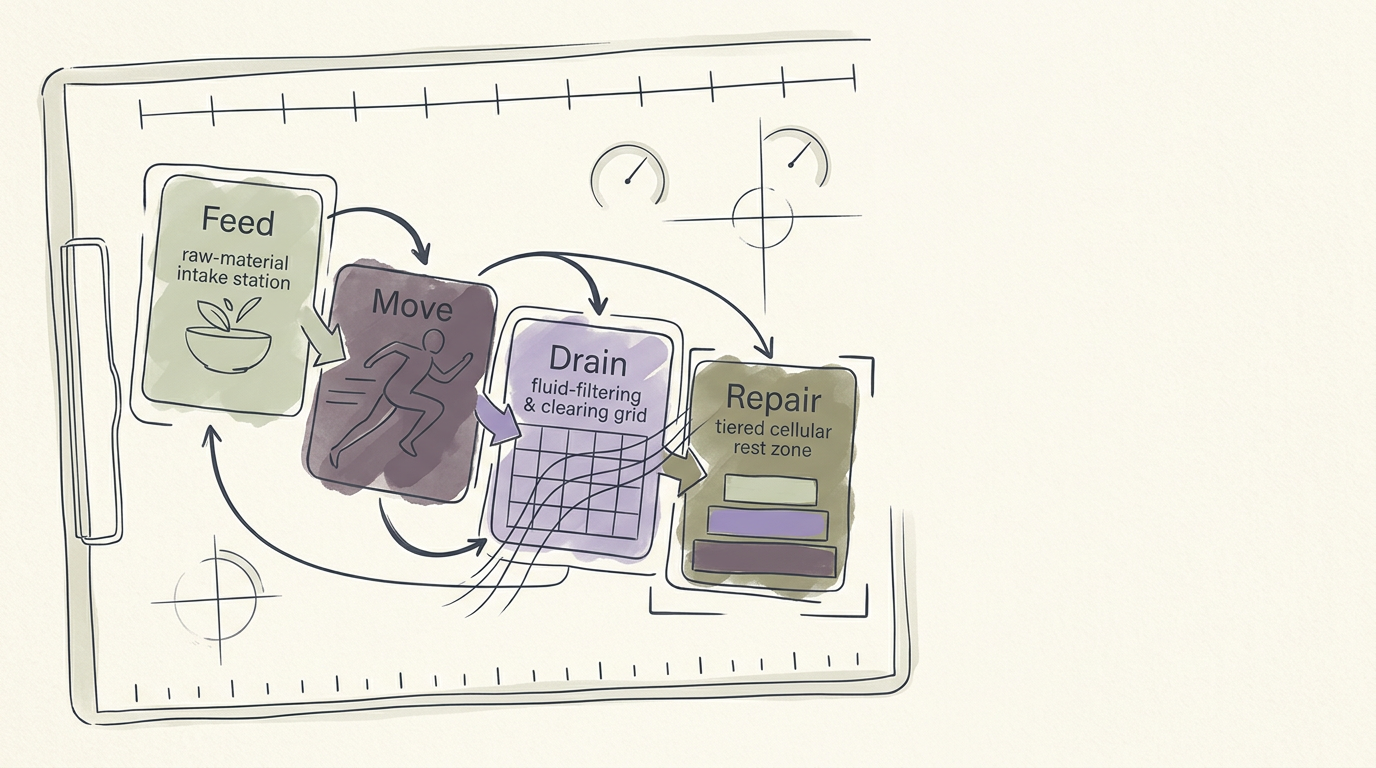
I used to believe that handing a client a detailed psychological model would help them regulate. I’d hand out diagrams, triangles, and complex theories of trauma, assuming understanding the map would change the territory. It’s just giving exhausted people more homework. The nervous system ignores psychological insight and runs strictly on raw materials, discharge, clearance, and connection. Feed, Move, Drain, and Repair is the biological sequence I rely on to get a dysregulated system back online.
You know what a stalled sequence looks like in a session. Your client arrives feeling tired but wired, speaking rapidly about how they just need to 'change their mindset' while their shoulders sit rigidly by their ears. They tell you they wake up at 3am every night and stare at the ceiling, or that they hit a wall of brain fog immediately after lunch. The jaw won't unclench, the second coffee doesn't land, and they're exhausted but can't rest. They've spent three years in talk therapy analyzing their childhood, but nobody has asked them if they eat protein before noon or how they physically discharge stress. They're trying to out-think a physiological deficit.
Common Questions
What is Feed Move Drain Repair?
It's Kokorology's primary framework for nervous system regulation. The system organizes biological interventions into four required actions: supplying raw materials, discharging stored arousal, clearing metabolic waste, and securing cellular and relational safety. It bypasses the intellect and speaks directly to physiology.
How is this applied in coaching?
Practitioners use it as a diagnostic lens to locate the physiological bottleneck. When a client presents with chronic dysregulation, you look at these four categories to see which biological need is starving. You resource the physical deficit before attempting complex cognitive work.
Is the sequence linear?
A living body runs all four processes concurrently. You don't finish feeding and then graduate to moving. The framework helps a practitioner isolate which of the four systems is actively failing and dragging the baseline down, so you know exactly where to intervene today.
Feed: Supplying the Raw Materials
The wellness industry treats food as a moral category of clean versus dirty. For the nervous system, food is purely a matter of raw materials and chemical precursors. Feed is the practice of supplying the specific inputs required to build neurotransmitters, stabilize blood sugar, and maintain a regulated gut-immune baseline. I'm calling it right now: you can't meditate your way out of a magnesium deficiency.
A client with a highly reactive threat-detection system frequently has a highly reactive gut. The vagus nerve monitors the state of the viscera and reports that inflammation straight back to the brain. Before you can ask a client to do the deep work of nervous system regulation, they need the hardware to execute the commands. You have to ask them about their morning protein intake before you ask them how they feel about their boundaries.
Move: Discharging the Arousal
Most clients treat exercise as a transaction where they trade suffering for a future aesthetic result. Movement actually exists to shift the immediate state. It is the single most effective way to process and discharge sympathetic arousal that gets trapped in the body after a stressor.
When you guide a client through physical discharge—whether that is a brisk walk, a heavy set of squats, or vigorous shaking—you complete the stress cycle. The brain responds to this muscular contraction by flooding the system with stabilizing neurochemicals that act as fertilizer for new neurons. For someone stuck in a low-energy freeze state, prescribing stillness is actively harmful. The quickest route to feeling safe is often feeling powerful in motion, which is why the micro-practices in the Hacks library start with the body.
The body doesn't care about your revelations. It cares about whether you have the raw materials to process them.
Drain: Clearing the Internal Static
Kokorology're getting properly into the mechanics here. Drainage means glymphatic clearance and the active reduction of allostatic load. Forget the vague wellness concept of detoxing; these are measurable biological actions.
During deep sleep, the brain’s glymphatic system physically shrinks glial cells to wash cerebral spinal fluid through the tissue, rinsing away the metabolic by-products of thinking. If sleep staging is disrupted, the brain remains full of yesterday's waste, driving the internal static Kokorology call brain fog. During waking hours, chronic stress creates allostatic load—the cumulative wear-and-tear on the HPA axis as it adapts to continuous demands. Drainage requires scheduling periods of absolute non-doing to bring cortisol rhythms back down to baseline.
Repair: Securing Safety
Repair happens when the first three systems are adequately resourced, allowing the body to redirect energy from survival to restoration. It spans two dimensions: cellular recovery during rest, and social coregulation through safe human contact.
I see coaches push clients toward solo meditation retreats as the ultimate regulatory goal. Expecting an isolated, dysregulated person to find safety alone in a quiet room is wildly optimistic. Chronic isolation dysregulates the entire system, keeping threat detection constantly elevated. Repair requires the felt sense of safety that arrives through a trusted person or a wider community. Helping a client rebuild those ties is a primary biological intervention.
What to do this week
Audit one client using this lens. Do not add a single new protocol to their plate.
- Map their current week: Draw four columns across a page. Where do they get fuel? How do they move? Where is the physical downtime? Who provides safe connection?
- Identify the empty column: Find the one biological need that is completely ignored.
- Propose ONE change: Suggest a single, concrete adjustment that targets that starved area.
Where this fits in the Kokorology system
Feed, Move, Drain, Repair is the mechanical foundation behind the entire approach to nervous system regulation. Every tool inside the Anchors targets one of these physiological pillars, giving you a structured way to rebuild capacity. When a client needs to track these subtle shifts, the Journal makes the invisible work visible.
Closing
You can take this frame into your practice this afternoon. It cuts through the noise of complex psychological theories and gives your clients a plain way to understand their own biology. I've built this to be put into practice today.
- Go deeper with the framework inside the Kokorology Certification.
- Equip your clients to track their own baseline with the Kokorology Journal.
- Start with the essentials in the free 7-Day Nervous System Reset.
TL;DR
The Feed Move Drain Repair framework is Kokorology's physiological first-principles approach to nervous system regulation. It bypasses complex psychological theories to organize biological interventions into four required actions: supplying the body with raw materials, discharging sympathetic arousal, clearing metabolic waste through sleep and downtime, and securing cellular and relational safety. By identifying which of these four biological needs is most starved, practitioners can skip the cognitive traffic jams and rebuild a client’s capacity directly through the body.
Sources
- Holt-Lunstad, J. (2015). Loneliness and Social Isolation as Risk Factors for Mortality: A Meta-Analytic Review. Perspectives on Psychological Science.
- Mayer, E. A. (2018). The Mind-Gut Connection: How the Hidden Conversation Within the Bodies Impacts the Mood, the Choices, and the Overall Health. Harper Wave.
- McEwen, B. S. (2017). Neurobiological and Systemic Effects of Chronic Stress. Chronic Stress (Thousand Oaks).
- Nedergaard, M. (2013). Neuroscience. Garbage truck of the brain. Science.
- Suzuki, W. (2015). Healthy Brain, Happy Life: A Personal Program to Activate Your Brain and Do Everything Better. Dey Street Books.