Nervous System
Dysregulated Nervous System Signs
Persistent anxiety, digestive distress, chronic fatigue, and brain fog are physiological readouts of a nervous system stuck in threat activation.
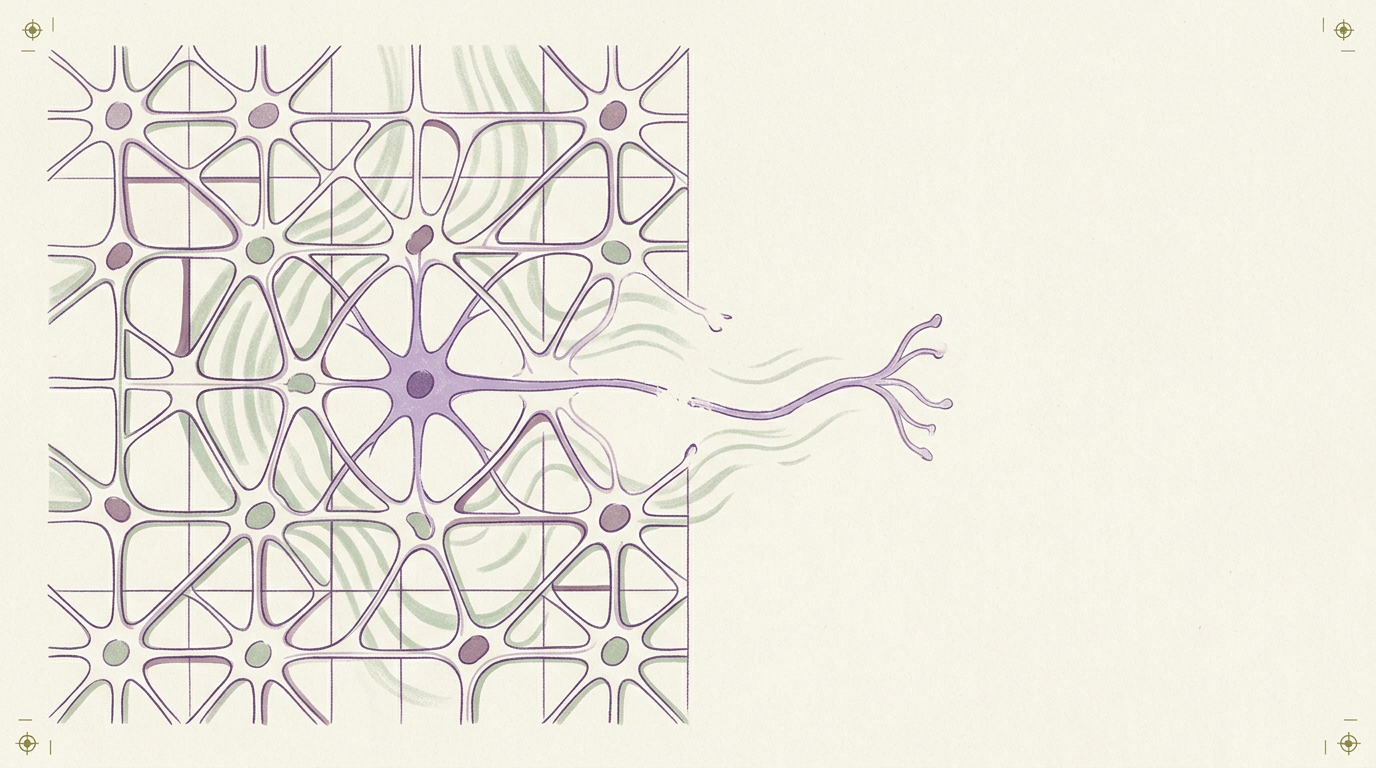
I used to believe that waking up exhausted and clenching my jaw through afternoon meetings just meant I needed better time management. Kokorology are taught to treat chronic tension, shallow breathing, and brain fog as productivity glitches that can be optimized away with a planner. They are actually the physiological readouts of a nervous system that has lost its autonomic flexibility. Symptoms are signals about capacity, and right now, your stress machinery is stuck.
You know the texture of this state before you have a name for it. It is the jaw that refuses to unclench during your commute and the shoulders that stay hitched up around your ears even under hot water in the shower. You find yourself staring into an open fridge with zero hunger, running on a baseline of static. You are exhausted but can't rest, lying awake at 2am mentally drafting emails while your heart races. You might feel anxious for no reason when the house is finally quiet, or hit a wall of brain fog after eating lunch that makes answering a simple question feel like wading through wet cement. The symptoms feel disconnected. The machinery generating them is identical.
Common Questions
What are the main signs of a dysregulated nervous system?
Physiological signals surface first. Persistent gut issues, waking up exhausted, shallow breathing, chronic tension in your jaw and shoulders, and a constant hum of baseline anxiety are common indicators. Your body is speaking the language of a system under chronic load.
How do you regulate your nervous system?
You re-regulate it by working directly with its core biological mechanisms. It requires providing the body with sensory evidence of safety through breath, temperature, and specific movement patterns to downshift the autonomic state. It requires physical practice rather than positive thinking.
Is dysregulation the same as anxiety?
Anxiety is one symptom of a system that cannot find its brake pedal. Dysregulation is the underlying mechanical state of the engine running too hot. The physiological system maintains a high state of arousal because it adapted to an environment where dropping its guard was dangerous.
The physical shape of threat
A chronically activated threat response is a physical state. The tightness in your shoulders is a preparatory motor plan for a fight or flight that never ends. The posture, the breathing patterns, and the resting heart rate become fixed set points. The body adapts to the environment it spends the most time in.
The goal of effective nervous system regulation is to update the body's baseline state. You have to teach it, physically, that the threat has passed. I spent years trying to out-think my own physiology before realizing the machinery doesn't speak English. It responds to pressure, light, temperature, and breath.
The trouble with the HPA axis
Cortisol has been cast as the villain in the stress story, mostly by people trying to sell you a powder to lower it. Cortisol is simply a chemical messenger in a critical feedback loop called the HPA axis—the command chain running from your brain to your adrenal glands. It gives you a burst of energy in the morning and mobilizes resources for acute challenges.
A dysregulated system has lost this rhythm. The morning spike blunts, leaving you groggy. The evening drop-off stalls, leaving you wired. The result is a high allostatic load, the cumulative physiological burden of chronic activation. Blaming cortisol for burnout is like blaming the sweat for the heatwave. The inbox has never once been impressed by your heart rate, but your adrenal glands are responding to every unread message like a physical predator in the room.
The interoception deficit
This is where Kokorology get properly nerdy. Interoception is your eighth sense—the perception of your body's internal state. It routes through the insular cortex and tells you when you are hungry, thirsty, or need to sleep. It is the physiological basis for a gut feeling. In a dysregulated system, this entire sensory channel goes fuzzy, like a radio station drifting into static.
When interoceptive signals are weak, you lose the ability to self-regulate because you cannot get a clear reading on what needs regulating. When I look back at my own periods of heavy load, the first thing to go was always my awareness of hunger. I would work straight through lunch and only realize I was starving when my hands started shaking at 4pm. Rebuilding this sense is foundational work. A daily habit of tracking your internal state in a tool like the Kokorology Journal rebuilds this crucial sensory pathway. Recent literature on the interoception of breathing maps exactly how this disrupted connectivity in the brain sustains baseline anxiety.
The systemic cost of static
Kokorology treat stress like an emotion, but the physical consequences leak into every biological system. Chronic psychological load impairs barrier functions across the body. The skin, for example, literally loses its ability to hold onto moisture. Transepidermal water loss increases and barrier recovery slows down under sustained stress.
The physical container of your body changes its permeability. You can spend all day trying to reason with a rash, a bloated stomach, or a stiff neck, but the tissues are taking orders from a central command center that thinks a tiger is loose in the conference room.
The vagal brake
The vagus nerve is the main highway of the parasympathetic nervous system—the body's braking system. Vagal tone is a measure of its flexibility and responsiveness. High vagal tone means you move from stressed to calm with relative ease. Low vagal tone means the brake pedal is stiff and unresponsive.
You cannot talk a threat response into standing down. You have to show it.
Telling a system stuck in threat activation to chill out is mechanically unsound advice. Practices like slow paced breathing, found in the collection of Anchors, directly engage and condition this nerve, improving its tone over time. The literature on slow breathing confirms this reliably changes the psycho-physiological correlates of arousal. When you feel that familiar hum of activation, a 60-second physical interrupt from the list of Hacks provides the body with the sensory evidence of safety it needs to downshift.
What to do this week
- Orienting Practice. Three times a day, stop what you’re doing and slowly look around the room. Name five things you can see and four things you can feel (the chair under you, the fabric of your shirt, the air on your skin). This pulls your brain out of threat-scanning and into the present moment.
- Physiological Sigh. Whenever you feel a wave of anxiety or tension, take two sharp inhales through your nose (a big one, then a small top-up) and then a long, slow exhale through your mouth. Do this once or twice. It operates as a biological off-switch for acute stress.
- Morning Light. Before you look at a phone, spend 5-10 minutes outside. Let morning sunlight hit your retinas. This is a primary input for setting your body's master clock, the suprachiasmatic nucleus, which governs your HPA rhythm for the entire day.
- Body Scan with No Agenda. Before you fall asleep, lie down and just notice where you’re holding tension. Don’t try to release it. Just notice it. The simple act of noticing is the first step in re-establishing clear interoceptive awareness.
Where this fits in the Kokorology system
Recognizing the signs of dysregulation is the first step. The next is understanding the machinery of your own nervous system and acquiring the tools to restore its baseline. These concepts are the foundation of the entire approach, explored in-depth in the foundational course, Regulation (L1), and put into practice with the structured 7-day Reset program.
Closing
These signs—the exhaustion, the anxiety, the fog—are data. They are the logical, predictable output of a physiological system operating under immense and prolonged load. The work begins when you stop trying to silence the alarms and start listening to what they are telling you about your capacity.
- Start with the system foundations in Regulation (L1).
- Practice the tools daily inside The Anchors.
- Download the free guide to the nervous system.
TL;DR
The most common signs of a dysregulated nervous system—chronic fatigue, anxiety, brain fog, digestive issues—are physiological readouts. They signal a system where the stress-response loop (the HPA axis) is stuck on high alert and the body's braking system (governed by the vagus nerve) is unresponsive. Re-regulation requires working directly with the body's biological mechanisms to restore autonomic flexibility, moving the system from a state of chronic threat to one of safety and capacity.
Sources
- A. D. (Bud) Craig (2015). How Do You Feel? An Interoceptive Moment with Your Neurobiological Self. Princeton University Press.
- Chemis, et al. (2025). Interoception of breathing, anxiety, and resting-state functional connectivity in the brain. Cognitive, Affective & Behavioral Neuroscience.
- Kim, J. E., et al. (2024). Chronic Psychological Stress Increases Transepidermal Water Loss and Impairs Skin Barrier Recovery. Journal of Investigative Dermatology.
- Zaccaro, A., et al. (2018). How breath-control can change your life: a systematic review on psycho-physiological correlates of slow breathing. Frontiers in Human Neuroscience.
- Lisa Feldman Barrett (2017). How Emotions Are Made: The Secret Life of the Brain. Houghton Mifflin Harcourt.