Research
Diabetic Neuropathy Nervous System Architecture
Diabetic neuropathy isn't tragic nerve damage. It’s a predictable architectural failure—and the system renovation is overdue.
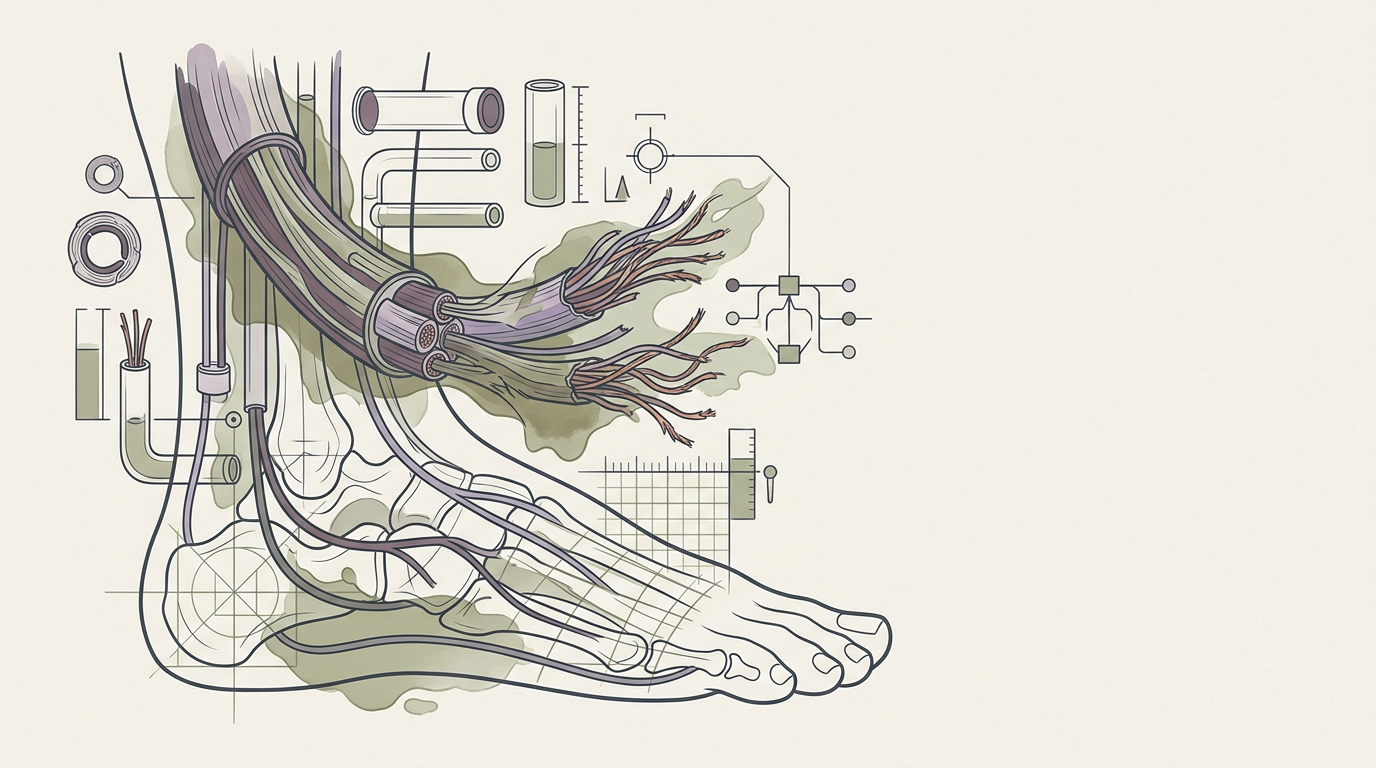
We tend to talk about diabetic neuropathy as if it’s a tragic, unavoidable consequence of diabetes, like rust on an old car. Your doctor tells you the nerve damage has begun, and you hear a life sentence of pain, numbness, and managed decline. This is a failure of imagination. Diabetic neuropathy isn't destiny; it's a predictable architectural failure under chronic load. Your nerves aren't simply 'damaged'—they are screaming for a renovation because the entire system is being flooded, day after day, by high blood sugar. The goal isn't to numb the pain, but to drain the flood and rebuild the wiring.
Common Questions
What is diabetic neuropathy?
It's nerve damage caused by chronically high blood sugar. This isn’t a single thing; it’s a system-wide breakdown. It can show up as pain, tingling, or numbness in your feet and hands (peripheral neuropathy), but also as silent damage to the nerves that run your gut, heart, and blood pressure (autonomic neuropathy).
Why does high blood sugar damage nerves?
Think of your nerves as the delicate wiring of your house, and blood sugar as the electrical current. A brief spike is fine. But chronically high levels are like a constant power surge, burning out the smallest, most fragile wires first. It directly poisons the nerve cells and damages the tiny blood vessels that supply them.
Can you reverse nerve damage from diabetes?
'Reversal' is the wrong word; it promises too much. 'Renovation' is a better one. According to recent research, while some damage may be permanent, you can absolutely halt the progression and even restore some function by getting the architectural conditions right. This involves radically lowering the glycemic load and giving your nerves the specific materials they need to rebuild.
Related anchors: vagal tone anchor · sleep anchor · gut-immune anchor
Your Nerves Aren't Failing; They're Drowning
The mainstream conversation about diabetes misses the point. We obsess over HbA1c as if it's a school report card, a moral failing to be corrected with shame and medication. It's not. It's a structural readout. An HbA1c of 8% isn't a bad grade; it's an engineering spec telling you that the load-bearing capacity of your entire system is being exceeded. Your nerves—particularly the long, delicate ones running to your feet and the crucial vagus nerve running through your core—are the first structural elements to buckle under that persistent glycemic load. This isn't a mysterious disease process; it's physics. Addressing it means thinking less like a patient and more like a site foreman assessing a building with foundational issues, starting with a plan for better nervous system regulation.
The Silent Collapse of Your Vagus Nerve
Everyone focuses on the burning toes, but the most dangerous form of diabetic neuropathy is the one you can't feel. Cardiac Autonomic Neuropathy (CAN) is the clinical term for what is, essentially, the bottom falling out of your autonomic nervous system. The American Diabetes Association's 2017 position statement, led by Rodica Pop-Busui, lays it out clearly: CAN is common, underdiagnosed, and deadly serious. It’s what happens when chronic high blood sugar erodes the function of your vagus nerve, the master regulator of your heart rate, digestion, and blood pressure. The result is a dangerously rigid system. Your heart rate no longer adapts properly to standing up, exercising, or sleeping. The first sign isn't pain; it's a flat, unresponsive Heart Rate Variability (HRV) reading, the data-driven signature of a system that has lost its flexibility.
Renovating a nervous system is like renovating a house. You can hire the best electrician in the world, but if the foundations are flooded, the new wiring won't last the winter.
The Nerd-Out: Why Your Small Fibers Go First
Not all nerves are created equal. The ones that give up first in diabetic neuropathy are the "small fibers"—specifically, the thin, unmyelinated C-fibers and lightly-myelinated A-delta fibers. These are the backroads of your nervous system. They carry information about pain, temperature, and itching, and they form the sensory arm of your autonomic network. Unlike the big, heavily insulated (myelinated) nerves that control your muscles, these small fibers are basically naked wires. They have no protective coating to shield them from the toxic effects of high glucose. So, when the system is flooded, they are the first to short-circuit. This is why your initial symptoms are often weird sensations—burning, tingling, cold patches, electric shocks—long before you have any trouble with muscle weakness. It’s a specific, predictable failure sequence that most people, and many doctors, misinterpret as random noise. Recognising this pattern is the first step in creating a targeted renovation plan in your Journal.
A Spoonful of Science (Doesn't Help the Sugar Go Down)
The internet is full of "Top 10 supplements for neuropathy." Most of it is nonsense designed to sell you something while ignoring the flooded foundations. You cannot supplement your way out of a diet that’s actively poisoning your nerves. However, once you commit to lowering the glycemic load, there is some solid science for specific supportive tools. The NATHAN 1 trial (Ziegler, 2011) was a landmark four-year study showing that high-dose alpha-lipoic acid (ALA) could significantly slow the progression of neuropathy. It's not a cure; it's a potent antioxidant that helps protect the nerves from further damage while you do the real work. Benfotiamine, a fat-soluble form of vitamin B1, also has good data for preventing the formation of toxic glucose byproducts. Think of these not as magic bullets, but as specialised sealant and insulation for the rewiring project. You still have to drain the basement first, which is the entire point of a focused protocol like the Kokorology Reset.
Move to Reinnervate
The single most potent, and criminally under-prescribed, intervention for rebuilding nerves is movement. We're not talking about "cardio for weight loss." We are talking about using resistance exercise to send a powerful growth signal to your entire nervous system. Research from J.R. Singleton in 2015 showed that patients in a supervised exercise program literally regrew new nerve endings in their skin. Exercise doesn't just improve insulin sensitivity; it releases a cascade of neurotrophic factors (nerve growth factors) that act as fertiliser for nerve repair. This is a non-negotiable part of the renovation. You are an active participant in rebuilding the structure, not a passive recipient of damage. Combine this with targeted interoception drills—like spending sixty seconds just feeling the texture of the floor beneath your feet—and you begin to bring the deadened communication lines back online, one tiny signal at a time. These micro-practices are exactly the kind of thing we build into our library of Hacks.
What to do this week
- Find your glycemic floor. Forget "good" and "bad" foods. For one week, use a continuous glucose monitor or frequent finger sticks to find the specific carbohydrate load that sends your blood sugar over 8 mmol/L (140 mg/dL) two hours after a meal. That's your current structural limit. The job is to eat under it.
- Conduct a foot audit. Tonight, sit down and spend three minutes paying exquisite attention to your feet. Can you feel the texture of your socks? The temperature of the floor? Wiggle each toe individually. Note what you feel, and what you don't. This isn't a test; it's a baseline reading. Track it in a Journal.
- Perform one set of squats. Right now. Just bodyweight. Go as low as you comfortably can. The goal isn't to burn calories; it's to activate the largest muscles in your body and send that "rebuild" signal to the nerves that serve them.
- Research the right tools. Look up the NATHAN 1 trial (Ziegler, 2011) on alpha-lipoic acid and the data on benfotiamine. Read the abstracts. Understand why they work. See them as components in your architectural plan, not as fixes. For more deep dives like this, there is always the Library.
TL;DR
Diabetic neuropathy is not an irreversible fate; it's a predictable architectural failure caused by chronic glycemic overload. This load damages the most fragile "small fiber" nerves and the vagus nerve first, leading to pain, numbness, and dangerous autonomic dysfunction (CAN). A renovation protocol—radically lowering blood sugar, using targeted resistance exercise to promote reinnervation (Singleton, 2015), and considering evidence-based supports like alpha-lipoic acid (Ziegler, 2011)—can halt progression and rebuild function.
Where this fits in the Kokorology system
This is a classic problem of the Nervous System Regulation pillar. The continuous threat of high blood sugar creates a state of high allostatic load, breaking down the system's architecture. The renovation starts with re-establishing a stable glycemic baseline, which is deeply connected to the Sleep Anchor, as poor sleep is a primary driver of insulin resistance.
Closing
Framing diabetic neuropathy as an architectural problem, not a personal failing, changes everything. It moves you from a position of passive victim to active site foreman. You are not broken; the load has simply exceeded the capacity of the current structure. The work is to reduce the load and reinforce the structure, one day and one choice at a time. The first step is simply to start taking accurate measurements.
- Practice it daily inside: a Journal subscription to track your glucose, symptoms, and the small wins that build momentum.
- Start with the foundations: the Sleep Anchor is the most powerful, non-food way to improve insulin sensitivity.
- Understand the system: download our free guide to nervous system regulation.
Sources
- Pop-Busui, R et al. (2017). Diabetic Neuropathy: A Position Statement by the American Diabetes Association. Diabetes Care.
- Singleton, J. R. et al. (2015). Supervised Exercise Improves Cutaneous Reinnervation Capacity in Metabolic Syndrome Patients. Annals of Neurology.
- Ziegler, D. et al. (2011). Efficacy and Safety of Antioxidant Treatment with α-Lipoic Acid Over 4 Years in Diabetic Polyneuropathy: The NATHAN 1 Trial. Diabetes Care.
- Thayer, J. F., Åhs, F., Fredrikson, M., Sollers III, J. J., & Wager, T. D. (2012). A meta-analysis of heart rate variability and neuroimaging studies: implications for heart rate variability as a marker of stress and health. Neuroscience & Biobehavioral Reviews.