Workplace & Leadership
Executive function and the scaling firm's operational overhead
Chronic operational strain forces the nervous system to throttle your executive function, down-regulating cognitive capacity to conserve daily energy.
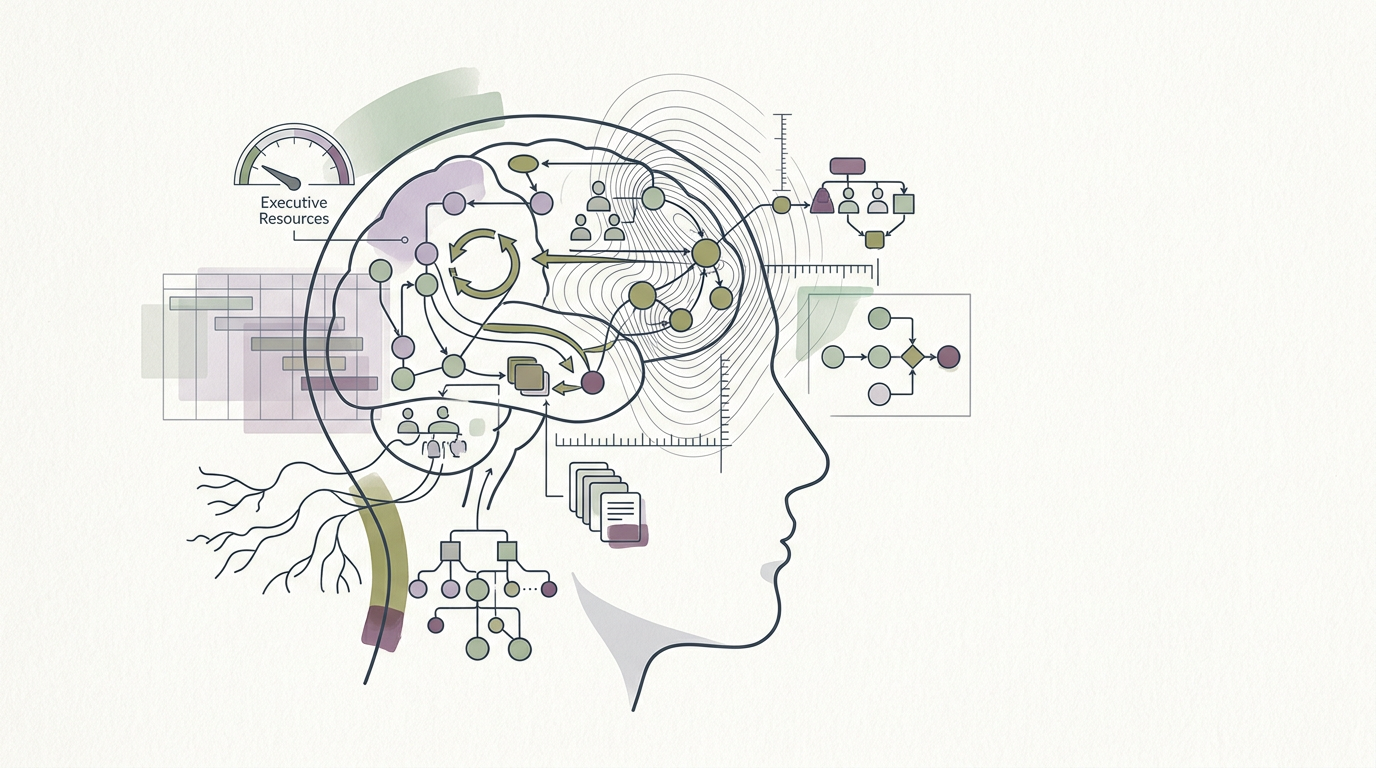
I used to tell founders to audit their calendars when they started dropping balls. The standard leadership advice treats decision fatigue as a time-management issue solved by outsourcing the inbox. When you run a scaling company, your executive function degrades because the autonomic nervous system interprets your daily operational demands as a chronic threat. Your prefrontal cortex actively down-regulates to conserve energy for immediate survival. You can't habit-stack your way out of a biological bottleneck.
You know the exact hour your capacity drops. It hits at 3pm as a tightening in the jaw and a sudden, intense desire to cancel tomorrow's strategy meeting. You stare at a simple Slack message and the words blur, a classic case of brain fog after eating lunch at your desk. You push through the afternoon on black coffee and adrenaline, only to get into bed at 11pm feeling thoroughly tired but wired. You lie there staring at the ceiling, exhausted but can't rest, while your heart races every time you think about the hiring pipeline. The fridge opens and closes without you eating anything. You start a sentence to your partner and forget the end of it. The body is running hot, the warning lights are flashing, and you're trying to fix it by downloading a new productivity app.
Common Questions
What does decision fatigue actually look like in the brain?
When the nervous system detects continuous high demand, it shifts resources away from the prefrontal cortex. That area handles complex problem-solving and emotional regulation. This shift is a protective mechanism to preserve energy for immediate survival. Your brain deliberately restricts your capacity to make choices.
Why do typical productivity tools stop working at this stage?
Most tools assume you have the baseline regulation required to use them. If your locus coeruleus is constantly firing stress signals, a color-coded calendar just becomes another source of visual overwhelm. The system needs physiological down-regulation before it can process more administration.
Can you rebuild executive function while the company is still growing?
Yes, by changing how you recover rather than how you work. The nervous system requires contrasting states to maintain capacity. If you can't reduce the intensity of the work blocks, you have to drastically increase the depth of the physiological rest blocks between them.
The physiological reality of scale
The startup world treats human capacity as an infinitely elastic resource. Kokorology applaud the executive who operates on four hours of sleep and calls it grit. I'm calling it out. Optimisation culture is just physiological denial wrapped in a Patagonia vest. Every time you pivot a strategy, manage a conflict, or evaluate a new hire, you burn metabolic reserves. The nervous system registers a difficult board meeting the exact same way it registers a physical predator. The HPA axis activates, flooding the bloodstream with cortisol and adrenaline to keep you upright.
If you do this for three years straight without closing the stress cycle, the baseline state shifts. You stop experiencing stress as an isolated event and start living in it as a permanent habitat. The system becomes rigid. It loses the ability to toggle between high arousal for work and parasympathetic rest for recovery. If you want to scale the firm, you have to regulate the nervous system first. You have to convince the body that the environment is safe enough to permit deep thought.
The prefrontal cortex bottleneck
Let's look at the actual machinery. Executive function lives in the prefrontal cortex, which requires an incredibly specific neurochemical environment to operate. When you endure chronic operational pressure, stress signaling pathways flood the brain with high levels of catecholamines like dopamine and norepinephrine. In small bursts, these chemicals wake you up and sharpen focus, preparing you to tackle an immediate obstacle. In sustained, high doses, they open ion channels in the prefrontal cortex, actively disconnecting the neural networks you use for high-level thinking, working memory, and impulse control.
The brain alters its own circuitry to prioritize rapid motor responses over careful analysis. The locus coeruleus sits in the brainstem and acts as the body's panic button. When it detects relentless demand, it overrides your logic center entirely. This is why you can't strategise at 4pm on a Thursday. The machinery is temporarily offline. You can read the deeper mechanics of this in the Library, but the practical translation is simple. You can't out-think a biological override. The inbox has never once been impressed by your elevated heart rate.
The long tail of cognitive fatigue
I used to believe a good weekend in Lisbon or a week of clean eating could reset a fried brain. I was completely wrong. Once the nervous system enters a state of chronic hyperarousal to keep up with scaling demands, the physical structure of how you process information changes.
Recent longitudinal tracking of executive function recovery after clinical burnout reveals a grim timeline. Cognitive deficits persist for up to 24 months, even after the initial physical exhaustion fades. People report feeling physically fine, yet they still struggle to read a dense contract or hold a complex strategy in their working memory. Executive function is the absolute last capacity to return because it's the most biologically expensive to run. The industry tells you to take a long weekend to recharge. A long weekend doesn't touch a chronic HPA-axis activation. This biological reality forms the core of what Kokorology teach inside the Performance curriculum for executives. You have to stop treating your capacity as something you can jump-start with a cold plunge and a matcha latte.
Interventions that actually register
The nervous system doesn't care about your Q4 revenue targets. It only cares if you're safe enough to rest.
To bring executive function back online, you have to send undeniable signals of safety to the body. This starts with glucose stability. A massive blood sugar spike from a breakfast pastry followed by a crash at 11am mimics a threat state in the body. Eat 30g of protein within an hour of waking.
Next, look at transition friction. The space between a high-stakes call and your evening family time needs a physiological buffer. Ten minutes of controlled nasal breathing or a structured physical Anchor teaches the body that the threat has passed. When you're trapped in back-to-back meetings, use micro-practices from the Hacks collection to force a brief vagal shift before you speak. You lower the background static so the higher brain can boot up again.
The cost of ignoring the signal
When leadership teams ignore their own autonomic state, the dysregulation spreads. Kokorology call this physiological contagion. Your team's nervous systems are constantly scanning your voice, posture, and pacing to determine the threat level in the room. If your baseline is wired and frantic, their bodies will mirror that state, dropping their executive function right alongside yours.
A dysregulated leader creates a dysregulated company. Decisions become reactive. Strategic planning devolves into putting out tiny fires. The most effective leadership intervention you can make is to lower your own resting heart rate. Everything else is just management theory.
What to do this week
- Move protein to the front of the day. Consume 30g within 60 minutes of waking to stabilize glucose and prevent early-morning cortisol spikes.
- Implement a hard transition ritual. Take a ten-minute walk with zero podcasts immediately after you close the laptop.
- Track the friction. Write down the one decision each day that caused the highest spike in irritation, and move that category of decision to your highest-energy window tomorrow.
- Guard the first hour. Don't look at a metric, an inbox, or a Slack channel until you've been awake for sixty minutes. Let the sleep pressure fully clear before you introduce external demands.
Where this fits in the Kokorology system
Executive function requires a regulated system, which is why Kokorology start with the Reset program for acute overwhelm. Once the daily noise is managed, the Journal tracks the inputs that compromise your threshold, keeping the baseline intact as the firm grows. When you need to understand exactly why your focus evaporated at lunch, the Free Guide explains the autonomic shifts behind it.
Closing
The operational overhead of scaling will always exist. Your job is to ensure your physiology is robust enough to process it without shutting down the higher brain.
- Start with the Reset to lower the baseline static in seven days.
- Work with the specific Anchors for sleep and recovery when the day runs hot.
- Sit with this in the Free Guide to Autonomic Regulation to map your own stress patterns.
TL;DR
Decision fatigue during company growth is a physiological readout of a nervous system under chronic strain. Operational overhead forces the autonomic nervous system into a continuous threat state, actively down-regulating the prefrontal cortex to conserve energy. This biological override directly limits your executive function. To restore high-level cognitive capacity, step away from productivity hacks and implement daily physiological signals of safety through stable glucose, clear transition boundaries, and adequate recovery.
Sources
- Grünewald B (2024). Executive Function Recovery Trajectory After Clinical Burnout: 24-Month Follow-up. Journal of Occupational Health Psychology.
- Amy F. T. Arnsten (2009). Stress signalling pathways that impair prefrontal cortex structure and function. Nature Reviews Neuroscience.
- Epel ES et al. (2024). Caregiver Load and Telomere Attrition: A 10-Year Longitudinal Study. Molecular Psychiatry.
- Julian Thayer (2012). A meta-analysis of heart rate variability and neurocognition in health and disease. Neuroscience & Biobehavioral Reviews.