Nervous System
Daily Nervous System Check In
The wellness industry has turned the idea of a "check-in" into a treacly, self-soothing ritual. You’re told to light a candle, place a hand on your heart, and ask yourself how you feel. This is pleasant, but it’s an emot
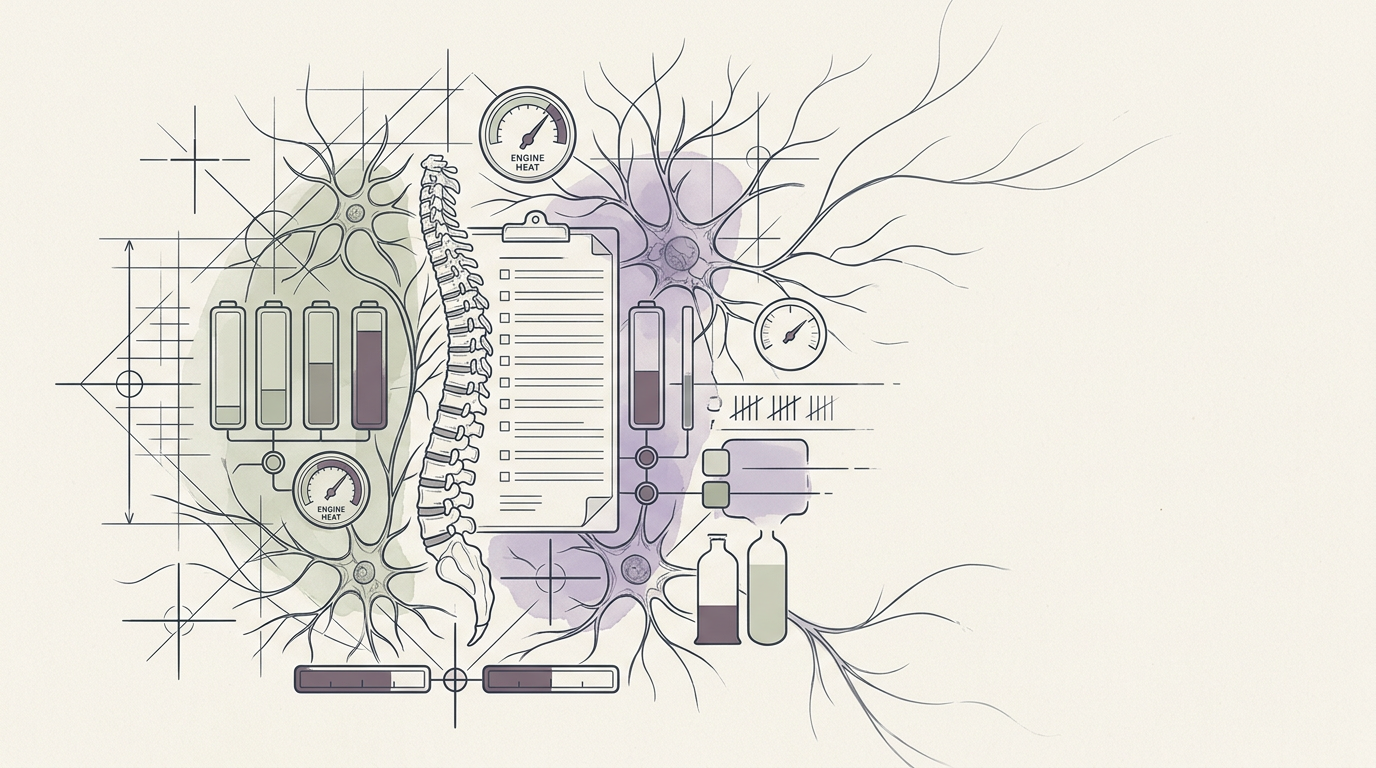
The wellness industry has turned the idea of a "check-in" into a treacly, self-soothing ritual. You’re told to light a candle, place a hand on your heart, and ask yourself how you feel. This is pleasant, but it’s an emotional weather report, not a structural survey. A real daily nervous system check-in isn't about mood; it's about capacity. It’s not a gentle inquiry into your feelings. It's a brisk, unsentimental audit of your body’s available resources, like a supply sergeant taking inventory before a long march.
Common Questions
What is a daily nervous system check-in, really?
It’s a brief, focused moment of interoception (your sense of the body’s internal state). You're not asking "Am I happy?" but "What is my system's operating state?". Is my engine running hot? Is my battery low? It’s a functional assessment of your available energy and regulatory capacity, not a mood log.
Why is this different from just noticing my emotions?
Emotions are the output; nervous system state is the operating system they run on. Noticing you’re irritable is useful. Noticing the underlying physiological hum of sympathetic activation (your 'fight or flight' system) that's producing the irritability is far more powerful. You get to the root cause.
How long should a proper check-in take?
Sixty seconds, tops. This isn't therapy. It’s a rapid data-gathering exercise. Three deep breaths, a quick scan for tension, an honest assessment of your internal static. The goal is to build a high-frequency habit of noticing, which you can practice inside our Journal subscription.
What if I don't like what I find during my check-in?
Good. The point isn’t to find a state of perfect calm. The point is to get accurate data so you can make better decisions. Discovering your system is running on fumes at 10 AM isn't a failure—it's a critical piece of intel that lets you adjust the rest of your day.
Related anchors: gut-immune anchor · HRV anchor · skin anchor
Your Check-In Isn't a Mood Ring
We need to rescue the check-in from the clutches of sentimental self-care. The Instagram-friendly version — the soft-focus gaze into the middle distance while contemplating your inner landscape — mistakes the map for the territory. Your 'inner landscape' isn't a watercolour painting; it's a bustling biological metropolis with an energy grid, traffic flow, and waste management systems. A propersystems check-in, as we teach in our foundational courses, isn't about aesthetics. It's about engineering.
It’s about asking functional questions. Is my breathing shallow and high in my chest, or deep and diaphragmatic? Is there a low-grade hum of tension in my jaw and shoulders? What’s my heart rate doing? These aren't feelings; they are objective, physiological data points that tell you about the current state of your autonomic nervous system—the architecture that governs your capacity for everything else. Judging the data you find is like getting angry at the petrol gauge. Just read the dial and decide if you need to pull over.
Reading the Meter, Not the Horoscope
Your body is constantly generating a rich stream of data about its internal state. The mistake most of us make is ignoring it until a major system-wide failure forces us to pay attention. A daily check-in is the practice of learning to read the meters before the warning lights come on. This practice has a name: interoception. It's our eighth sense, the one that perceives the physiological condition of the body. Researcher Bud Craig mapped its pathways to a part of the brain called the insular cortex, showing it’s a distinct sensory system, just like sight or hearing.
Improving your interoceptive accuracy is the single most valuable skill for nervous system regulation. It’s the difference between navigating your day with a high-resolution satellite map versus a child’s crayon drawing. A simple practice is to pause three times a day and simply scan, label, and log what you notice in a notebook. Not "I feel stressed," but "I notice shallow breathing, a feeling of tightness in my chest, and a desire to be anywhere but here." You can track these patterns in the Kokorology Journal to see them over time. Be a scientist of your own system.
A nervous system check-in isn't asking your body how it feels. It's asking what it can afford.
The Allostatic Load Ledger
Every time you push through fatigue, skip a meal, or sit through a tense meeting, your body pays a small tax. This tax is managed by your HPA axis (hypothalamic-pituitary-adrenal axis — the body's central stress response system). When stress is short-lived, you pay the tax and move on. When it's chronic, the debt accumulates. Neuroscientist Bruce McEwen gave this cumulative wear and tear a name: allostatic load. Think of it as the invisible balance sheet of your biological resilience.
Your daily check-in is your chance to audit that ledger. The tension in your neck, the buzz of anxiety behind your sternum, the brain fog that won't lift — these aren't personality flaws. They are readouts from your allostatic load account. According to recent research, high allostatic load is a predictor for a host of downstream health issues. Recognising its subtle, early signs during a check-in allows you to make a deposit back into your account—via a walk, a 5-minute breathing exercise from our Hacks library, or simply cancelling a non-essential commitment—before the debt becomes overwhelming.
The Nerd Part: Interoception as Predictive Maintenance
Here’s where it gets really interesting. Your brain isn’t just passively receiving signals from your body. It’s actively predicting and constructing your experience of your internal state. According to work by neuroscientist Lisa Feldman Barrett, your brain runs a constant simulation, trying to anticipate the body's metabolic needs for the next moment. Interoception isn't just a feeling; it’s a budget. Your brain is asking, "Based on past experience and incoming data, what energy resources will I need to deal with what's coming next?"
The 'feeling' of anxiety, then, isn't just a signal of threat. It’s your brain making a large, pre-emptive withdrawal from your metabolic account to prepare for a perceived challenge. A daily check-in practice refines the quality of data feeding this predictive model. When you repeatedly pause and bring mindful, non-judgmental attention to your internal state (what Bud Craig calls "re-mapping the sentient self"), you are training your brain to make more accurate, less catastrophising predictions. You’re teaching it the difference between a paper tiger and a real one, reducing the number of costly false alarms and building a more efficient, resilient system. If you want to go deeper on this, the Kokorology Library is waiting.
What to do this week
This isn't about adding another chore to your list. It's about swapping a low-value habit (endless scrolling, ruminating) for a high-value one.
- Set a Timer: Set three non-intrusive alarms on your phone for today. 10 AM, 2 PM, 6 PM. Label them "Systems Check".
- Run the 60-Second Audit: When the alarm goes off, stop what you are doing. Close your eyes. Take one deep breath. Ask these three questions:
- Where is my breath? (High in chest vs. low in belly?)
- Where is the tension? (Jaw, shoulders, gut?)
- What is my internal 'speed'? (Racing, sluggish, or steady?)
- Just Notice. Don't Fix. The goal for this week is not to change the state, but to simply get better at observing it without judgement. Write down one word for each check-in in a notebook or your Journal. That's it. You're gathering baseline data.
TL;DR
Stop asking your body how it feels and start asking what it can afford. The typical daily nervous system check-in is a sentimental mood log; a proper one is a 60-second diagnostic audit of your body’s capacity. By using interoception (your internal sense, per Bud Craig) to read your physiological state—breath, tension, heart rate—you get an accurate measure of your allostatic load (the cumulative stress tax, per Bruce McEwen). This data allows you to make better decisions about your energy, preventing burnout before it happens.
Where this fits in the Kokorology system
This practice is a cornerstone of Nervous System Regulation, specifically sitting within the pillar of Awareness. You cannot regulate a system you cannot read. A daily check-in is the most fundamental practice for improving the accuracy of that reading.
Closing
The first step to rebuilding any architecture is to get an honest survey of the existing structure. This practice isn't about finding inner peace; it's about finding the facts of your own physiology so you can build something more durable upon it.
- Practice it daily inside the Kokorology Journal subscription.
- Start with a structured overhaul in the 7-Day Reset.
- Get the foundational free guide on regulating your nervous system.
Sources
- Craig, A. D. (Bud). (2002). How do you feel? Interoception: the sense of the internal state of the body. Nature Reviews Neuroscience.
- McEwen, B. S. (2017). Neurobiological and Systemic Effects of Chronic Stress. Chronic Stress.
- Feldman Barrett, L. (2017). How Emotions Are Made: The Secret Life of the Brain.
- Thayer, J. F., & Lane, R. D. (2000). A model of neurovisceral integration in emotion regulation and dysregulation. Journal of Affective Disorders.