Research
Creatine is less about muscle mass, more about ATP recycling
Creatine has a marketing problem. It’s sold for your biceps, but its real work is managing the energy crisis your inbox creates in your brain.
Creatine has a marketing problem. It’s known as a supplement for bodybuilders chasing muscle mass, a tub of white powder that lives in the world of gyms and shaker bottles. For years, I held this same view, dismissing it as irrelevant to my own concerns about brain fog and burnout. This was a mistake born from looking at the wrong organ. The most interesting effects of creatine are not in your biceps, but in your brain.
It’s the first Tuesday after a holiday. The quiet of the break is gone, replaced by an inbox that feels personally hostile. Every email is a new tab opening in your brain, every meeting invite a demand for a performance of attention you don't quite have. By 3pm, you’re staring at a document and the words have stopped making sense. You reach for another coffee, but the problem isn't a caffeine deficit. That cognitive friction is a dispatch from your brain’s energy department, reporting a critical shortage of its primary currency.
Your brain runs on an energy currency called ATP
Every single thing your brain does—from processing a conversation to regulating your mood to deciding what to eat for lunch—costs energy. This energy is delivered by a molecule called adenosine triphosphate (ATP). Think of it as the universal, fully-charged battery for every cell in your body. When a cell needs to do work, it 'spends' an ATP molecule by breaking off a phosphate group, which releases energy and turns the molecule into 'spent' adenosine diphosphate (ADP).
Your brain is extraordinarily expensive to run. It consumes about 20% of your body's total energy budget despite being only 2% of its weight. This is because your neurons are constantly active, firing off signals to keep the whole system online. A huge portion of this energy is spent powering millions of tiny molecular pumps that maintain the electrical gradients necessary for nerve impulses. Unlike your muscles, which can store a hefty reserve of fuel as glycogen in a kind of local warehouse, your brain has almost no energy storage. It operates on a strict, just-in-time delivery system, depending on a continuous supply of glucose and oxygen from your bloodstream to generate new ATP second by second.
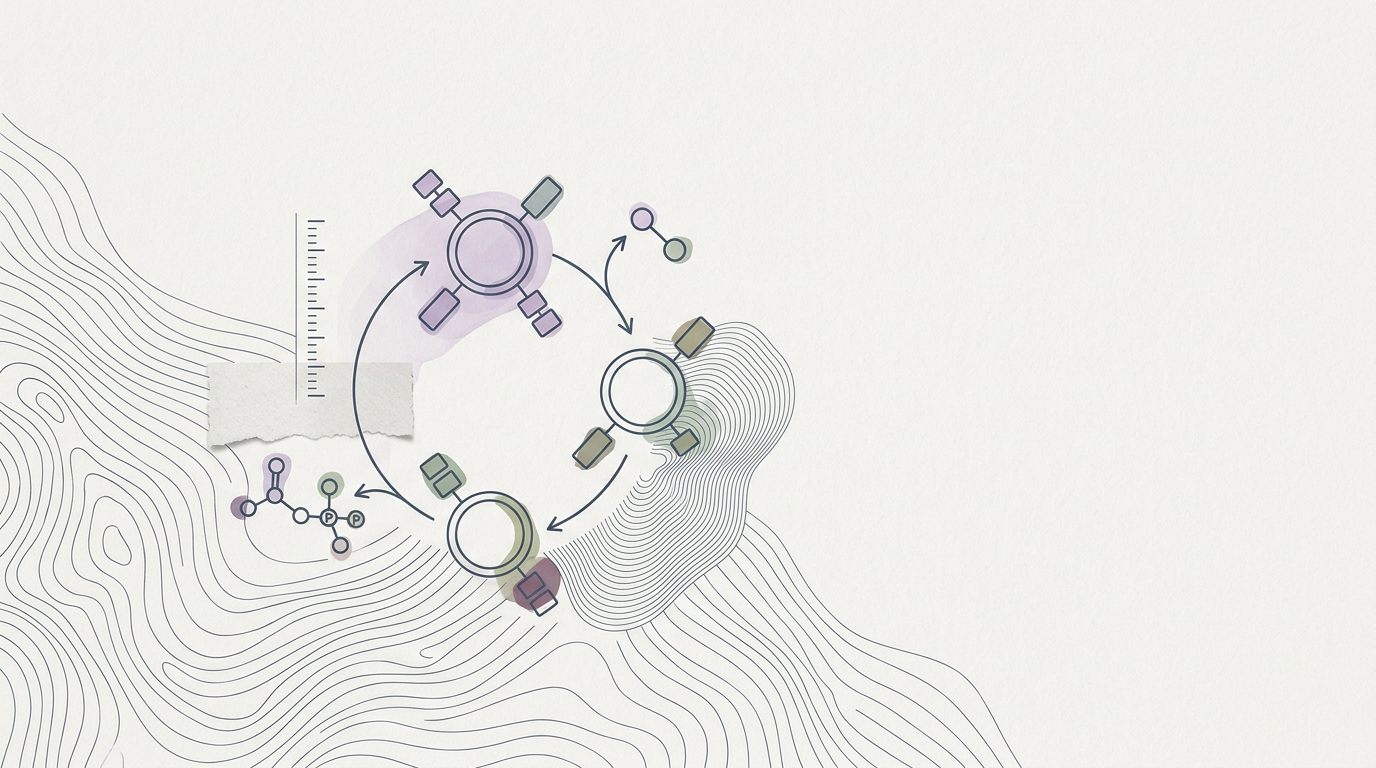
When you're in a high-demand situation—like a day of back-to-back meetings, trying to learn a new skill, or working while sleep-deprived—you spend ATP faster than your standard cellular machinery can regenerate it. The result is what you experience as brain fog, slow thinking, and an inability to focus. Your brain is prudently rationing a dwindling power supply. This is where creatine enters the picture. Its primary job is to serve as a rapid-recharging system. It holds onto a high-energy phosphate group, forming a molecule called phosphocreatine. When a 'spent' ADP molecule appears, phosphocreatine can instantly hand over its phosphate, recycling it back into a 'charged' ATP molecule on the spot. It makes you dramatically more efficient at reusing the energy you already have.
Related anchors: sleep anchor · burnt-out anchor · performance anchor
Cognitive load is an energy transaction
The feeling of being 'drained' after a long day of focused work is a literal description of your brain’s energy state. High cognitive load—managing complex projects, navigating social dynamics, suppressing distractions—is a period of high ATP expenditure. When the demand for ATP outstrips the brain's ability to recycle it, performance drops off a cliff. The word you're looking for vanishes. The simple decision feels impossible. Your patience evaporates. For a long time, I treated my own afternoon slump as a failure of discipline. I now understand it as a predictable, physiological event—a brownout triggered by spending cognitive currency I didn't have.
Think of your brain's energy supply like the power grid of a small city on a hot day. There's a maximum amount of power available. Basic functions like breathing and circulation are the hospitals and emergency services; they always get power. But when demand surges—when everyone turns on their air conditioning at once—the grid gets strained. To prevent a total blackout, the utility company initiates a brownout, dimming the lights in residential areas. Your brain fog is a brownout. The brain is deliberately reducing power to higher-order cognitive functions like planning, creative problem-solving, and emotional regulation to protect the core systems.
Supplementing with creatine is like installing a series of high-capacity backup batteries across the city grid. It ensures there is a deep pool of phosphocreatine ready to regenerate ATP the moment it's spent. This allows your brain to sustain high-energy function for longer periods and handle sudden surges in demand before hitting that wall of cognitive fatigue. It's particularly effective during periods of acute stress, like sleep restriction. When you don't get enough sleep, your brain's ability to clear out metabolic waste and restore its energy reserves is compromised. You start the day with a depleted grid. Creatine helps offset this by providing an external boost to the energy recycling system, preserving cognitive function when it would otherwise decline.
Creatine as a cognitive buffer
The most useful way to think about creatine is not as a performance enhancer, but as a cognitive buffer. It’s a tool for resilience. The goal is to stop your operating system from crashing on a normal Wednesday.
The phosphocreatine system is your brain’s first line of defence against sudden metabolic stress. A difficult conversation, a sudden deadline, an unexpected technical problem—these are all "surge" events that cause a rapid drain on local ATP pools. Without a sufficient phosphocreatine buffer, this sudden demand causes the ratio of ATP to ADP to fall. This shift is a powerful danger signal at the cellular level, triggering a cascade of protective down-regulation. This is the physiological root of suddenly feeling overwhelmed, irritable, or wanting to procrastinate. Your brain is trying to force you to conserve energy.
By maintaining a topped-up phosphocreatine pool through daily supplementation, you increase the system’s capacity to absorb these shocks. The brain can meet these surge demands without immediately triggering an energy crisis. This translates into a greater ability to stay focused, regulate your emotional state under pressure, and maintain mental clarity throughout a demanding day. It’s the difference between running your system right up to the red line every day and operating with a small but critical reserve in the tank. This reserve is what allows for cognitive flexibility—the ability to handle the unexpected without the whole system threatening to shut down. It's the capacity to hold two opposing ideas at once, or to switch from a deep-focus task to a team meeting without feeling like you've been unplugged.
Common Questions
Will taking creatine make me look bulky or bloated?
Creatine draws water into cells, which is a key part of how it works. This is called intracellular hydration. In the initial phase of taking it, you might notice a small increase on the scale, but this is primarily water weight inside your muscle tissue, not fat gain or the kind of puffiness you get from a salty meal. Gaining significant muscle bulk requires a powerful stimulus from heavy resistance training and a consistent calorie surplus; 5 grams of creatine a day will not do it on its own.
Is creatine safe to take every day?
Creatine monohydrate is one of the most extensively studied dietary supplements on the market. For healthy individuals, long-term daily use at the recommended dose of 3-5 grams is considered very safe. The body of research on its safety and efficacy is vast and reassuring. As with any supplement, if you have pre-existing kidney or liver conditions, you should consult your doctor before starting.
What is the best type of creatine to buy?
Stick with creatine monohydrate. It is the most researched, most effective, and typically the most affordable form. Over the years, many companies have released more expensive, "advanced" forms—buffered, esterified, or liquid versions—but none have been conclusively shown to provide superior benefits to plain old monohydrate in clinical trials. Look for a product that is just pure creatine monohydrate without unnecessary fillers or flavourings.
When is the best time to take creatine?
For cognitive and general saturation benefits, consistency is far more important than timing. Creatine works by accumulating in your cells over time, not as an immediate stimulant. Take your 3-5 gram dose whenever is most convenient for you to remember it each day—with a meal, in your morning coffee, or after a workout. The goal is simply to maintain a consistent, elevated level in your system.
Closing
Understanding your brain's energy budget is the first step. The next is to give it the raw materials it needs to stay balanced under load.
- To go deeper on building systemic resilience, explore the Kokorology Foundations programme.
- For a personalised plan to manage your energy and capacity, book a 1:1 consultation.
- For a free tool to track your daily state, download the Nervous System Journal prompts.
TL;DR
Creatine is more than a supplement for muscle growth; it is a crucial tool for managing brain energy. Its primary role is to help rapidly recycle ATP, the main energy currency of your cells, via the phosphocreatine system. This acts as a cognitive buffer, improving your brain's ability to sustain focus and handle high mental demand, especially during periods of stress or sleep restriction. Daily supplementation can improve cognitive stamina and reduce brain fog, making it a foundational practice for supporting your capacity.
Sources
- Avgerinos, K. I., Spyrou, N., Bougioukas, K. I., & Kapogiannis, D. (2018). Effects of creatine supplementation on cognitive function of healthy individuals: A systematic review of randomized controlled trials. Experimental Gerontology, 108, 166–173.
- Rae, C., Digney, A. L., McEwan, S. R., & Bates, T. C. (2003). Oral creatine monohydrate supplementation improves brain performance: a double-blind, placebo-controlled, cross-over trial. Proceedings of the Royal Society of London. Series B: Biological Sciences, 270(1529), 2147–2150.
- Allen, P. J. (2012). Creatine metabolism and psychiatric disorders: Does creatine supplementation have a role? Neuroscience and Biobehavioral Reviews, 36(5), 1442–1462.
- Mike Murray (summary) (2026). Creatine helped preserve cognition during sleep restriction. Examine Study Summary — Nutrients, 2026.