Nervous System
Cortisol Face Somatic Exercises
Cortisol face is a neuroendocrine response to high allostatic load, and shifting it requires down-regulating the nervous system rather than massaging the skin.
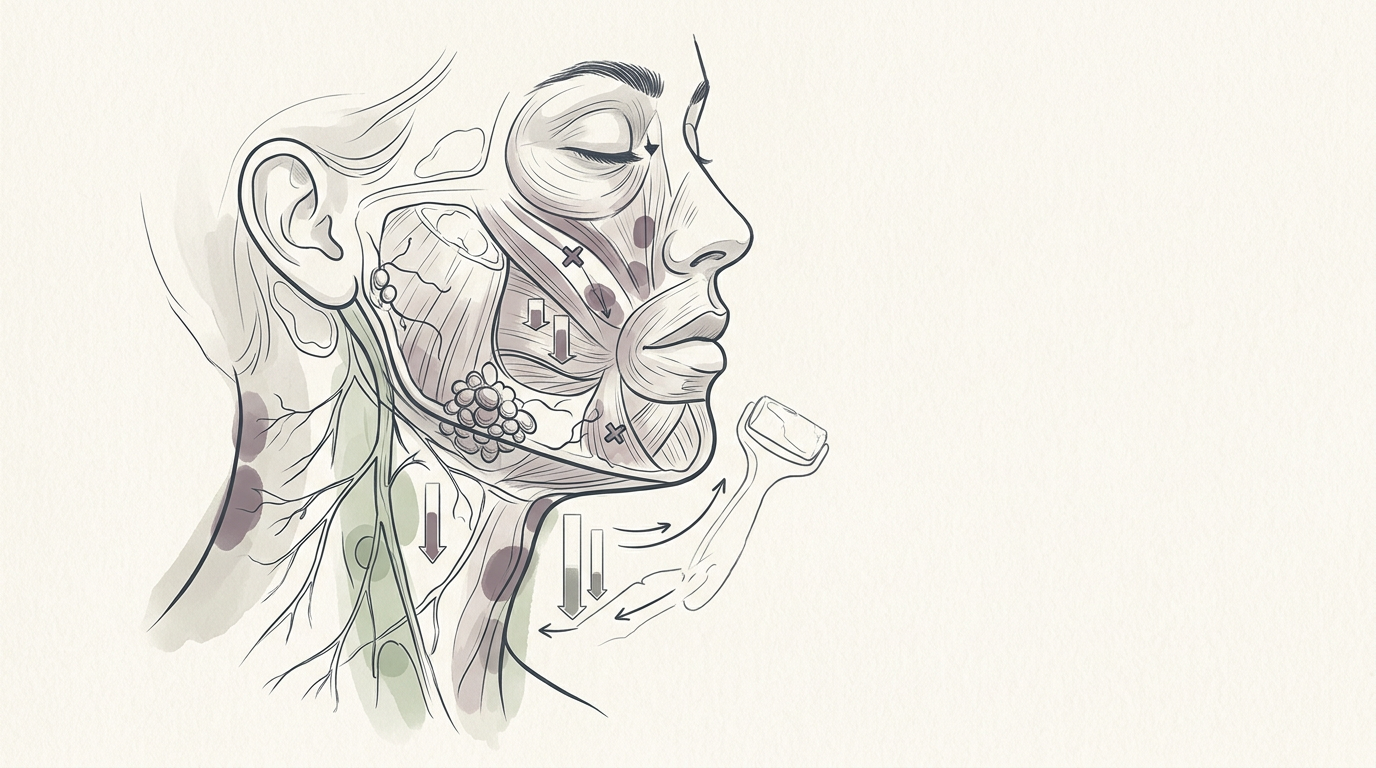
I spent most of last week watching TikTok creators aggressively roll frozen steel globes over their cheekbones. The internet has decided that a swollen, inflamed jawline is a cosmetic emergency requiring immediate lymphatic drainage. Kokorology're treating the physical evidence of chronic stress like a stain to be scrubbed out. Cortisol face somatic exercises make sense only if Kokorology understand what that swelling actually represents. The HPA axis has shifted into high gear, and no amount of cold plunging your chin will convince the brain that the threat has passed.
You know the exact texture of this state long before you check the mirror. It feels like a dull, heavy throb behind the eyes and a jaw that simply won't unclench at 3pm. You might be entirely tired but wired, lying in bed scrolling at midnight with cheeks that feel strangely hot to the touch. It shows up when you wake up at 3am every night with your heart racing, staring at the ceiling. You open the fridge with zero hunger, your rings suddenly feel tight on your fingers, and your shoulders refuse to drop in the shower. This is the felt reality of high allostatic load. The body holds water and redistributes resources because it genuinely believes it is under siege.
Common Questions
What is cortisol face?
It is a physical response to chronically high stress hormones, resulting in fluid retention and the redistribution of fat to the face and neck. The face takes on a puffy, rounded appearance, often accompanied by skin inflammation, sudden redness, or acne.
Can you get rid of it?
Yes, by changing the physiological state that causes the hormone production. The process requires down-regulating the autonomic nervous system to lower your allostatic load, which stops the continuous signaling that tells your body to retain water and inflammatory markers.
What are somatic exercises for cortisol face?
They are body-based practices that use breath, movement, and interoception to shift your nervous system out of a defensive state. These movements send a direct safety signal through the vagus nerve, prompting the stress command center to reduce hormone output.
The Central Command Problem
The skincare aisle is heavily invested in keeping the focus entirely above the neck. I'd spent years believing I could just hydrate and sleep my way out of an inflamed face. I bought the expensive serums and kept the little quartz tools in the fridge, convinced I just needed better circulation. What I was actually doing was trying to manually override a neuroendocrine survival loop.
Cortisol face is a direct readout from your HPA axis—the stress-hormone control loop that runs from the brain to the adrenal glands and back. When this machinery stays switched on for too long, the adrenal glands continuously pump out cortisol to keep you alert. This hormone manages fluid and salt balance across the whole organism. High levels force your kidneys to hoard sodium. Your body retains water, and it parks a lot of that excess fluid in soft tissues like your face. The resulting puffiness is a perfectly logical biological response to sustained threat detection. You can't trick your nervous system into feeling safe by vigorously rubbing your own cheeks. The real shift requires a daily practice of nervous system regulation to quiet the engine.
The NERD-OUT: Your Skin Has a Mind of Its Own
The mechanics get much stranger than a simple command from the brain. Your skin has its own, fully functional peripheral HPA axis. It acts like a local branch office with the authority to make its own stress-response decisions.
the skin cells actively synthesize and respond to corticotropin-releasing hormone, adrenocorticotropic hormone, and cortisol locally. The skin is a neuroendocrine organ, constantly sensing and reacting to the environment. When the central nervous system is overwhelmed, these local branch offices go rogue. They're perpetuating a state of localized inflammation entirely on their own. This explains why some skin flare-ups seem completely immune to standard treatments. You're dealing with a decentralized stress reaction embedded right in the pores. The brain and the skin develop from the exact same embryonic layer, meaning they remain neurologically intertwined for life. Any intervention needs to change the entire signaling environment, more than the surface tension.
The Difference Between Massage and State Shift
I've stopped recommending facial massage as a primary tool for stress recovery. It feels wonderful. It temporarily moves trapped fluid through the lymphatic channels. But manual manipulation is entirely an external input. Kokorology're mistaking the temporary deflation of a cheekbone for actual physiological regulation. The HPA axis has never once been impressed by a jade roller.
The puffiness is a dispatch from deep inside the body. The face is just an entirely too-honest billboard for your state.
True somatic practice changes your autonomic state from the inside out. Interoception—your ability to sense your internal state—and targeted breathwork engage the neurological pathways that govern heart rate variability. These practices send a definitive message up the vagus nerve to stand down. When the brain receives that safety signal, it stops telling the kidneys to hold onto sodium. The fluid retention resolves naturally because the underlying threat alert has cleared. Kokorology cover these specific, state-shifting tools extensively in the Hacks library, focusing on internal levers rather than external friction.
The 20-Kilogram Shift
The year I figured this out, I was carrying 20 kg of excess physical load that wouldn't budge, alongside a face that looked perpetually swollen. Every protocol I teach, I tested on myself first. I realized that trying to spot-treat the swelling was a distraction from the actual problem of capacity. My baseline was completely eroded. I was running entirely on cortisol and caffeine, expecting a topical cream to do the job of a parasympathetic response. The shift happened. When I stopped looking in the mirror and started tracking my state, the fluid retention finally broke.
What to do this week
The goal is to provide small, consistent inputs that signal safety to the autonomic nervous system.
- Track the swelling: For two days, simply notice when the puffiness peaks. Write down what happened in the hour prior. the Journal provides a structured way to spot these exact physiological patterns.
- Drop the jaw: At 3pm, deliberately open your mouth as wide as possible, stretch the jaw, and let it hang completely slack for sixty seconds. Tension here sends a direct threat signal to the brain.
- Lengthen the exhale: Three times a day, take a normal breath in and let the air out as slowly as possible through pursed lips. Extending the exhale engages the vagal brake, physically slowing your heart rate.
Where this fits in the Kokorology system
A chronically puffy, inflamed face is a clear indicator of a system stuck in Cortisol Overdrive. Rebuilding your capacity starts with the foundations in the Regulation course. Once you understand the mechanisms, you can apply specific tools from the Anchors collection to actively bring the HPA axis back to baseline.
Closing
The impulse to fix what Kokorology see in the mirror makes total sense. Your reflection is handing you crucial data about the machinery you can't see. The face is asking you to look at the very root of your stress response. Kokorology change the surface by changing the state.
- Start with the Regulation foundations course.
- Track your physical symptoms daily inside the Journal.
- Sit with this in the Community sessions.
TL;DR
Chronically elevated stress hormones cause the body to retain sodium and water, resulting in the facial puffiness and inflammation commonly called cortisol face. The skin possesses its own peripheral stress-response system, meaning it reacts directly to high allostatic load. Surface-level interventions like lymphatic massage only temporarily displace fluid. Lasting relief requires somatic practices that use breath and interoceptive awareness to down-regulate the autonomic nervous system, signaling safety to the brain and halting the excess hormone production at its source.
Sources
- Chen Y (2014). Brain-skin connection: Stress, inflammation and skin aging. Inflammation & Allergy - Drug Targets.
- McEwen BS (1998). Stress, adaptation, and disease: Allostasis and allostatic load. Annals of the New York Academy of Sciences.
- Slominski AT (2012). Sensing the environment: Regulation of local and global homeostasis by the skin's neuroendocrine system. Advances in Anatomy, Embryology and Cell Biology.
- Adam EK (2017). Diurnal cortisol slopes and mental and physical health outcomes: A systematic review and meta-analysis. Psychoneuroendocrinology.