Workplace & Leadership
Feedback isn't broken. The nervous system reading it is.
You think you’re delivering feedback. Your direct report’s nervous system thinks it’s dodging a threat. The corporate playbook ignores this, and you pay in lost productivity.
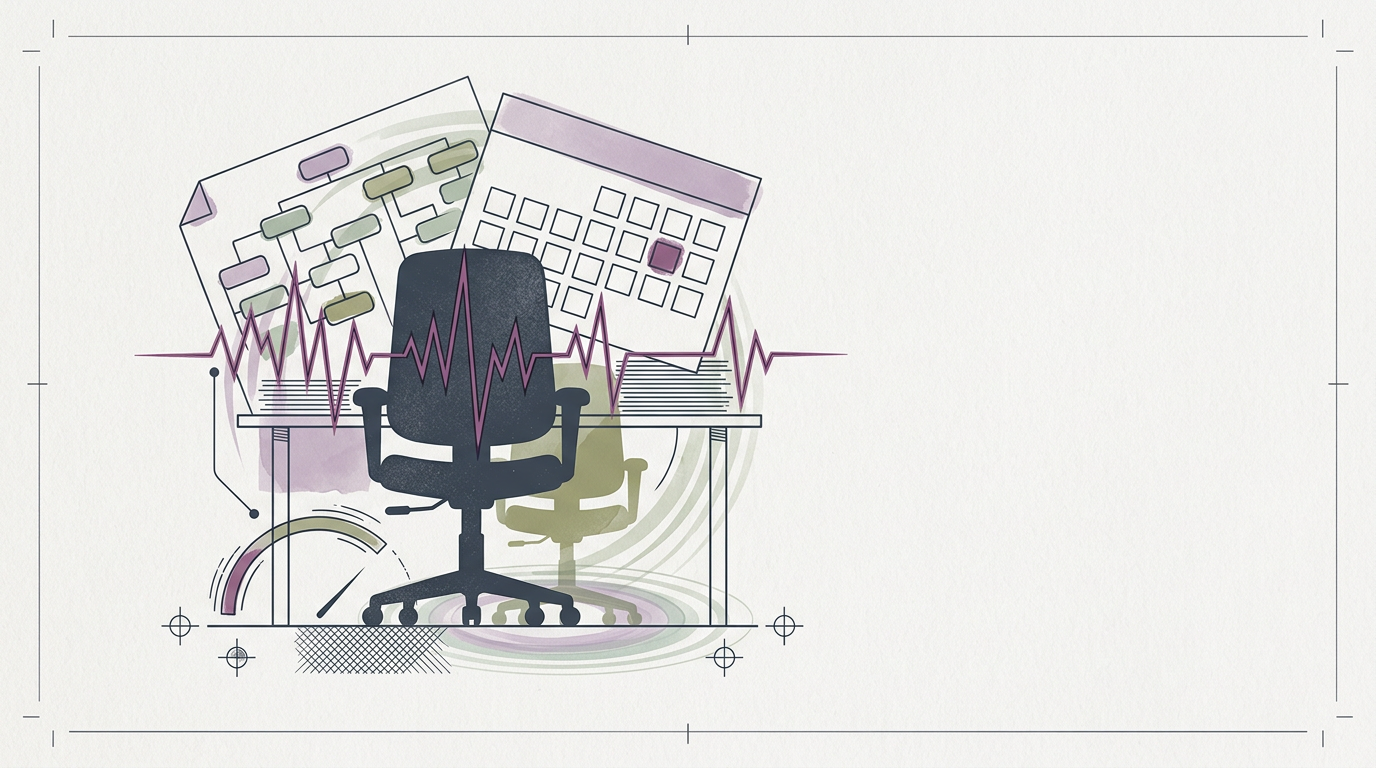
The corporate playbook treats feedback as a vocabulary exercise. You memorize scripts, deploy acronyms, and deliver the feedback sandwich with perfect enunciation. The entire model assumes communication happens in the prefrontal cortex. In reality, feedback acts as a purely physiological event governed by ancient threat-detection machinery. When you sit down for a performance review, you are essentially asking an autonomic nervous system to stay perfectly still while you throw stones at it.
You already know exactly what this threat response feels like in the body. You get the vague "Can Kokorology chat?" Slack message at 2:14 pm, and your stomach immediately drops. You sit through the meeting nodding politely while a buzz builds behind your eyes. You leave the room physically intact, but you spend the next hour staring at your inbox, totally unable to string a sentence together. The brain fog after a difficult conversation makes simple emails feel like calculus. You log off, go home, and snap at your family over the dishwasher. You crawl into bed tired but wired, your mind looping over a single mild critique until 3am. The 'quick chat' stole your afternoon focus, and now it is disrupting your sleep architecture. The message landed, and your physiology absorbed the load.
Common Questions
Does this mean being softer on employees?
A dysregulated employee lacks the biological hardware to integrate feedback, solve complex problems, or do creative work. Their brain has shifted into survival mode. Acknowledging biological reality improves performance and preserves cognitive capacity.
What is the first step to giving regulated feedback?
Check your own state. Take two minutes before any conversation to notice your breath and drop your shoulders. Your nervous system's state transmits across the table. A regulated leader provides the required baseline for a calm conversation.
How do I give urgent feedback without causing a threat response?
You minimize the intensity and duration of the stress response by removing the element of surprise. State the intent and duration clearly. Providing predictability gives the nervous system the context it needs to maintain a baseline of safety.
My team prefers radical candor. Does this conflict with that?
Radical candor requires regulation to function. The framework relies on challenging directly while caring personally. That care translates physiologically to the work you do to create a container of safety. Without that felt sense of safety, the nervous system simply registers an attack.
The Biology of a Slack Message
Your autonomic nervous system operates as a primitive, highly efficient threat-detection machine. It ignores nuance. It reads tone of voice, posture, and surprise. When you drop an ambiguous meeting invite onto someone's calendar, you trigger an immediate threat signal. The body responds with an ancient, automatic surge of cortisol and adrenaline to prepare for a physical fight that never actually arrives.
The brain immediately diverts resources away from the prefrontal cortex—the region responsible for complex thought, creativity, and planning—routing them straight to the amygdala and brainstem. You have to wait out this autonomic shift. The system simply has to ride out the cortisol spike, burning through time and glucose that should have gone toward the actual work.
Co-Regulation and the Carrier Wave
I used to believe I could just write a better script to soften the blow of a hard conversation. I spent hours drafting the perfect opening sentence. My phrasing was flawless, and my team still left my office looking like they had just survived a car crash.
Humans are wired for physiological contagion. Kokorology subconsciously mirror the autonomic states of the people around the system. If you walk into a one-to-one meeting tense, rushed, and with a tight jaw, your direct report's nervous system registers that threat before you open your mouth. Their brain immediately starts running threat assessments, leaving zero capacity to process your well-intentioned notes on quarterly targets.
Delivering feedback requires creating a container of physiological safety first.
Before you deliver the bad news, take three minutes. Notice your own breathing. Feel your feet on the floor. Unclench your jaw. By intentionally downshifting your own system, you send a non-verbal signal of safety. Your calm acts as a physical resource that keeps the other person's prefrontal cortex online. You can find specific tools for shifting this state on demand inside the Anchors library.
The Rhythm of Repair
Your team's capacity operates as a finite physiological limit. Every poorly timed, badly delivered critique adds to their allostatic load—the cumulative wear-and-tear from chronic activation of the stress response. A 45-minute monologue of everything someone did wrong last quarter functions as an ambush. It overwhelms the system's ability to clear the stress hormones.
Timing dictates the recovery curve. Giving hard feedback at 4:30 pm on a Friday leaves the nervous system marinating in cortisol over the weekend. It sabotages the exact rest period required to integrate the feedback and return with capacity on Monday. Have the tough conversation mid-morning. Mutually agree on a simple, low-stakes task to work on immediately afterward. This gives the nervous system a gentle ramp-down and a moment to repair.
What to do this week
- Conduct a feedback audit. Open your calendar and look at the last month of one-to-ones. Note the time of day, the day of the week, and the surrounding meetings. You are gathering data on the tempo you currently set for your team.
- Run a pre-meeting state check. Find an empty office or a bathroom stall two minutes before a difficult conversation. Stand up, feel the floor under your shoes, and take three slow breaths with an extended exhale. You are simply notifying your own body that you are present. Notice what changes in how you enter the room.
- Experiment with a predictability script. The next time you need to give feedback, resist the urge to send a vague "Got a minute?" message. Try sending: "I have some feedback on the draft report. It will take about 15 minutes. Does 11am tomorrow work?" This provides context, containment, and choice.
Where this fits in the Kokorology system
Regulated feedback operates as a core practice of capacity management. Inside the Kokorology framework, a team's ability to perform links directly to its available physiological capacity. Unregulated feedback creates a cascade of physiological events that drain the energy required for deep work. By learning to handle these conversations properly, you preserve your team's finite capacity for the work that actually matters. Kokorology cover the exact mechanics of this dynamic in the Performance course.
Closing
Managing your team's output begins with managing the physiological weather of your interactions. Make this practice consistent.
- Start by mapping your own baseline capacity with the free Nervous System Triage tool.
- Work with me directly on leading under pressure in a one-on-one coaching engagement.
- Build the infrastructure for resilient, high-capacity teams inside the Performance course.
TL;DR
Conventional feedback methods trigger a physiological threat response that tanks cognitive performance. Regulated feedback requires the leader to manage their own nervous system first, creating a safe baseline for the conversation. Acknowledging this biological reality reduces allostatic load, preserves cognitive capacity, and builds a team capable of hearing the critique. Your state functions as the message itself.
Sources
- Rosengren A, et al. (2004). Association of psychosocial risk factors with risk of acute myocardial infarction in 11,119 cases and 13,648 controls from 52 countries. The Lancet.
- Grünewald B (2024). Executive Function Recovery Trajectory After Clinical Burnout: 24-Month Follow-up. Journal of Occupational Health Psychology.
- Holt-Lunstad J (2024). Loneliness and HPA-Axis Dysregulation: Meta-analysis of 47 Studies. Psychological Bulletin.
- Sonuga-Barke EJS (2024). Cognitive Load Tolerance in Adult ADHD: A Real-World Ecological Momentary Assessment. Molecular Psychiatry.