Nervous System
The Caffeine You're Drinking Isn't the Caffeine You Think: Bound vs. Free, and Why Your Ne
All caffeine shares the same molecule, but the delivery matrix changes how fast it hits and how loudly your autonomic nervous system reacts.
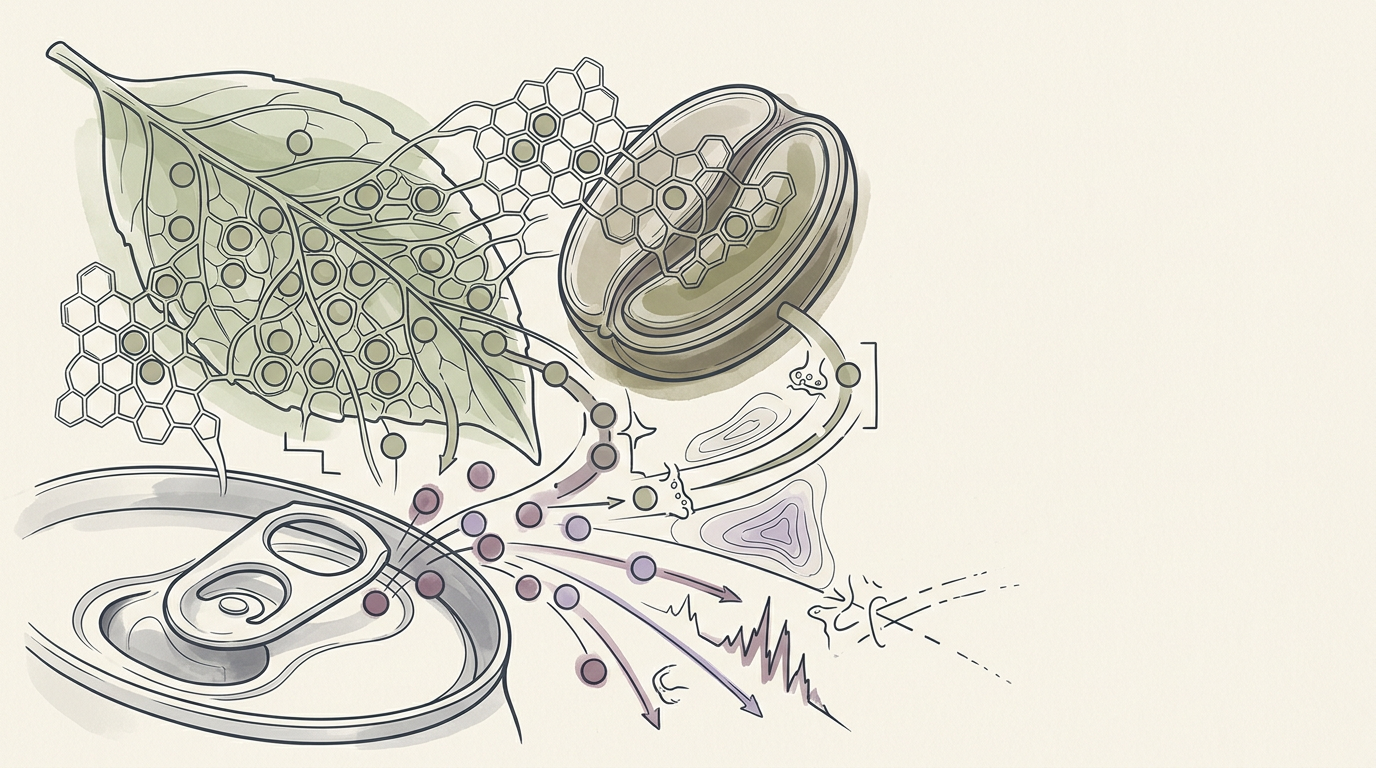
I spent thirty minutes this morning reading a German public health survey showing a massive spike in energy drink consumption among teenagers, and the policy panic is entirely focused on the milligrams. The volume of caffeine is a secondary issue. The real hazard is the speed of delivery. The assumption that 150mg of caffeine from a green tea and 150mg from a neon can behave identically in the body completely ignores how the autonomic nervous system processes stimulants.
You already know what the wrong delivery system feels like. It's 2pm, you drank a pre-workout or a zero-sugar energy drink an hour ago, and now your shoulders are pinned to your ears. You feel exhausted but can't rest. The screen is right in front of you, yet you can't hold a single thought long enough to finish an email. You are sitting completely still, but your internal state is preparing to run from a lion. This is the classic tired but wired state, where your eyes buzz and your jaw locks tight, but no actual energy is available to your muscles. People search for reasons they feel anxious for no reason in the middle of the workday, completely missing that they just mainlined a synthetic stimulant without a seatbelt. The can just forced the system to sprint on empty.
Common Questions
What is caffeine anhydrous?
It is dehydrated, synthetic caffeine stripped of its plant matrix. Because it has no tannins or chlorogenic acids to slow it down, it crosses the gut lining almost instantly, creating a rapid, steep spike in cortisol and epinephrine.
Why does matcha feel different than coffee?
Matcha contains L-theanine, an amino acid that acts as a gentle brake on the central nervous system. It softens the physiological arousal of the caffeine, allowing you to maintain alertness without the sharp sympathetic activation that usually accompanies an espresso.
Does decaf still trigger the nervous system?
Yes, mildly. Decaf still contains residual amounts of bound caffeine, usually between 2 and 15 milligrams per cup. For highly sensitive systems, this small amount can still stimulate arousal pathways and interfere with sleep staging if consumed late in the day.
Should I quit caffeine entirely if I am burnt out?
Removing the stimulant completely is rarely the first step. The immediate move is switching the delivery mechanism from fast, free anhydrous sources to slow, bound plant sources to reduce the sharpness of the cortisol spike.
The illusion of equal milligrams
I used to believe that managing my daily intake was just basic math. I figured as long as I stayed under 300mg, the source was irrelevant. I was wrong.
In nature, the molecule 1,3,7-trimethylxanthine never travels alone. It grows embedded inside a dense plant matrix, tightly bound to larger compounds that your gut has to physically dismantle before any absorption can happen. In a factory, it gets stripped out of that matrix, dehydrated, and turned into a fine white powder called caffeine anhydrous. The chemical structure remains identical. The physiological impact becomes unrecognisable.
The biological seatbelt
Bound caffeine lives in coffee beans, tea leaves, cacao, and yerba mate. Because it is chemically tethered to tannins, polyphenols, and chlorogenic acids, your digestive system has to break those bonds first. This delays gastric emptying and stretches the absorption curve across roughly 45 to 90 minutes. The stimulus arrives as a rolling hill.
The different plant matrices dictate the exact autonomic response. Coffee carries chlorogenic acids, which can drop blood sugar rapidly on an empty stomach. That 11am slump people blame on caffeine wearing off is frequently just the chlorogenic acid causing a glucose dip. Tea contains L-theanine, an amino acid that crosses the blood-brain barrier and applies a gentle brake to the central nervous system. It promotes alpha brain waves and softens the vasoconstriction caffeine naturally causes.
The body does not care how many milligrams are on the label. It only cares how fast the chemical hits the bloodstream.
Yerba mate carries a fascinating trio of methylxanthines: caffeine to stimulate, theophylline to open the airways, and theobromine to relax the blood vessels. This combination generates alert wakefulness with significantly lower cardiac strain. I constantly recommend swapping to mate inside the Reset program when standard coffee starts ruining people's sleep pressure.
The artificial emergency of anhydrous caffeine
Free caffeine lives in mass-market sodas, conventional energy drinks, and almost every pre-workout mix. With zero plant compounds holding it back, anhydrous powder crosses the gastric mucosa almost instantly. Plasma concentration peaks rapidly, aggressively docking with adenosine receptors in the brain.
This speed matters because the HPA axis—the stress-hormone control loop running from your brain to your adrenal glands—interprets rapid chemical shifts as environmental threats. The steep spike in arousal signals the locus coeruleus to dump norepinephrine into the system. Cortisol and epinephrine flood the bloodstream together. The sympathetic nervous system initiates a full threat-burst response.
This rapid physiological mobilization is incredibly useful if you are about to lift heavy weights. It's actively destructive if you are sitting at a desk. Your adrenals have no idea what a deadline is; they just know you are behaving like you are being hunted. Drinking an energy drink to send emails is like pulling the fire alarm to read by the strobe light. The inbox has never once been impressed by your heart rate.
The physiological reflex
When the synthetic spike ends, the drop is steep. The crash that follows is a mandatory parasympathetic rebound trying to drag the system back to baseline. The sudden lethargy, the brain fog, and the heavy limbs are simply the vagus nerve applying the emergency brake after an unearned sympathetic sprint.
This mechanism becomes actively harmful if you are already running hot—burnt out, perimenopausal, or navigating a high-demand role. Dumping free anhydrous caffeine into a dysregulated baseline doesn't generate energy. It forces a depleted system into hyperarousal. Kokorology teach people inside nervous-system regulation foundations that the goal is expanding baseline capacity, not whipping a system that desperately needs rest.
What to do this week
- Match the matrix to the task. Reserve anhydrous caffeine strictly for intense physical output. If you're sitting down, stick to bound plant sources.
- Buffer the coffee. Drink your morning coffee alongside protein or fat to soften the chlorogenic acid glucose dip.
- Test the L-theanine shift. If you feel jittery by noon, switch tomorrow's second cup of coffee for matcha or high-quality green tea. Notice the difference in your jaw tension by 3pm.
Where this fits in the Kokorology system
Understanding how chemical inputs alter your state is a core component of the foundational nervous-system regulation curriculum. Once you grasp the mechanisms, you can use specific practices from the Library to down-regulate after accidental overstimulation. For acute moments of caffeine-induced panic, run one of the rapid somatic tools in the Hacks database to signal safety back to the brain.
Closing
Your daily caffeine habit is either supporting your autonomic baseline or actively eroding it. The next time you reach for a mid-afternoon boost, look closely at whether you're choosing a gradual botanical lift or a synthetic emergency.
- Start with the foundations in Regulation L1.
- Work with the full protocol inside the Reset.
- Practice daily capacity-building in the Journal.
TL;DR
Caffeine is a single molecule that produces wildly different nervous system reactions depending on its delivery method. Bound caffeine in coffee and tea digests slowly because plant compounds restrict its release, creating a gradual, manageable rise in alertness. Free anhydrous caffeine in energy drinks and sodas crosses into the bloodstream immediately, triggering a rapid spike in cortisol and a harsh sympathetic stress response. Matching the type of caffeine to your baseline capacity prevents artificial anxiety and eliminates the inevitable afternoon crash.
Sources
- Adam, E. K., et al. (2017). Diurnal cortisol slopes and mental and physical health outcomes: A systematic review and meta-analysis. Psychoneuroendocrinology.
- van Dam, R. M., Hu, F. B., & Willett, W. C. (2020). Coffee, Caffeine, and Health. New England Journal of Medicine.
- Owen, G. N., et al. (2008). The combined effects of L-theanine and caffeine on cognitive performance and mood. Nutritional Neuroscience.
- Deutsches Ärzteblatt (2026). German teens boost energy drink sales, risking nervous system load. German Prevention Radar.