Nervous System
Mitigating cognitive load accumulation from synchronous interactions
The brain fog you feel after a day of back-to-back meetings is a predictable physiological response to sustained prefrontal load.
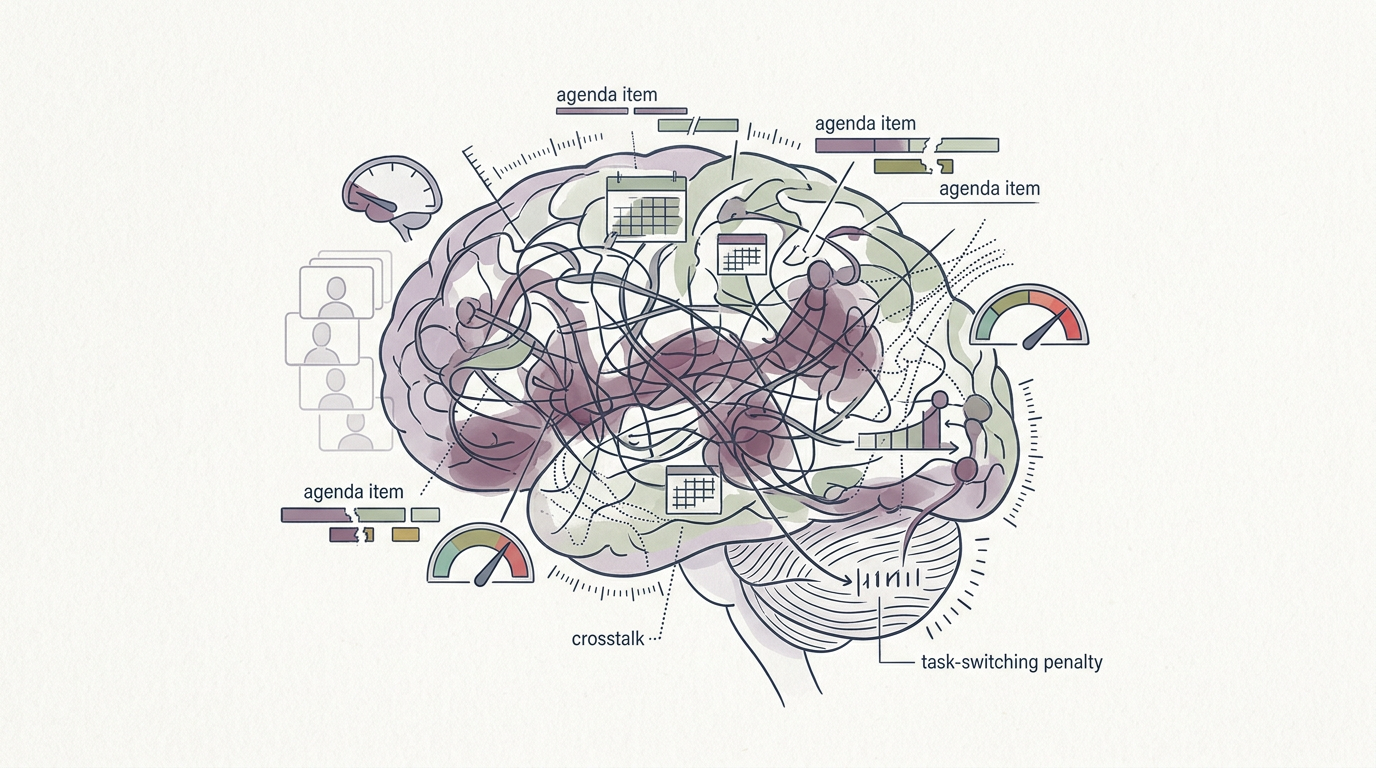
The modern calendar is designed for a nervous system that doesn't exist. The prevailing corporate assumption is that humans can transition from a high-stakes strategy call to a team sync with zero biological friction, provided they consume enough caffeine. I'm calling it. This relentless pacing ignores the actual machinery of the human body. Every hour spent tracking fragmented social cues on a screen drives up your allostatic load, pushing the brain's stress-hormone control loop—the HPA axis—into a steady, simmering hypervigilance. The inbox has never once been impressed by your heart rate, but your physiology is keeping the score anyway.
You click 'Leave Meeting' and the sudden silence in your kitchen feels actively heavy. You're staring at the blank wall behind your monitor, acutely aware of the dull buzz behind your eyes and a jaw so tight it aches. You need to type a quick follow-up email, but the words refuse to assemble themselves. You open the fridge with zero actual hunger, just a desperate need for a sensory state change. This is the classic presentation of brain fog. You feel tired but wired, pacing the room with a restless, irritable energy that makes sitting back down feel impossible. By the time evening rolls around, you find yourself doom-scrolling at 11:47 p.m., trapped in a cycle where you are exhausted but can't rest. The capable, articulate person from 9 a.m. has completely evaporated, leaving behind a husk of static.
Common Questions
Why do video calls drain my energy faster than in-person meetings?
Video calls force your brain to process incomplete social cues while simultaneously monitoring your own face. This dual-focus demand creates an artificial intensity. Your prefrontal cortex has to work overtime to fill in the missing physical context, rapidly saturating your capacity for sustained attention.
What is the physiological mechanism behind this mental fatigue?
Sustained synchronous interaction keeps your arousal networks locked in a high gear. Specifically, it strains the locus coeruleus, a small cluster of neurons responsible for focus and alertness. When forced to fire continuously without natural visual breaks, this machinery becomes overloaded and temporarily down-regulates.
Can supplements or productivity tools resolve this?
They only mask the signal. Swallowing a nootropic or downloading a focus app attempts to override a biological limit. The fatigue is a protective mechanism signaling that your nervous system requires a shift in state. Adding a stronger stimulant simply ignores the warning.
The machinery of paying attention
I used to believe that stamina was a matter of willpower. I would stack six calls in a row and wonder why my vision blurred by three o'clock. What I didn't understand then was the sheer mechanical limitation of the locus coeruleus. Buried deep in the brainstem, this tiny blue spot is the primary source of noradrenaline—the chemical that drives arousal, focus, and vigilance. Under natural conditions, the locus coeruleus fires in pulses. You focus, you look away, you reset.
A modern video call demands continuous, unyielding firing. You're tracking the speaker's tone, the micro-expressions of five other colleagues, and the highly unnatural sight of your own face in real time. The tank still holds fuel, but the pipe has narrowed to a trickle. This continuous firing saturates the system. When the call finally drops, your brain is starved of the precise neurotransmitter required to initiate whatever task comes next.
The hypervigilance trap
Corporate scheduling norms treat recovery as an optional perk. I see clients constantly pushing through the afternoon haze, consuming 300mg of caffeine to force an exhausted system to keep performing. When you force an overstimulated HPA axis to remain engaged, you stay in a state of low-grade threat detection. You're physically safe at your desk, but your physiology is responding to the barrage of pings, shifting eye contacts, and rapid context-switching as if you were navigating a genuine hazard.
The fatigue you feel at 3 p.m. is a direct request from your nervous system for a transition.
This chronic load disrupts everything from digestion to your circadian rhythm. You can't out-optimise a saturated nervous system. Pushing harder only guarantees a deeper crash later.
Clearing the static
Restoring your baseline requires a deliberate shift in sensory input. You've got to step out of the narrow visual field of the screen and change your state.
I've stopped recommending productivity hacks for afternoon fatigue. I test every protocol I teach on myself first, and the most reliable Anchor to down-regulate after a heavy cognitive sprint is panoramic vision. Letting your eyes drift across the middle distance—trees, clouds, the far end of the street—signals to the brainstem that the immediate demand has passed. This widens the pipe and allows your autonomic nervous system to begin the transition back to a regulated baseline.
What to do this week
- Enforce transition windows. Block ten minutes before and after any meeting over forty-five minutes. Sit in the quiet. Do not look at your phone.
- Shift your visual field. After you close the laptop, walk to a window and let your gaze soften on the furthest point available for two unbroken minutes.
- Track the crash. Document the precise hour your focus dissolves inside the Journal. Identifying your natural threshold is the first step to managing your load.
Where this fits in the Kokorology system
Managing cognitive load is a foundational skill taught inside Nervous System Regulation. If you're consistently hitting the wall by lunch, the Reset provides a structured seven-day path to rebuild your baseline capacity.
Closing
Stop expecting your brain to function like a server rack. Give it the physical space it needs to shift gears.
- Go deeper into managing your daily capacity inside Performance L2.
- Rebuild your baseline over seven days with the Reset.
- Get the free weekly guide on nervous-system mechanics and stop fighting your biology.
TL;DR
The brain fog you experience after back-to-back meetings is a direct physiological consequence of sustained cognitive load. Your attention network, specifically the locus coeruleus, becomes saturated from continuous visual and social processing without natural breaks. Forcing yourself to push through with caffeine only exacerbates the strain on your nervous system. Restoring your focus requires deliberate visual and mental decompression to allow your physiology to return to a regulated baseline.
Sources
- Thayer, J. F., et al. (2009). Heart rate variability, prefrontal neural function, and cognitive performance. Annals of Behavioral Medicine.
- Aston-Jones, G. & Cohen, J.D. (2005). An integrative theory of locus coeruleus-norepinephrine function: adaptive gain and optimal performance. Annual Review of Neuroscience.
- Critchley, H.D. & Garfinkel, S.N. (2017). Interoception and emotion. Current Opinion in Psychology.