Nervous System
Bone loss starts before your last period, not after
Your skeleton is a dynamic tissue that requires mechanical force to maintain density. The silent drop in bone mass begins quietly in your thirties.
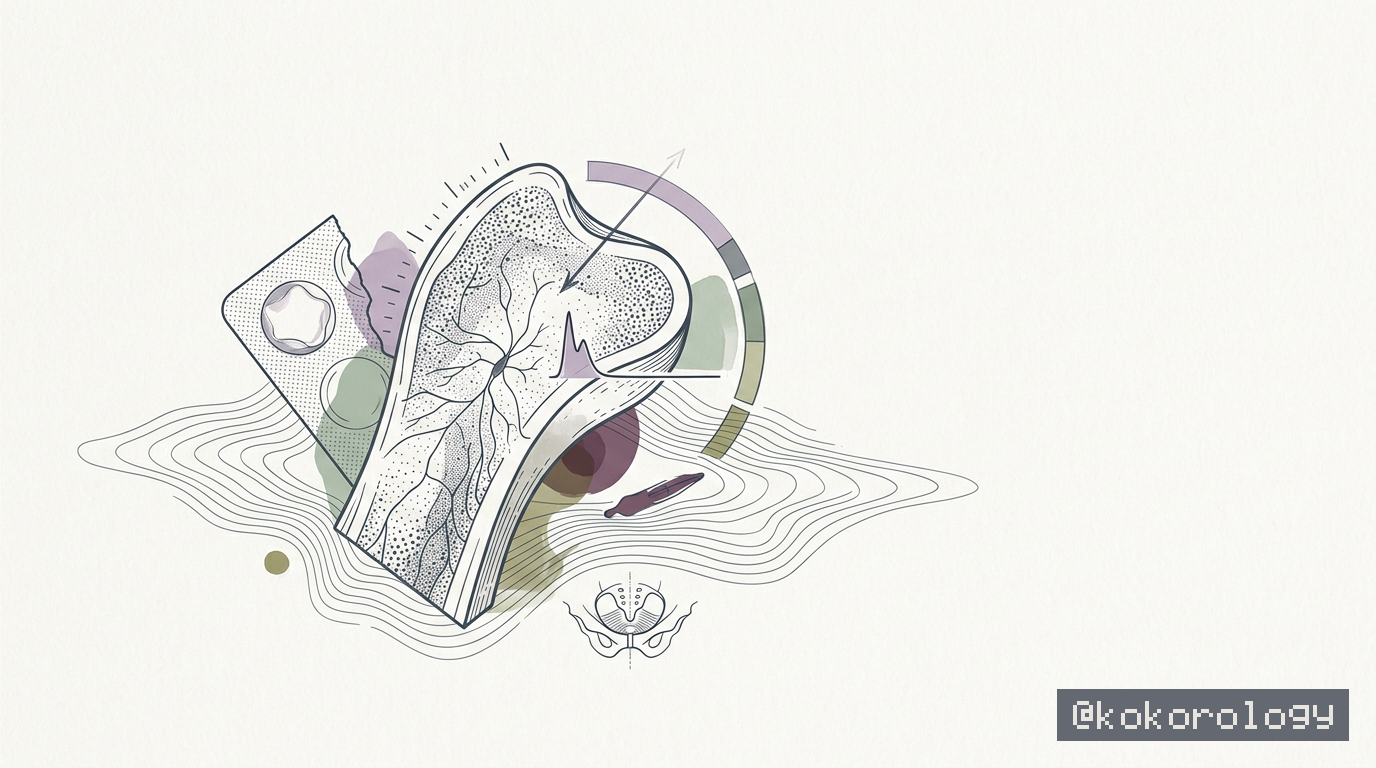
I'd always assumed my bones were permanent internal anatomy that I wouldn't have to think about until I turned sixty. The wellness industry treats skeletal health as a sudden post-menopausal cliff, solvable with calcium gummies and a pleasant walk. I'm calling it. The silent drop in density begins in your mid-thirties, driven entirely by a nervous system that has stopped receiving the physical signals required to maintain mass.
You'll feel the shift as a low-grade physical hesitation you can't quite name. You're capable and strong, but you pause for a split-second before jumping off a box at the gym, calculating the landing. You wake up with stiffness in the morning that takes two coffees to clear. The algorithms are suddenly serving you ads for collagen and Vitamin D, making you feel anxious for no reason about your own skeleton. You find yourself drifting toward the back of the studio, opting for the low-impact modifications, wondering why your hips ache when you sleep on your side. The jaw tightens when you read articles about aging. You're exhausted but can't rest, caught in a loop of trying to protect a body that actually desperately needs you to challenge it.
Common Questions
When does bone density start to drop?
Your skeleton reaches peak mass around age 30. After that, the baseline shifts. The body begins dissolving old bone faster than it mineralizes new tissue. The decline accelerates as estrogen drops during perimenopause, but the slow thinning begins more than a decade before your final period.
Does calcium actually stop bone loss?
Calcium provides the raw minerals. It doesn't provide the instruction to use them. Swallowing supplements without applying physical force to the body simply creates expensive urine. The tissue needs a mechanical reason to absorb the nutrients.
What kind of movement preserves bone?
Your bones require impact and heavy resistance. Activities like swimming and cycling are wonderful for cardiovascular health and regulating autonomic tone, but they provide zero osteogenic load. The tissue demands to be compressed and stressed through jumping, sprinting, or lifting heavy weights.
The nervous system runs the remodeling
The industry loves to talk about bones as dead sticks. Your skeleton is highly innervated, living tissue constantly talking to your nervous system. Bone is packed with sensory nerves that detect mechanical stress. When you jump, the impact creates a piezoelectric charge—a tiny electrical signal generated by the bone matrix itself.
The nervous system registers this charge and directs your osteoblasts to lay down fresh mineral. Without that heavy mechanical input, the brain assumes a dense skeleton is an unnecessary metabolic expense. It simply lets the osteoclasts dissolve the tissue.
The estrogen drop is only half the story
I used to recommend gentle yoga to women complaining of joint stiffness in their late thirties. I've stopped doing that. Kokorology blame estrogen for everything in perimenopause. Estrogen naturally suppresses the cells that break down bone, so when hormones fluctuate, the dissolving cells run wild.
Kokorology completely ignore the mechanical void. By age 38, most people have stopped sprinting, jumping, and lifting heavy objects. The force deficit does just as much damage as the hormone deficit.
Your skeleton doesn't respond to intention. It responds to force.
You have to load the system heavily enough to make it believe it needs to be stronger. This means impact. It means lifting something heavier than your laptop bag. It means telling your skeleton, through direct physical stress, that it is very much still needed.
Piezoelectricity and sympathetic tone
Let's look at the actual machinery. When you load a bone heavily, you compress the crystalline matrix of the tissue. This compression generates that piezoelectric effect, literally pushing fluids through the tiny canals inside the bone, which the osteocytes (the master regulator cells) detect as shear stress. They instantly relay this mechanical data to the central nervous system.
Simultaneously, chronic psychological stress—the kind that leaves you tired but wired at 11pm—elevates sympathetic nervous system activity. High sympathetic tone actively suppresses bone formation by upregulating beta-adrenergic receptors on the osteoblasts. You can't build dense tissue while your nervous system is stuck in a threat state. You have to lift heavy, and you have to know how to downshift into parasympathetic recovery afterward.
Expensive urine in the supplement aisle
The entire conversation is stuck on calcium, as if Kokorology're made of chalk. I fell for this too, diligently taking vitamin D and assuming my internal baseline was covered. You need calcium, vitamin D, vitamin K2, and magnesium. You also need protein. These are non-negotiable materials.
Giving your body these nutrients without the mechanical signal to use them is pointless. The supplement aisle thrives on the idea that you can swallow your way out of physics. Tissue density requires physical stress.
What to do this week
- Jump. Seriously. Find a clear spot on a solid floor. Jump up and down ten times. Don't land softly like a cat; let your body absorb a satisfying, flat-footed impact. Do this once a day.
- Carry something heavy. Pick one day this week. When you get groceries, bypass the cart. Use two baskets and carry them to your car. Feel the pull through your hands, arms, shoulders, and spine.
- Prioritize protein early. Aim for at least 30 grams of protein in the first 90 minutes you're awake. Bone is 50% protein by volume, and the tissue requires amino acids just as much as it requires minerals.
- Track your assumptions. Use the Journal to notice where you hold back physically. Do you default to the lighter weight? Do you choose the low-impact modification automatically? Observe the pattern without judgment.
Where this fits in the Kokorology system
Preserving physical density is a core piece of long-term nervous system regulation. The movement protocols in the Hacks offer quick ways to introduce impact into a stagnant afternoon. For the deeper work of building tissue resilience and managing the sympathetic stress that degrades it, Kokorology run the heavy programming inside Performance.
Closing
The narrative that you are destined to become fragile is a choice. Your skeleton is waiting for instructions. Apply force now, in your thirties and forties, so the question of fragility never enters the room.
- Apply the principle: Start with the 60-second interventions in the Hacks to reintroduce impact today.
- Build the capacity: Join the Performance program to systematically build the strength that preserves tissue.
- Start here for free: Get the 7-Day Reset to clear the autonomic static blocking your recovery.
TL;DR
Bone loss is a mechanical failure that begins in your mid-thirties. The drop in estrogen accelerates the decline, but the root cause is a skeleton deprived of heavy physical force. Your skeleton is living tissue wired directly to your nervous system, requiring compression and stress to maintain its density. Supplements provide the raw minerals, while impact and heavy lifting provide the necessary instruction to absorb them. You have to load the tissue to keep it.
Sources
- Examine.com (2026). Prunes for bone density: signal, not significance. Examine.com Study Summaries — June 8–15, 2026.
- Examine.com (2026). High-protein diets and bone density during weight loss in older adults. Examine.com Study Summaries — June 8–15, 2026.
- Examine.com (2026). Calcium supplements linked to cognitive decline in older women — but the evidence is mixed. Examine.com Study Summaries — June 8–15, 2026.
- Morton RW, Murphy KT, McKellar SR, et al. (2018). A systematic review, meta-analysis and meta-regression of the effect of protein supplementation on resistance training-induced gains in muscle mass and strength. British Journal of Sports Medicine.
- Frost, H. M. (1994). Wolff's Law and bone's structural adaptations to mechanical usage: an overview for clinicians. The Angle Orthodontist.