Nervous System
Beyond the Grind: Unpacking the Paradox of Wellness Burnout
Wellness burnout represents a nervous system response to the chronic demands of perceived self-optimisation, leading to exhaustion rather than genuine wellbeing.
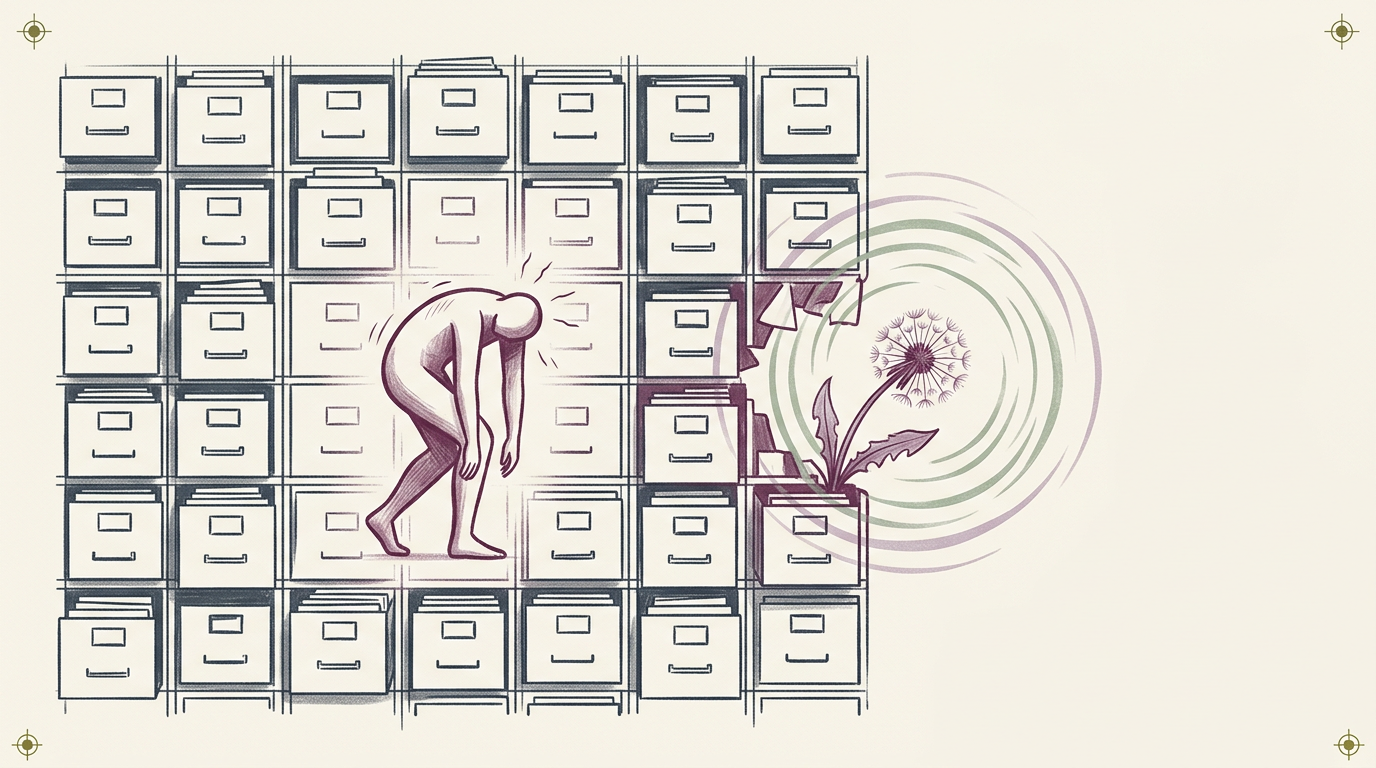
I used to believe that if I felt exhausted, I just needed to buckle down and optimize my routine. The wellness industry insists that the remedy for a fried nervous system is a second, unpaid job managing your recovery. I've stopped recommending that approach entirely. Wellness burnout is the predictable physiological response to the chronic stress of self-optimization. The constant monitoring of every biological metric forces a system already running on fumes to treat its own repair as a literal threat.
You wake up at 3am every night with your mind racing about the 15-minute meditation you forgot to do. There is a very specific tightness in your chest when your wearable gives your recovery a failing grade before your feet even hit the floor. You are tired but wired, staring at the ceiling while running a mental inventory of yesterday's macronutrients. By 3pm, the jaw clench returns, accompanied by brain fog that no amount of structured hydration clears. You sit on the couch scrolling through breathwork tutorials, feeling anxious for no reason and entirely disconnected from your body. You are exhausted but can't rest, because resting has become just another task you are currently failing at.
Common Questions
What is wellness burnout?
It is a state of physiological exhaustion triggered by the relentless pursuit of health. Your nervous system registers the constant tracking of biological data as a chronic stressor. The cognitive effort required to manage your wellbeing creates a persistent burden on your autonomic system, driving depletion rather than recovery.
Why does tracking cause stress?
Monitoring introduces a target, and targets introduce the possibility of failure. When you evaluate your sleep or heart rate against an external ideal, your brain interprets suboptimal numbers as a real danger. That vigilance activates the exact stress pathways you are actively trying to quiet.
How does this differ from standard burnout?
Standard burnout is typically driven by external demands from employers, caregiving, or finances. Wellness burnout is a paradox where the source of the persistent threat signal is the exact regimen you adopted to feel safe. The chronic stress stems directly from your own biological scorecard.
The biology of the optimization treadmill
I see this constantly in 1:1 Coaching: clients showing up with a 12-step morning routine, wondering why they feel worse. The effortful pursuit of wellness goals demands heavy lifting from your prefrontal cortex. This region is responsible for planning and impulse control, and in its zeal to hit a 10,000-step quota and drink 30g of protein before 8am, it constantly nudges the locus coeruleus.
That tiny nucleus in the brainstem acts as your primary source of noradrenaline. It is your alarm bell. Goal-striving keeps this alarm system on a low simmer, forcing the sympathetic nervous system to stay engaged all day. Over time, this chronic activation drives up your allostatic load—the cumulative wear-and-tear on your body from being stuck in a vigilant state. You are treating your own biology as a puzzle to be solved aggressively. Cortisol is just cortisol. Your body doesn't differentiate between the stress of an impending work deadline and the stress of a low heart rate variability score.
The tyranny of the tracker
The wellness industry has somehow turned breathing—a thing you've been doing without instruction since the day you were born—into a paid course. Kokorology've outsourced interoception to a fleet of apps. Interoception is the brain's capacity to sense its internal state, from the rhythm of your heart to the stretch of your lungs. Instead of feeling the background hum of fatigue, you wait for a notification on your wrist to give you permission to stop. Your Apple Watch, for the record, is not impressed by your suffering.
This abstraction creates distance between you and your actual state. True interoceptive awareness is analogue. It is the subtle feeling of your stomach clenching before a thought even registers as stressful. You can't rebuild this fundamental human skill by staring at more dashboards. I recommend leaving the watch on the charger for a day and using the Journal to notice what you actually feel. Reacquaint yourself with the raw data of your own tissues.
Your nervous system doesn't have a performance-review cycle. It has a rhythm.
Why "listening to your body" fails
"Listen to your body" is the platitude of the decade. I used to say it myself, until I realized how useless it is in practice. When you lack nervous system regulation, listening to your body is like taking directions from a person who is actively on fire. The signals are completely distorted by panic.
A system jacked up on stress hormones doesn't whisper for a nourishing meal and a gentle walk. It screams for a pint of ice cream, three hours of doomscrolling, and a fight with a loved one. A dysregulated state craves the familiar, even when the familiar is exactly what is driving the exhaustion. The work is first to build enough stability that you can begin to trust the signals again. That requires establishing safety through predictable, boring routines. Once the volume drops, you can distinguish the actual signal from the noise.
What to do this week
- Take a data holiday. Pick one metric you currently track—sleep, steps, macros, or HRV—and abandon it for three days. Hide the app. Take off the ring. Notice what happens to your jaw tension.
- Schedule 15 minutes of nothing. Block the time. You are not allowed to be productive, to meditate, or to improve yourself in any way. Just sit in a chair.
- Practice strategic inefficiency. Do one ordinary task at 75% speed. Wash the dishes or walk to the corner store slowly, on purpose. Let the system drop its guard.
- Use tiny interventions. When the anxiety spikes over a missed habit, use a physical reset from the Hacks library to change the state rather than overthinking it.
Where this fits in the Kokorology system
Wellness burnout reveals a system whose attempts at regulation have become a source of dysregulation. The move is away from anxious management and toward embodied awareness. The most effective starting point is a structured break from the noise, which is the entire premise of The Reset, the 7-day onramp.
Closing
The goal is to build a nervous system that is resilient enough that you don't have to think about it constantly. The path there runs on less effort. Withdraw the managerial oversight and let the machinery find its baseline. It is time to get well enough so you can actually get on with your life.
- Start with a structured withdrawal from the noise inside The Reset.
- Work with Kokorology to rebuild your baseline without the metrics inside 1:1 Coaching.
- Get the field notes on dropping the optimization treadmill in the free weekly newsletter.
TL;DR
Wellness burnout is the physical exhaustion caused by the relentless pursuit of self-optimization. When health becomes a set of performance metrics to be tracked, it changes from a source of restoration into a source of chronic stress. This constant self-monitoring keeps the brain's alarm centers active, elevating allostatic load and flooding the body with threat signals. The solution involves a strategic reduction in effort, deliberately ignoring the wearables and routines to allow the nervous system to naturally regulate and find its baseline.
Sources
- Bruce S. McEwen (2017). Neurobiological and Systemic Effects of Chronic Stress. Chronic Stress.
- Robert M. Sapolsky (2004). Why Zebras Don't Get Ulcers. Holt Paperbacks.
- Amy F. T. Arnsten (2015). Stress weakens prefrontal cortical connections: implications for childhood trauma. Neurobiology of Stress.
- Deborah Lupton (2016). The Quantified Self. Polity Press.
- Joseph Firth, et al. (2019). The "online brain": how the Internet may be changing the cognition. World Psychiatry.