For Coaches
Between Session Tracking for Therapists Without Spying
Your client sits in your office, regulated by the room and by you, and tells you they had a ‘bad week’. When you ask for specifics, the signal dissolves. They can’t quite recall the felt sense of the Tuesday morning shut
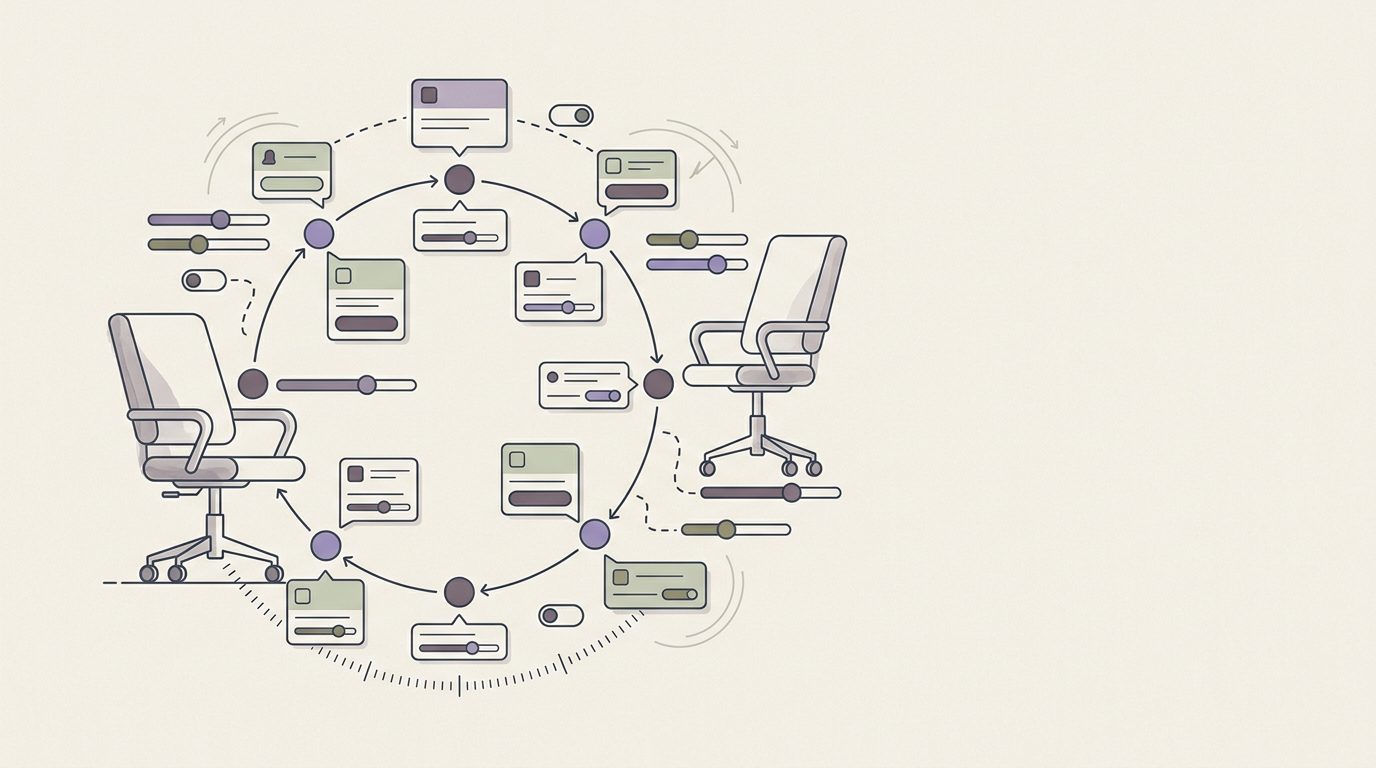
You ask a client how their week was, and they offer a vague, polite summary of a Wednesday meltdown that sounded apocalyptic in their email. The standard coaching move is to dig into the narrative and ask them to remember exactly how it felt. I've stopped doing this. Asking a regulated prefrontal cortex to accurately report on a Tuesday afternoon state of threat detection is like asking a sober person to write a reliable field guide to being drunk. The data only lives in the state itself.
Watch this happen in your own body before you look at your clients. You sit down in a quiet room, perfectly safe, trying to explain the "brain fog after eating" that derailed your entire afternoon yesterday. Or you attempt to describe why you were "anxious for no reason" at 11:47 p.m. last night. In the daylight, with a calm heart rate and decent vagal tone, the memory feels thin. You know you were staring at the open fridge with no hunger, your jaw locked tight enough to crack a molar, completely unable to finish a simple email. You were "tired but wired," but right now, in the safety of the present moment, you can't actually touch the texture of that panic. The physiological state has cleared. The nervous system updated its threat assessment, and the raw sensation simply packed up and left.
Common Questions
What is between-session tracking, really?
It is a client-led, opt-in method for capturing physiological data in the moment. It avoids the detailed narrative essay and prompts for a quick, body-scored rating on energy or activation. This provides a high-fidelity, low-lift signal of their nervous system's weather pattern throughout the week.
Does this create more homework for the client?
Traditional journaling demands a dysregulated person act as a coherent author. A few taps in an app like the Kokorology Journal offers a much lower barrier to entry for self-awareness. It turns a massive cognitive lift into a brief moment of interoceptive contact.
How does this change the actual session?
It scaffolds the conversation with a verifiable map. You transition from asking open-ended questions about their week to noticing their energy consistently cratered around 3 p.m. on weekdays. It grounds the session in concrete data, bypassing the story they managed to assemble in the waiting room.
The Amnesty of the Regulated Room
Every practitioner knows the client who emails in a frantic, dysregulated state on Sunday night, only to arrive for their Wednesday session calm, articulate, and insightful. The fire is out, and the evidence has been swept away. When your client is co-regulated with you in the safety of your office, their prefrontal cortex is back online. They literally cannot access the raw, non-verbal somatic reality of their earlier state. The regulated room offers an amnesty on past states. Demanding they recount it is asking them to perform a memory they no longer inhabit. I used to view this as resistance; I now see it as basic physiology.
Narrative Burden and the Autonomic Shift
Kokorology've placed a massive cognitive load on a system running on fumes by asking for a coherent story. "Tell me about it" places a huge demand on a person whose autonomic shift has already pulled resources away from language processing. Traditional blank-page journaling compounds this demand. A simple, body-scored check-in bypasses the storyteller and queries the system directly. A one-to-five rating on sleep pressure or a simple tag for jaw tension acts as a seismograph picking up a tremor. Kokorology want a clean reading from the machine, without requiring them to write a tragedy about it.
Nerd Out: Prefrontal Load and Pattern Recognition
The neurovisceral integration model maps exactly how prefrontal neural function and heart rate variability link to cognitive performance. When a client shares their weekly data, you're looking at the heatmap of that integration. Kokorology map interoception. I don't actually care that a client logged 'anxious' at 2:07 p.m. on Tuesday.
A single data point is just gossip. A pattern is a diagnosis.
You step back into the role of city planner, tracking the signature of the physiological escalation to see the landscape of their nervous system from above. The raw numbers show you exactly when the sleep anchor failed or when the midday coffee triggered an arousal spike.
Building a Collaborative Dashboard
Let's be clear: this requires a client-owned, opt-in architecture. The client records their data for themselves, and chooses to share the patterns. This choice preserves their agency. The client remains the only expert on their own interoceptive experience, and the tools must reinforce that reality. Kokorology teach this exact dynamic inside the certifications because therapeutic outcomes heavily depend on this sense of collaboration. You are both looking at the dashboard together, figuring out how the engine runs.
What to do this week
Want to experiment with this without a fancy app? Run this low-fi protocol.
- Reframe the ask. Stop assigning journaling. Assign data capture. Tell your client you're going to be scientists together for one week.
- Pick one metric. Energy (-3 to +3) is a solid starting point. Or track "tension in my jaw" on a 1-5 scale. Keep it dead simple.
- Set a schedule. Ask them to log it three times a day: morning, midday, evening. It'll take under ten seconds each time.
- In session: look at the pattern together. Lay out the numbers. Locate the peaks and troughs.
- Ask, then stop talking. The only question you need is, "What do you notice when you look at this?" The client's own insight, sparked by seeing their physiological reality objectified, will do the heavy lifting.
Where this fits in the Kokorology system
This approach is a direct application of the Kokorology pillar of Nervous System Regulation. It uses a simple mechanism to build the foundational skill of interoceptive awareness, which Kokorology track and cultivate using the Kokorology Journal. The goal is to build a dataset that allows for smarter, more targeted interventions, a methodology Kokorology map extensively inside the coaching frameworks.
Closing
By shifting from narrative to data, you equip your clients to see the architecture of their present state. You step away from being a confessor and become a collaborator, looking at the same dashboard, figuring out exactly how the machine works together.
- Continue the deep dive inside the Practitioner Certifications.
- Start with the Practitioner Pack & sample client screens.
- Give your clients a tool to practice it daily inside the Kokorology Journal.
TL;DR
Your clients cannot accurately recall the felt sense of a dysregulated state once they sit regulated in your office. State-dependent memory prevents it. By using between-session tracking to capture body-scored physiological data in the moment, you bypass the need for narrative recall. This collaborative, opt-in approach shifts your work from the forensic interrogation of events to recognizing somatic patterns. It builds the therapeutic alliance by making you co-navigators of their nervous system's architecture.
Sources
- Khalsa SS, Adolphs R, Cameron OG, et al. (2018). Interoception as a dimensional framework for understanding anxiety. Biological Psychiatry: Cognitive Neuroscience and Neuroimaging.
- Thayer JF, Hansen AL, Saus-Rose E, Johnsen BH (2009). Heart Rate Variability, Prefrontal Neural Function, and Cognitive Performance: The Neurovisceral Integration Model. Journal of Personality and Social Psychology.
- Norcross JC, & Wampold BE (2019). The alliance in context: Accomplishments, challenges, and future directions. Psychotherapy, 56(1), 1-4.
- Ogden P, & Fisher J (2015). Sensorimotor Psychotherapy: Interventions for Trauma and Attachment. W. W. Norton & Company.