Nervous System
Before the Hyperbaric Chamber: the Boring, Free Interventions That Move the Needle Most
The industry sells $30,000 oxygen pods when a twenty-minute run does the same job. Here are the basic practices that actually shift your state.
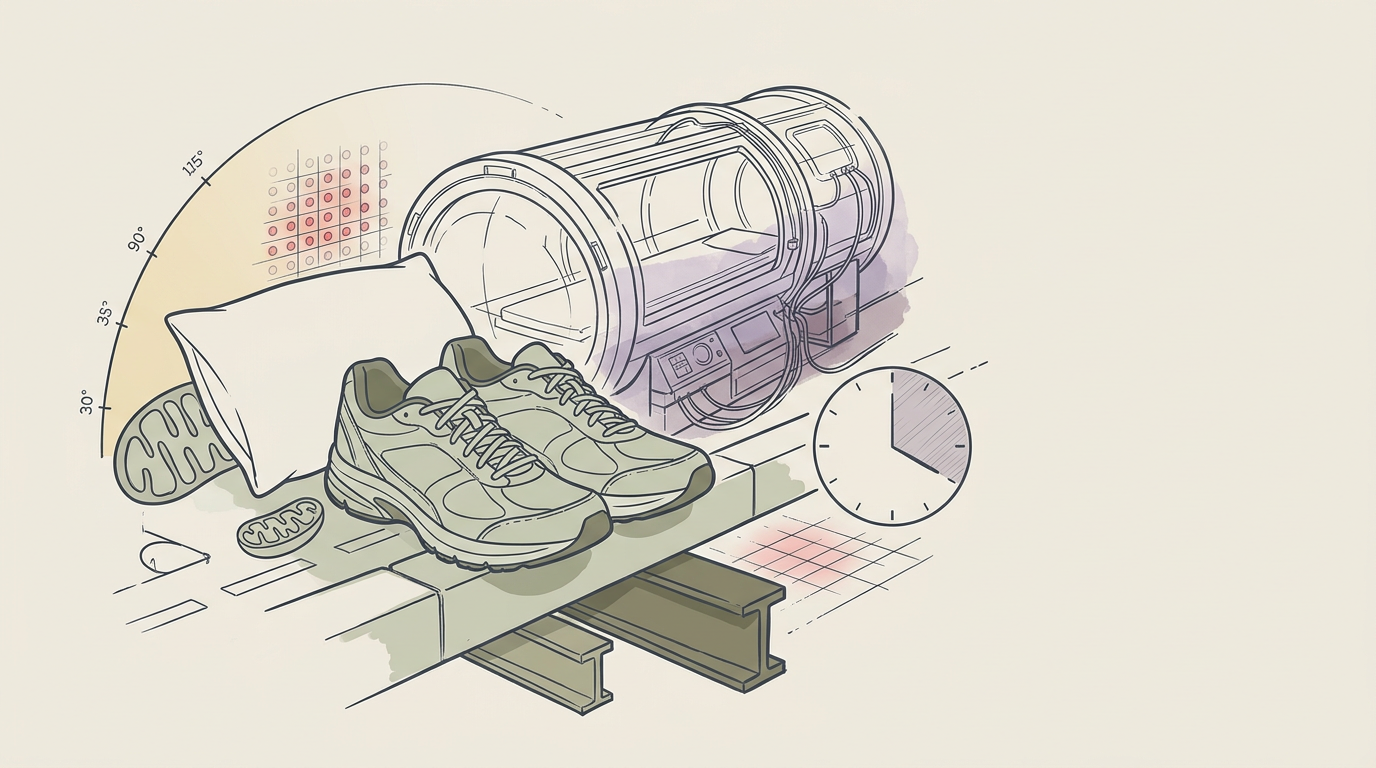
A friend recently asked me if she should buy a $30,000 soft-shell hyperbaric chamber. She hadn't gone for a run in roughly three years. I asked her this gently, the way you ask someone whether they've tried turning the laptop off and on again. The optimization industry treats the nervous system like a gadget rack, insisting that cellular health requires proprietary equipment and a subscription fee. Kokorology're attempting to buy the way out of autonomic dysregulation using tools that only work on an already capable body.
This is what happens when baseline capacity narrows. You wake up at 3am every night, jaw clamped tight, staring at the ceiling while your mind loops through an entirely mundane email. The second coffee of the morning doesn't register, leaving you tired but wired as you sit down for your first meeting. You open the fridge at 3pm with no actual hunger, just a vague need to change the channel in your head. You finally get into bed, and having your heart racing when you lie down just makes you feel disconnected from your body. The physiological state has drifted, and no amount of online shopping will correct it.
Common Questions
What is autonomic dysregulation?
It's a state where your nervous system loses the ability to shift smoothly between activation and rest. Your body perceives ordinary demands as threats, keeping stress-response loops engaged long after the immediate challenge has passed.
How does morning sunlight affect the nervous system?
Light exposure in the first hour of waking signals the suprachiasmatic nucleus in the brain to halt melatonin production and initiate the daily cortisol pulse. This establishes your circadian rhythm, which governs energy, mood, and sleep pressure.
Why is zone-2 cardio important for recovery?
Low-intensity, steady-state movement increases capillary density and mitochondrial volume. This expands your physical capacity to clear physiological waste, making your baseline state more resilient to daily spikes in demand.
The protocol is never the obstacle
I used to believe that if someone just had the perfect, scientifically validated routine, they'd do it. I was wrong. The information is rarely the missing piece. Kokorology have access to more biological data than any generation in history, yet Kokorology are chronically depleted. The brain under prolonged allostatic load preferentially seeks novelty and immediate reward. A $30,000 purchase decision activates dopaminergic reward circuitry instantly. A twenty-minute walk doesn't. Kokorology crave the gadget because the nervous system, hovering in hypervigilance, picks the massive dopamine hit over the steady, accumulating drip of an actual habit.
The problem is the sequence. Tools like hyperbaric oxygen therapy show genuine promise for traumatic brain injury and tissue healing. If your aerobic base is so detrained you get winded on a flight of stairs, the limiting factor on oxygen delivery to your tissues is your capillary density and mitochondrial volume. You build those variables by walking briskly a few times a week. The advanced interventions deliver a slight enhancement on a regulated baseline.
Sunlight over panels
Morning sunlight delivers roughly 10,000 to 100,000 lux of light intensity. The best home red-light panels deliver a narrow band of wavelengths at a fraction of the intensity the sun gives you for free. Going outside within an hour of waking establishes the circadian pacemaker. This single input governs your cortisol rhythm, melatonin onset, and evening sleep pressure.
The most powerful biological interventions available to the system are entirely unsexy, which is precisely why no one can sell them to you.
I'm seeing clients spend thousands on specialized panels while waking up in dark rooms and staring immediately at their phones. Start with the sun. When you can consistently get outside before 9 a.m. for a month, then you can look at the peptide catalogue. The peptide market is largely solving a metabolic problem that a modern diet created. If you eat in a fourteen-hour window and avoid fiber, no semaglutide analogue will outpace what a protein-forward, real-food week does for your inflammatory state.
Movement as a metabolic regulator
You don't need a metabolic cart strapped to your face to begin expanding your cardiovascular capacity. You need rhythmic, steady movement. Post-meal walking directly influences the autonomic nervous system by downshifting sympathetic activation. It clears glucose from the bloodstream using muscle contraction independent of insulin.
When Kokorology look at the brain under chronic stress, the imaging data reveals a widening gap between demand and recovery. The prefrontal cortex struggles to maintain top-down control over the amygdala. Steady-state movement gives the nervous system a predictable, rhythmic motor pattern to organize itself around. It metabolizes circulating adrenaline. It pulls the brain out of the threat-detection loop. This expands your baseline capacity, allowing you to handle the next stressor without tipping into static. I've stopped recommending any supplementary device until this basic physical machinery is running. I test every protocol on myself first, and the single biggest shift in my own metabolic health came from pacing the block after lunch.
What to do this week
- Walk outside within sixty minutes of waking. Ten minutes minimum. No sunglasses.
- Eat three protein-anchored meals. Stop consuming food at least two hours before bed.
- Walk briskly for twenty minutes after your heaviest meal of the day.
- Engage in one unhurried, undistracted conversation with a human being who is fond of you.
Where this fits in the Kokorology system
Expanding your baseline capacity is the core objective of the Regulation foundations course. When you need immediate tools to manage the daily static, the Hacks library offers sixty-second interventions. For a deeper understanding of how these mechanisms interact with your daily routine, explore the Journal for tracking your daily physical state.
Closing
Do the boring, unsexy things consistently. Expand the physical capacity of your body before you introduce a single optimization device. When the baseline holds, the physical inputs actually have something to work with.
- Start expanding your capacity in Regulation L1
- Find targeted protocols inside the Anchors
- Read the free guide to nervous system foundations
TL;DR
The optimization industry sells expensive gadgets that promise to fix chronic exhaustion and dysregulation. These devices provide slight enhancements that only work on an already capable baseline. True nervous system regulation requires free inputs like morning sunlight, steady-state movement, and consistent sleep. Expanding your physiological capacity happens through rhythmic, daily habits that govern cortisol pulses and clear metabolic waste, long before you ever need to purchase a piece of equipment.
Sources
- Chmiel, A., et al. (2025). Burnout and the brain: a mechanistic review of MRI studies. International Journal of Molecular Sciences.
- Dijk, D.J., & Czeisler, C.A. (1995). Contribution of the circadian pacemaker and the sleep homeostat to sleep propensity, sleep structure, electroencephalographic slow waves, and sleep spindle activity in humans. The Journal of Neuroscience.
- Volkow, N. D., Wang, G.-J., & Baler, R. D. (2011). Reward, dopamine and the control of food intake: implications for obesity. Bioessays.
- Buffey, A. J., et al. (2022). The acute effects of interrupting prolonged sitting time with short-duration walking on glycaemic control. Sports Medicine.
- Efrati, S., & Ben-Jacob, E. (2014). Reflections on the neurotherapeutic effects of hyperbaric oxygen. Restorative Neurology and Neuroscience.