Trends
Anthropic Wants To Make Drugs Now. Read The Fine Print.
A frontier AI lab developing its own drugs creates a closed loop of diagnosis and prescription. Your biology becomes a recurring revenue stream.
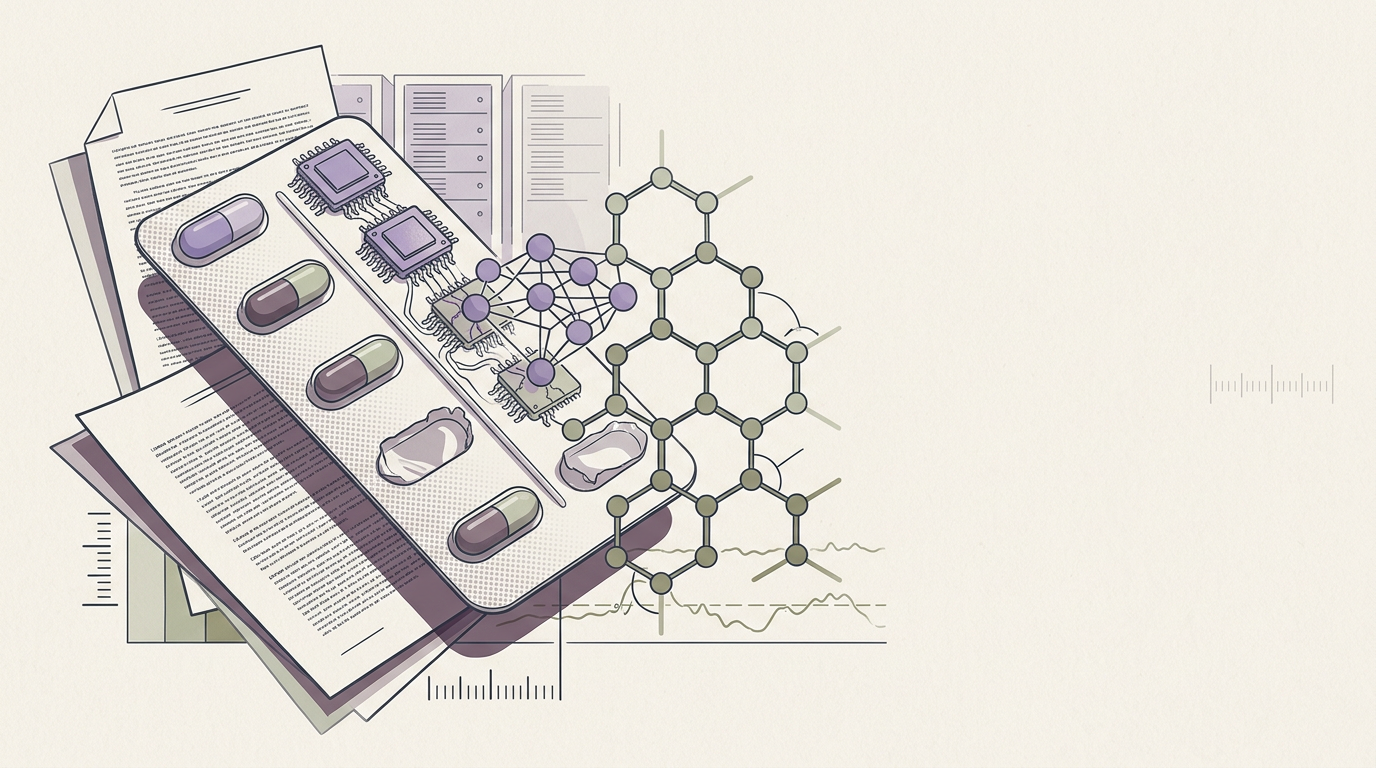
The tech press is currently celebrating AI drug development as a miracle of compressed timelines and bespoke molecules. I am calling it. An algorithm generating compounds to hit specific targets sounds like progress. It is fundamentally a system designed to keep the nervous system in a heavily managed state of baseline arousal. The HPA axis—the stress-hormone control loop that runs from your brain to your adrenal glands—becomes just another data stream to be monitored, modulated, and packaged by a server.
You already know the exhaustion of living as a data point. You wear the tracker, check the recovery score, and feel a quiet dread when the screen flashes red. You're tired but wired at 11:47pm, scrolling through optimisation threads while your jaw stays locked. You wake up at 3am every night, trying to figure out which variable you mismanaged. The fridge is open but you have zero hunger. Your shoulders won't drop in the shower. You are anxious for no reason, waiting for a device to tell you what to do next. When your physiology feels like a failing project, a molecule engineered perfectly for your specific fatigue profile sounds incredibly appealing.
Common Questions
How does AI change drug discovery?
In parts of the pipeline, algorithms identify targets and optimise trial arms incredibly fast. In the parts that matter to a physical body, safety and off-target effects still require slow, human, expensive observation. Speed at the top of the funnel doesn't translate to speed at your kitchen counter.
Will algorithm-designed drugs be safer?
They're going to be precise. Precision guarantees a targeted effect, and it guarantees very specific side effects. You still have to metabolise the compound, and your liver functions exactly the same way it did a thousand years ago.
Should I track my biometrics differently now?
Track them to understand your own baseline, rather than to grade your daily output. Guard your data. The model that decides what counts as a condition is owned by the exact same company selling the treatment.
The closed loop
The press releases focus heavily on altruism and cured diseases. I don't buy it. Most longevity tech is just avoidance with better packaging. Frontier AI labs require massive computing power, and drug development sustains it. When the same company trains the model on your health data and manufactures the compound that alters your state, the dynamic shifts entirely. You become the product, the consumer, and the testing ground simultaneously.
I used to believe that more health data was automatically empowering. I spent years assuming that if Kokorology just had better biometrics, Kokorology could perfectly calibrate the physical capacity. I was wrong. I completely missed how easily observation turns into pathologising normal human variance. If an AI model compares your sleep staging against a billion peers, a slightly restless Tuesday becomes a treatable condition.
The physiological response
Let's look at what actually happens in the body when Kokorology outsource regulation. The vagus nerve acts as the parking brake of the nervous system; pull it, and the engine quiets. When you rely entirely on an external chemical cue to force that brake, interoception degrades. Interoception is your brain's ability to perceive your internal physical state. You can read the clinical papers on this inside the Library, but the mechanism is plain: the brain simply stops practising how to read its own signals.
Allostatic load—the physiological wear and tear of chronic stress—accumulates rapidly because the external intervention suppresses the immediate symptom without altering the environmental demand. The resting heart rate drops, the cortisol spike flattens, but the organism learns helplessness. You'll see a quiet chemical suppression of an under-resourced nervous system that would simply rather feel less than endure the friction of its actual environment.
I've stopped recommending any protocol that ignores this basic mechanism inside the Performance curriculum. A drug is a very fast patch. It patches the immediate output, introduces its own maintenance schedule, and entirely ignores the underlying capacity.
A moving benchmark
When an algorithm can rank you against a global dataset, average stops being acceptable. Everything a hair below a moving benchmark becomes something to medicate. The number of states worth taking a pill for goes up continually.
The tech industry has somehow turned breathing—a thing you have been doing without instruction since the day you were born—into a paid course. Now they're coming for your biochemistry. The inbox hasn't ever been impressed by your heart rate, but a server will gladly package the resulting cortisol spike into a new diagnostic category.
A strong nervous system does not renew monthly.
The unpatchable part of a human is the mitochondrial capacity, the muscle mass, the circadian rhythm, the social bond. You build them slowly with load, breath, food, dark, light, and other humans. That's the part a frontier AI drug company has absolutely no incentive to sell you. A robust, regulated body metabolises efficiently, absorbs predictably, and tolerates stress effectively. The healthier your baseline, the less you depend on the pipeline.
What to do this week
- Pick one biometric an AI drug company would love to track for you—sleep, glucose, resting heart rate, HRV. Track it for seven days without changing a single habit. Note the pattern.
- Do the boring inputs for that same biometric: consistent lights-out, protein at breakfast, ten minutes of nasal breathing at midday, a walk after dinner. Track again for seven days.
- Compare the two weeks. Notice what a functioning body will do on its own before a molecule is invited in.
- Write down every prescription, supplement, and biometric subscription in one list. Ask which ones exist because the baseline is broken.
Where this fits in the Kokorology system
Every tool in the Anchors library exists for one reason: to make the body less dependent on external inputs to stay regulated. The Journal tracks the inputs a pipeline cannot sell you—sleep quality, movement, food, breath, connection. This ensures decisions about your capacity get made against a baseline you built, not a benchmark someone else set. If you are deeply stuck in a cycle of outsourcing your regulation, the Coaching sessions focus entirely on rebuilding that internal read.
Closing
Guard your baseline. It is the only definition of well nobody can edit remotely.
- Start with nervous system regulation as the baseline every other decision sits on.
- Keep the Journal as a private record of the inputs no pipeline owns.
- Add Reset if you need a structured seven-day onramp back to feeling your own physical signals.
TL;DR
A frontier AI lab making its own drugs is a straightforward business decision designed to sustain massive compute demands. The danger lies in the closed loop. When the same company owns the model that interprets your health data and manufactures the pill to alter your state, your biology becomes a subscription service. Guard your allostatic load and build a strong physical baseline that the pipeline cannot sell back to you.
Sources
- Khalsa SS, Lapidus RC (2016). Can Interoception Improve the Public's Health?. Frontiers in Neuroscience.
- Shaffer F (2017). An Overview of Heart Rate Variability Metrics and Norms. Frontiers in Public Health.
- Reuters (2026). Anthropic announces internal drug development pipeline. CNBC.
- Stat News (2026). Frontier AI labs move into biotech and payer economics. Stat News.