Trends
Why You Should Care That AI Companies Are Buying Into Your Health
Stripe, Anthropic and OpenAI just co-funded a respiratory-infection push. This isn't charity — it's an acquisition. They need your biology online. Here's the hidden agenda, and why your nervous system is the real asset.
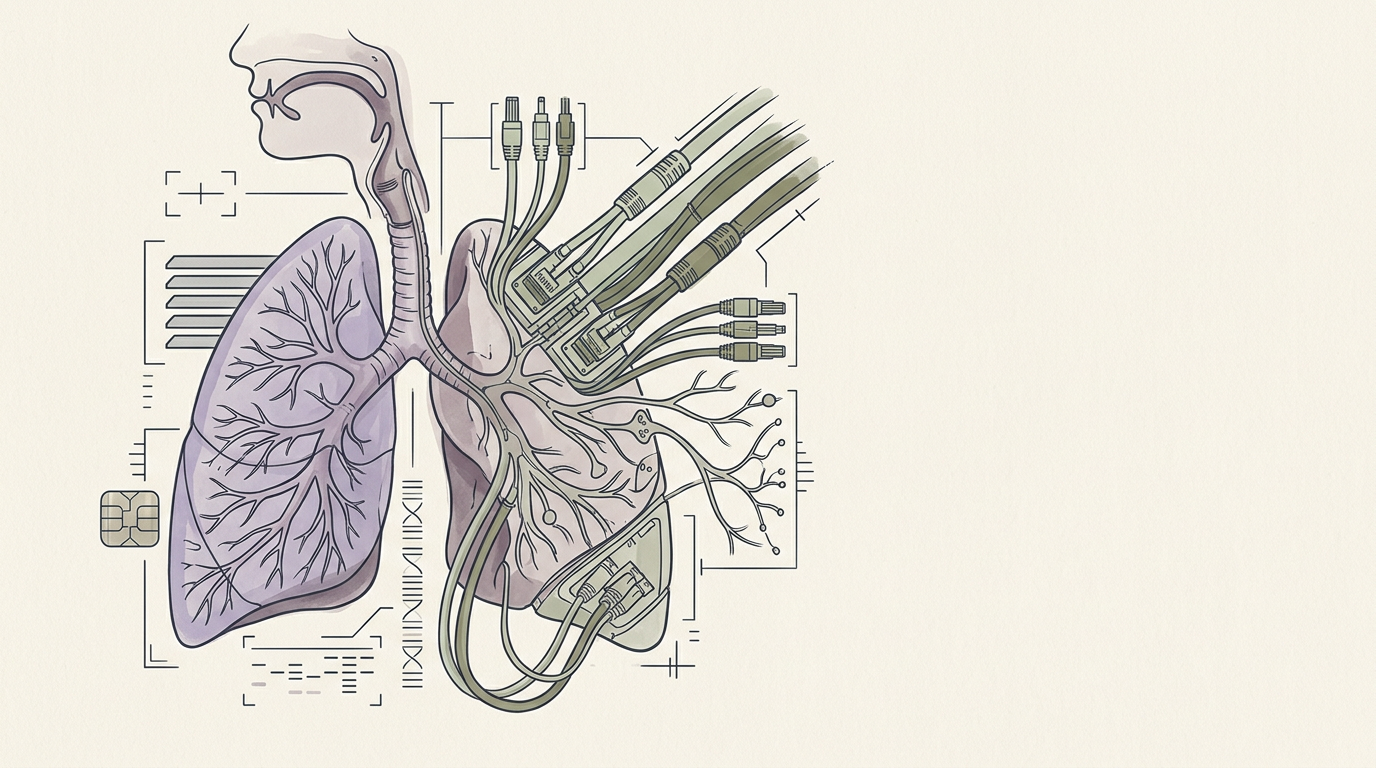
When three of the most powerful companies on earth quietly co-fund a project on respiratory infections, the right question isn't "isn't that nice?" — it's "what do they get out of it?"
This week MIT Technology Review reported that Stripe, Anthropic, and OpenAI are bankrolling research to prevent the next respiratory pandemic. A payments giant and two of the most aggressive AI labs in the world, suddenly very interested in your lungs. Cute.
Most coverage stopped at "tech billionaires do public good." That framing is the magician's other hand. The real story is an architectural one — about who owns the upstream of your biology, and what happens to your nervous system when health stops being a public good and starts being infrastructure owned by private labs.
The hidden agenda (it's not a secret, it's just unsaid)
Three things are simultaneously true. None of them are evil. All of them should make you pay attention.
1. Healthy humans are the substrate AI needs. Frontier AI is bottlenecked by humans — humans to train on, humans to sell to, humans to keep the economy producing the energy and capital these models eat. A population running on long COVID, chronic fatigue, and brain fog is a degraded substrate. Preventing respiratory infections isn't philanthropy; it's protecting the operating environment.
2. Biology is the next great dataset. Language was the warm-up. The real prize is modelling immune responses, protein folding, viral evolution — systems with trillions of interacting parts that no human brain can hold. Funding respiratory-infection research gives these labs access to the gnarliest, most valuable dataset on earth: human health at scale. They aren't sponsoring research. They're acquiring training data with a halo on top.
3. Whoever owns prevention owns the customer for life. Public-health infrastructure used to belong to governments, the WHO, university hospitals. Slowly, quietly, it's being absorbed by the same handful of companies that already own your attention, your payments, and your inbox. If they can also own the model that predicts when you'll get sick — and the agent that intervenes — they own the entire arc of your biology. That is a much stickier product than a chatbot.
This isn't a conspiracy. It's just capitalism doing what capitalism does, in a sector that used to be insulated from it. The hidden agenda isn't hidden. It's just unflattering, so nobody says it out loud.
Related anchors: vagal tone anchor · sleep anchor · gut-immune anchor
Why this is a nervous system story, not a lung story
Here's the part the press release won't tell you.
A respiratory infection is not a lung event. It is a nervous system event.
When a pathogen lands, your immune system floods the body with inflammatory messengers called cytokines. The brain finds out via the vagus nerve — the "inflammatory reflex" mapped by neurosurgeon Kevin Tracey (2002). The vagus is a load-bearing sensor wired into every major organ; it reads the inflammatory weather and reports back to command.
The brain's response is "sickness behavior" — the fatigue, brain fog, social withdrawal, appetite loss. That isn't weakness. It's a non-negotiable directive to shut down non-essential operations and pour every available watt into immunity.
One bad flu, your system recovers. Repeated hits, incomplete recovery, and you start accumulating what neuroscientist Bruce McEwen (1998) called allostatic load — the cumulative structural debt of being on biological high-alert too often. Cortisol stays elevated. HRV drops. Sleep architecture fragments. A low-grade inflammatory hum becomes the new baseline. Your capacity to focus, recover, and feel anything other than tired is systematically degraded.
So when these labs talk about "preventing respiratory infections at scale," they are also — whether they say so or not — talking about preventing millions of nervous systems from being shoved into high-load states over and over again. That is enormous downstream power. The question is who holds it, and on what terms.
What you actually need to care about
Three things, in order of how much they should bother you.
Sovereignty. If a small number of private companies become the upstream of human health, you don't get to opt out. You can refuse a social network. You cannot refuse the air quality model that decides whether your school gets masks in October. Notice who's quietly buying that lever.
Bias in the model. Health AI is trained on whoever's data is available. Historically that means wealthy, Western, male, often white. If the next generation of "preventative" infrastructure is built on that substrate, the people most likely to be missed are the same people who've always been missed — only now with the authority of a model behind it.
Your own architecture. Macro-level prevention does not absolve you of personal load. It just changes what's downstream. The more health becomes a model someone else runs on your behalf, the more important it is that you can still read your own signals.
What to do with this
Stop being a passive node. Become a legible one.
Map your own structural readouts. Resting heart rate, HRV, sleep depth, subjective energy — track them in a nervous system journal so you can see your own patterns before any model does. You want to be the person who notices their HRV drop a day before the sore throat, not the person waiting for a notification.
Tune your vagal tone. Slow exhales, cold exposure, humming, gargling — the boring practices that nudge the vagus toward better signal-to-noise. A well-toned vagal system manages inflammation more cleanly, which means fewer of those allostatic-load deposits.
Lower the total load. Infections aren't the only input. Sleep debt, chronic stress, ultra-processed food and screen-late-into-the-night all stack onto the same bill. You can't dodge every virus, but you can stop adding to the tab.
Common Questions
Q: Aren't you being cynical? Maybe they just want to help. A: Motive doesn't change the outcome. Even if every founder is sincere, the structural result is the same — a handful of private companies sitting upstream of public health. The question isn't whether they mean well. It's whether you want any single entity to own that position.
Q: Why drag the nervous system into a story about AI funding? A: Because that's where the consequences land. Respiratory infections are a delivery mechanism for systemic inflammation, vagal signalling, and allostatic load. If you only look at lungs, you miss the actual physiology being shaped. The nervous system is the system administrator; everything else is endpoints.
Q: What do I do, practically, if I don't trust this trend? A: Trust isn't binary. Use the macro infrastructure when it serves you, and keep your own data so you're never fully dependent on it. Sovereignty in this era is mostly literacy — knowing your own baselines, your own triggers, your own recovery curves.
TL;DR
- Stripe, Anthropic, and OpenAI co-funding respiratory-infection research isn't charity — it's a strategic move on the upstream of human health.
- They need healthy humans as substrate, biology as training data, and prevention as the stickiest possible product.
- The downstream physiology is a nervous system story: infections drive vagal load and allostatic debt (Tracey 2002, McEwen 1998).
- Care because sovereignty, bias, and personal capacity are all now in play. Track your own architecture so you stay legible to yourself, not just to someone's model.
Sources
- MIT Technology Review. (2026). Stripe, Anthropic, and OpenAI are co-funding an effort to stop respiratory infections.
- Tracey, K. J. (2002). The inflammatory reflex. Nature, 420(6917), 853–859.
- McEwen, B. S. (1998). Stress, Adaptation, and Disease: Allostasis and Allostatic Load. Annals of the New York Academy of Sciences, 840(1), 33–44.