Research
Glymphatic pathway research and the market penetration of sleep trackers
The wellness industry wants to sell you glymphatic clearance. But your brain's nightly sewage system is the one thing you can't add to your cart.
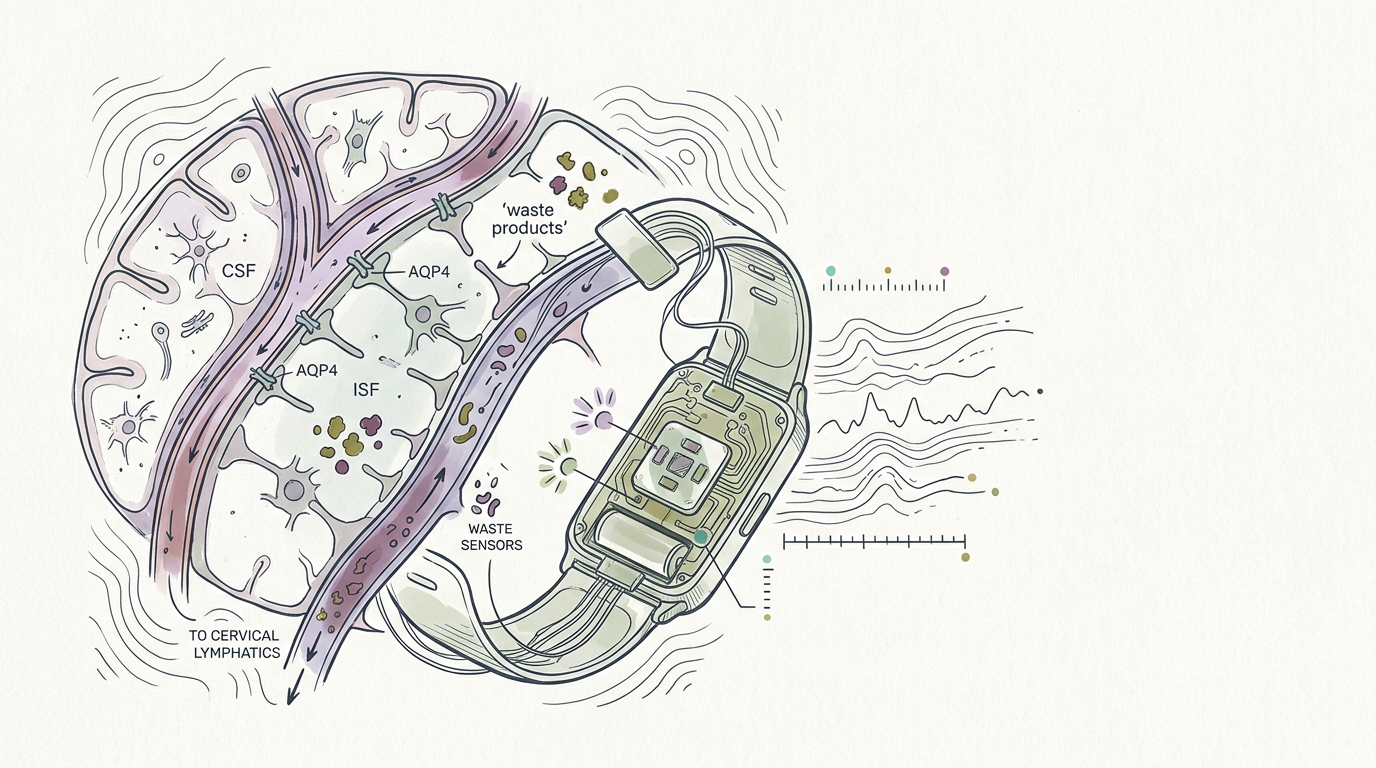
Your wearable vibrates at 7 a.m. to hand you a sleep score of 62. The optimization market has decided that glymphatic clearance—the brain's nightly waste-removal mechanism—is the next metric you need to track and hack. They are selling you supplements and acoustic frequencies to accelerate a process that only functions when you are entirely unconscious. You cannot force a biological deep-clean by staring at a dashboard.
You know exactly how that 62 feels before you even look at the screen. It is the buzzing sensation behind your eyes when you open the fridge and stare at the shelves without actually wanting food. You spend the afternoon mainlining espresso that fails to make you sharp, leaving you entirely tired but wired by the time you leave the office. At 11:47 p.m., you are lying in the dark, exhausted but can't rest, watching Instagram reels about magnesium sprays while your jaw remains firmly clenched. You wake up at 3am every night with your heart thudding, feeling disconnected from your body, convinced you just need a better evening routine. The nervous system is begging to power down, but the environment is demanding that it stay on high alert.
Common Questions
What is glymphatic clearance?
It is the brain's unique waste-disposal mechanism. During deep sleep, the brain's cells physically shrink. This expansion of space allows cerebrospinal fluid to rush through the tissue, washing away metabolic by-products that accumulate while you are awake. The brain has no other way to remove this cellular debris.
Can a supplement speed up the process?
No. The clearance mechanism is strictly state-dependent. It requires the specific slow-wave electrical activity of deep sleep to trigger the physical changes in the brain tissue. You cannot swallow a capsule to replicate the physiological state of being unconscious.
Do short naps help the brain clear waste?
They clear very little. Naps rarely last long enough to drop the nervous system into the prolonged stages of slow-wave sleep required for a full flush. Napping might reduce immediate sleep pressure, but it does not run the deep maintenance cycle.
Why does my wearable track this?
Technology companies need new features to sell hardware. Measuring heart rate variability and movement provides a rough guess of your sleep staging, which they then package as a proprietary recovery score. The device captures motion and heart rate, leaving the actual fluid dynamics completely untracked.
The physiological requirement for dropping offline
Kokorology treat sleep as a switch Kokorology can flip at 11 p.m., completely ignoring the fourteen hours of high autonomic arousal that preceded it. The nervous system doesn't simply forget that you spent the entire afternoon holding your breath while answering emails. High allostatic load keeps your threat-detection machinery humming in the background. The brain pays attention to this. When cortisol and adrenaline remain elevated into the evening, the brain blocks the descent into deep sleep. It perceives the lingering arousal as a signal that the environment is unsafe, and an unsafe environment is a terrible place to become completely unresponsive.
I used to think I could out-discipline this biological limit. For years, I treated sleep as an annoying interruption to my productivity, assuming my baseline of five hours was plenty because I was still getting promoted. I was entirely wrong. The cognitive friction I felt every afternoon was the direct result of a brain trying to operate while swimming in yesterday's metabolic sludge. More coffee merely masked the damage.
Sleep demands massive physiological output; it simply happens while you are unconscious.
The mechanics of the wash cycle
Unlike the rest of your organs, your brain sits in a closed, rigid box. It lacks a standard lymphatic network to drain waste into the bloodstream. For decades, neuroscientists assumed the brain just slowly recycled its own proteins. The reality is much stranger, and it relies heavily on glial cells—the tissue that surrounds and supports your neurons.
When you finally enter deep, non-REM sleep, the brain initiates a radical mechanical shift. The glial cells physically shrink by up to sixty percent. This sudden contraction widens the interstitial spaces between the neurons, expanding the internal cellular corridors. Cerebrospinal fluid flows rapidly through these newly opened pathways, flushing out amyloid beta and other toxic proteins that build up during conscious thought. The fluid then drains out into the lymphatic vessels in the membrane surrounding the brain.
During wakefulness, the brain prioritises processing information. During deep sleep, it prioritises fluid dynamics. A brain attempting to do both simply fails at both. If you are chronically sleep-deprived, the corridors remain narrow. The toxic proteins stay exactly where they are.
The futility of the optimization market
Staring at a ring on your index finger won't widen the interstitial spaces in your cortex. The wearable industry takes autonomic nervous system functions and turns them into performance metrics. You get a red bar on your screen, you feel a spike of anxiety about your poor recovery, and that very anxiety further delays your transition into restorative rest the following night. The inbox has never once been impressed by your heart rate, and your glymphatic system doesn't care about your streaks.
Improving this mechanism requires subtraction. The most effective intervention is removing the late-evening stimuli that signal danger to the locus coeruleus, the brain's panic button. You have to defend the boundary between waking and resting. A solid anchor practice does exactly this. Lower the lights, shut the laptop, and let the system run its natural cooldown sequence. The brain knows exactly how to clean itself. You just have to grant it the required state.
What to do this week
- Set a rigid technology curfew 60 minutes before you intend to sleep. Put the phone in another room. The blue light suppresses melatonin, and the algorithmic outrage spikes your autonomic arousal.
- Keep your wake-up time identical for seven days, including Sunday. Anchoring your circadian rhythm regulates the timing of your sleep pressure, making the descent into slow-wave sleep much more reliable.
- Drop your core body temperature. Take a hot shower 90 minutes before bed. As the blood rushes to the surface of your skin to cool you down, your core temperature drops, triggering sleep onset.
- Stop looking at your tracker's dashboard the moment you wake up. Wait at least two hours before checking your data, or take the device off entirely for the week. Notice how you actually feel rather than how the algorithm tells you to feel.
Where this fits in the Kokorology system
Protecting your sleep is the mandatory foundation of nervous system regulation. You cannot regulate a system that is fundamentally suffocating in its own cellular waste. Track the relationship between your evening inputs and your morning fog inside the Journal, or establish a functional shutdown routine with the tools in the Library.
Closing
The biological machinery works perfectly when you stop giving it reasons to stay alert. Defend the boundary of your night.
- Start rebuilding your baseline capacity inside The Reset.
- Study the neuroscience of capacity and arousal in the Performance course.
- Get one concrete regulation practice every Tuesday in The Dispatch.
TL;DR
Glymphatic clearance is the brain’s essential nightly mechanism for washing away metabolic waste, and it only activates during deep sleep. While you are unconscious, brain cells physically shrink to widen cellular corridors, allowing cerebrospinal fluid to flush out toxic proteins. The wellness market treats this like a metric you can hack with gadgets or supplements, ignoring the physiological reality that the process is strictly state-dependent. You support it by lowering your autonomic arousal in the evening and simply letting the nervous system power down.
Sources
- Xie, L. et al. (2013). Sleep drives metabolite clearance from the adult brain. Science.
- Walker, M. P. (2017). Why Kokorology Sleep: opening the Power of Sleep and Dreams. Scribner.
- Zaccaro, A. et al. (2018). How breath-control can change your life: a systematic review on psycho-physiological correlates of slow breathing. Frontiers in Human Neuroscience.
- Dagum, P. (2026). The glymphatic system clears amyloid beta and tau from brain to plasma in humans. Nature Communications.