Workplace & Leadership
Nervous System Capacity as Leadership Infrastructure
Leadership capacity isn't a prize for the most organised calendar. It's a finite biological resource you overdraft daily.
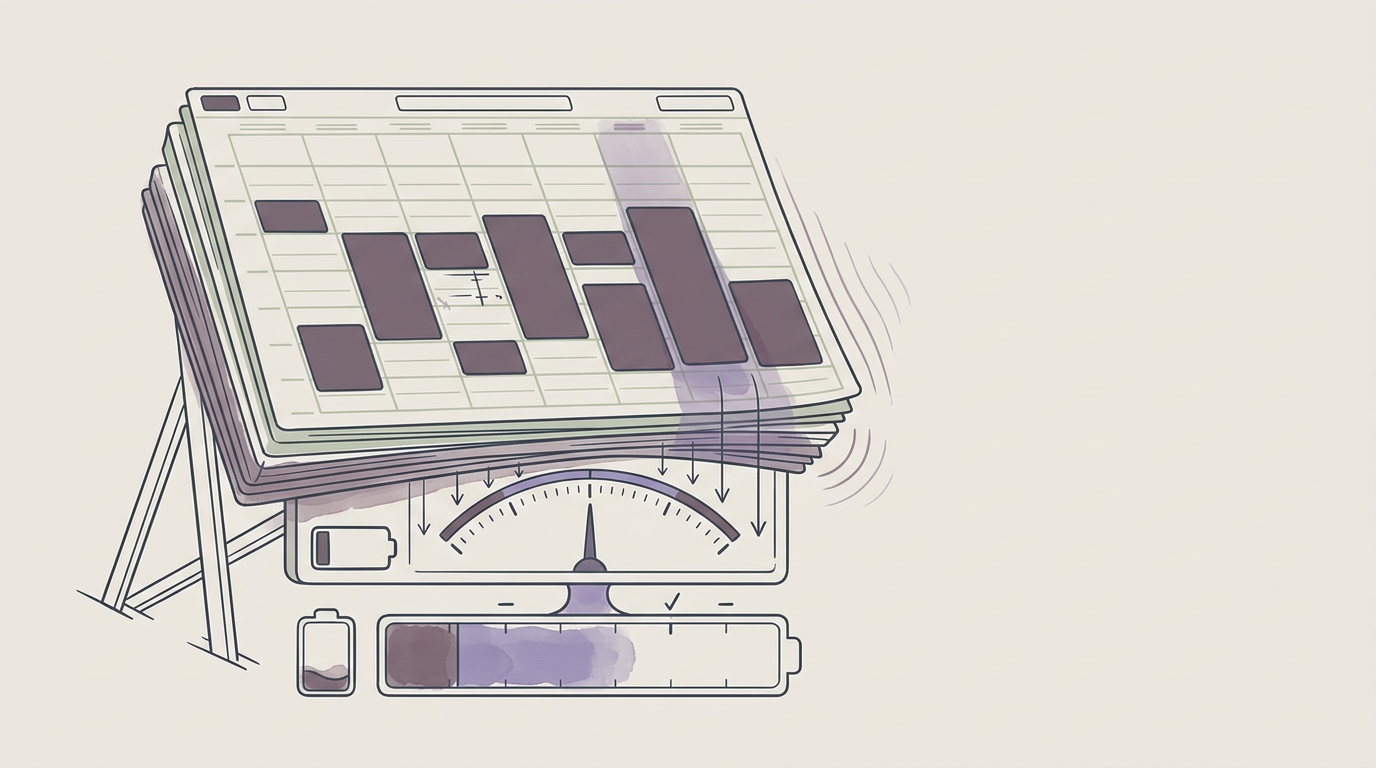
We’ve been sold a story that leadership capacity is a function of grit, hustle, and a well-organised calendar. Grind harder, wake up earlier, optimise your workflow, and you'll somehow expand the day to fit the ever-expanding demands. This is a comforting, convenient, and utterly wrong-headed fantasy. The truth is that your ability to lead, decide, and create isn't a moral virtue or a time-management puzzle. It is a finite biological resource. Your real bottleneck isn't the number of hours in the day; it's your nervous system capacity, and most leaders are running a massive, unacknowledged deficit.
Common Questions
What is nervous system capacity?
Think of it as your body's operational budget for handling stress. It's the total amount of cognitive, emotional, and physiological load your system can manage before performance degrades. When capacity is high, you're resilient, creative, and clear-headed. When it's low, you're reactive, foggy, and more likely to see threats where there are none. It’s not about willpower; it’s about available bandwidth.
Isn't this just another word for burnout?
No. Burnout is the destination; depleted capacity is the road you take to get there. Herbert Freudenberger, who first coined the term 'burnout', described it as a state of exhaustion from excessive demands. Capacity is the infrastructure that prevents you from getting there. Burnout is the system-wide power failure; dwindling capacity is the rolling brownout that precedes it.
Can you actually measure this capacity?
Not directly with a single number, but you can get dangerously close with proxies. Metrics like Heart Rate Variability (HRV)—the measure of variation in time between your heartbeats—give you a surprisingly accurate readout of your autonomic nervous system's flexibility and readiness. A high HRV suggests a resilient system with plenty of capacity. A chronically low HRV is a structural readout that your system is running on fumes.
Related anchors: vagal tone anchor · sleep anchor · gut-immune anchor
Your Allostatic Load Is Your Real Debt Ceiling
The modern workplace loves the fiction of a 'work-life balance', as if the physiology you bring to a spreadsheet is somehow different from the physiology you bring to your family dinner. Your nervous system doesn't recognise the distinction. It just tallies the load. The term for this cumulative wear-and-tear is allostatic load, a concept pioneered by neuroscientist Bruce McEwen. Think of it as a biological debt that accrues every time you override your need for rest, push through fatigue with another espresso, or deal with a crisis.
Every late night, every skipped lunch, every cortisol-drenched board meeting adds to the ledger. This isn't a metaphor. According to recent research, high allostatic load is correlated with impaired cognitive function, chronic inflammation, and a dulled executive function in the prefrontal cortex—the very part of your brain you hired for its strategic thinking. That feeling of being unable to make one more decision after a long day isn't a personal failing; it's a physiological resource limit. Your body can't tell the difference between a looming project deadline and the more primal threat of a predator; it just fires the same stress chemicals (McEwen, 2019). The balance isn't 'work versus life'; it's 'load versus recovery'.
The most important asset a leader has isn't their vision; it's the regulated nervous system that makes that vision possible.
HRV: The Only KPI That Governs the Rest
As a leader, you track your cash flow, your customer acquisition cost, your team's velocity. But do you track the one metric that underwrites your ability to interpret all that data without panicking? Your Heart Rate Variability (HRV) is a direct window into the state of your autonomic nervous system—the machinery that toggles you between 'go' (sympathetic) and 'rest-and-digest' (parasympathetic).
A high HRV indicates 'vagal flexibility' (Kemp, 2017), meaning your system can gracefully shift gears, adapting to challenges without getting stuck in a high-alert state. A low HRV means your system is rigid, stuck on 'go', and running inefficiently, like a car with the accelerator welded to the floor. For leaders in the US, with their deep adoption of wearables but weak PTO norms, this data is often a source of anxiety, not insight. They see a low HRV score and try to 'hack' it, missing the point entirely. A low HRV isn't a problem to be solved; it's a readout from your body's infrastructure. It's an invitation to stop adding load and start investing in genuine recovery, a cornerstone of our Performance L2 course.
The Locus Coeruleus and the Anxious Executive's Brain
Here’s where we get properly nerdy, far beyond the pop-science talk of cortisol. The real governor of your day-to-day arousal, focus, and vigilance is a tiny cluster of neurons in your brainstem called the locus coeruleus (LC). The LC is your brain's primary source of noradrenaline—a neurotransmitter that dials your brain's 'gain' up or down.
In a well-regulated state, the LC pulses noradrenaline in a way that sharpens focus and enhances memory, what Mara Mather calls the "Gist-versus-detail" trade-off (Mather, 2016). You can see the big picture. When you are under chronic stress, however, the LC shifts into a tonic, high-output mode. It floods the system. The result? Your attention scatters. You lose the ability to distinguish between a trivial email and an existential threat. Every Slack notification lands like a tiger in the bushes. This is the neurobiological architecture of an executive who can no longer innovate or think long-term; their brain is structurally locked into a state of short-term threat management. They can’t see the forest for the trees because their own brain chemistry is setting fire to the trees.
The Air You Breathe is Made of Your Boss's Nervous System
Companies spend fortunes on mission statements and murals about 'our culture'. It's mostly theatre. The real culture of a team isn't on a poster; it's the aggregate state of the nervous systems in the room. This is the principle of coregulation. We are constantly, unconsciously broadcasting and receiving signals about safety and threat from one another.
A leader with a dysregulated nervous system—running on high allostatic load and a haywire locus coeruleus—transmits that state to their team as surely as wifi transmits data. Your clipped tone, your shallow breathing, your inability to make eye contact; these are not personality quirks. They are autonomic readouts, and they put your team's nervous systems on defensive alert. This isn't woo; we have the receipts at the level of gene expression in the immune system (Cole, 2015). This is why leadership isn't just a solo activity; it's a deep responsibility to manage your own state as the primary input into the collective system. If you want to train your people in this, our practitioner certifications provide the toolkit.
What to do this week
This isn't about another productivity hack. It's about renovating your personal infrastructure.
- Run a Capacity Audit. For three days, use a Kokorology Journal page to note not what you did, but how much capacity it took. Rate tasks on a 1-5 scale of cognitive/emotional drain. See where the real costs are hidden.
- Schedule a 'No-Input' Block. Book 15 minutes in your calendar where the only goal is to reduce incoming information. No phone, no podcasts, no screens. Walk outside, look out a window, or practice simple resonance breathing. This isn't a break from work; it's the work of rebuilding capacity.
- Define Your Shutdown Protocol. The workday ends when you tell your nervous system it has. Instead of collapsing onto the sofa with your phone, create a 5-minute ritual to signal the transition. It could be washing your face, changing your clothes, or a short walk around the block. Signal to your body that the load-bearing part of the day is over.
TL;DR
Leadership capacity is not about willpower; it's a finite biological resource governed by your nervous system. Chronic demand leads to high allostatic load (McEwen, 2019), which degrades decision-making and innovation. Metrics like HRV offer a tangible measure of this capacity (Kemp, 2017). Rebuilding it isn't about productivity hacks but about architectural change: deliberately managing your physiological state and building non-negotiable recovery, like adequate sleep architecture (Walker, 2017), into your operational rhythm.
Where this fits in the Kokorology system
This is a direct application of the core principles of nervous system regulation. It treats leadership not as a set of soft skills, but as the output of a biological system whose state can be managed and whose capacity can be deliberately expanded.
Closing
Stop treating your capacity as an infinite resource you just need to manage better. It's a physiological asset that requires investment and maintenance. The single most effective thing you can do for your team, your company, and your own sanity is to begin treating your own nervous system as the critical infrastructure it is. If you're stuck in a pattern of burnout and overwhelm, direct coaching can provide the personalised support to rebuild that infrastructure.
- Sit with this in the Performance L2 course
- Practice it daily inside the Kokorology Journal
- Start with our free guide to nervous system regulation
Sources
- Cole, S. W. (2015). Human social genomics. PLoS Genetics.
- Freudenberger, H. J. (1974). Staff Burn-Out. Journal of Social Issues.
- Kemp, A. H., & Quintana, D. S. (2017). The relationship between vagal flexibility, creativity and psychopathology. Frontiers in Psychology.
- Mather, M., & Sutherland, M. R. (2016). The Gist of Things: How Noradrenaline Helps Prioritize and Consolidate Emotionally Arousing Events. Neurobiology of Learning and Memory.
- McEwen, B. S. (2019). The concept of allostatic load and its relevance to the neurobiology of stress and mental illness. Harvard Review of Psychiatry.
- Walker, M. (2017). Why We Sleep. Scribner/Simon & Schuster.