Nervous System
Cold Plunge Vagus Nerve What the Research Says
Your cold plunge doesn't tone your vagus nerve. It shouts 'FIRE!' in a biological theatre to see if your system can exit calmly.
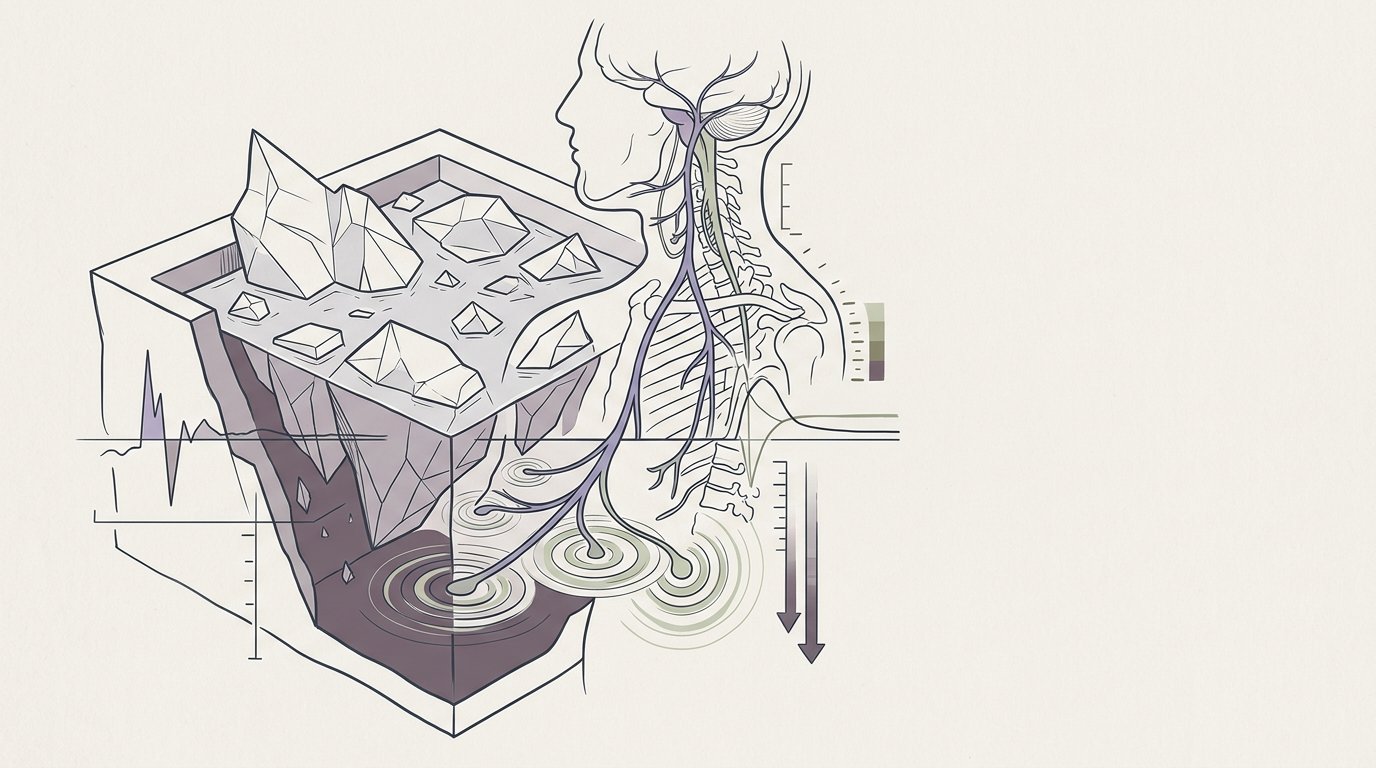
When you step into a tub of three-degree water, your brain does not register a wellness practice. It registers an immediate, life-ending threat. The wellness industry insists that submerging yourself in ice is a gentle way to stimulate the cold plunge vagus nerve connection, grouping it alongside deep breathing and quiet walks. A cold plunge is a biological fire alarm. The benefit lives entirely in how fast your nervous system can learn to turn the siren off.
You probably know the texture of a system that has forgotten where the brake pedal is. You climb into bed exhausted but can't rest, staring at the ceiling while your mind loops through a mundane email from 11am. You feel tired but wired, living with a jaw that won't unclench and a weirdly tight throat. You might wake up at 3am every night with a jolt, or notice your heart racing when I lie down. The afternoon brings a flat, gray fog where the words just won't come, yet your shoulders stay pinned to your ears. Your baseline state has become hyper-vigilant, scanning the environment for a threat that never arrives.
Common Questions
How does a cold plunge affect the vagus nerve?
The cold triggers a massive fight-or-flight stress response. The vagal involvement happens primarily in the rebound. By forcing your breath to slow down while submerged, you demand that your parasympathetic nervous system take over and calm the panic.
What is vagal tone?
Vagal tone is the background level of activity in your vagus nerve, often measured by Heart Rate Variability. High tone indicates your body can relax rapidly after a stressful event. It signals a flexible, regulated autonomic state.
Do I need a full ice bath?
No. The human face is covered in cold receptors wired directly into the same pathways. Splashing ice water on your face or submerging your forehead triggers the mammalian dive reflex, rapidly dropping your heart rate without the full-body systemic shock.
The anatomy of a fire alarm
I'm calling it. The narrative around ice baths has lost the plot entirely.
Kokorology are told to treat the vagus nerve like a temperamental muscle that needs heavy resistance training. The advice places ice baths on the exact same list as humming and mindful walks, as if these belong to the same category of human experience. If a freezing tub feels like a mindful walk, I have serious questions about your walks.
When your skin sensors detect ice, your brainstem floods your system with noradrenaline. Your adrenal glands dump massive amounts of cortisol. Your heart rate and blood pressure rocket upwards in a pure, unadulterated sympathetic spike. Your locus coeruleus—the tiny hub in your brainstem that controls arousal—does not care that you paid $4,000 for a curated outdoor tub. It just knows you are dying.
The rebound is the practice
I used to believe the endurance part was the point. I would grind my teeth and shiver violently for six minutes, convinced the sheer suffering was making me healthier. I was just practicing hypervigilance.
The magic lives in what your body is forced to do next. To survive the water, you have to override the gasp reflex. You have to breathe slowly through your nose and actively tell a panicked physiology that you are completely safe. This conscious act of imposing calm on chaos puts the parasympathetic state back in control. You are refining a reflex.
The goal of a cold plunge is never to prove you can endure a shock. The goal is to prove to your nervous system that it can recover from one.
That rapid down-regulation is a core skill Kokorology teach inside nervous-system regulation programs. You're learning to operate the machinery.
The cholinergic anti-inflammatory reflex
Here is the nerdy detour. The nervous system communicates directly with the immune system. When that massive adrenaline surge hits, the brain senses a severe threat that could easily lead to tissue damage.
It uses the vagus nerve as a high-speed communication line, sending a signal down to immune cells in the spleen. The instruction is to immediately suppress the production of inflammatory cytokines. You're intentionally triggering a massive stress cascade so the body will overcorrect and dial down baseline inflammation. This is a biological adaptation. You're altering the baseline threat response. Kokorology keep the deep clinical mechanics of this pathway documented in the Library.
Reading the signal
You stop guessing when you start measuring. Your Heart Rate Variability (HRV) tracks the beat-to-beat variation in your heart rhythm, giving you a daily readout of your autonomic flexibility.
When you start a cold practice, your HRV will tank immediately after the exposure. That represents the acute stress load. The metric to watch is your morning baseline in the days that follow. If your baseline HRV trends upward over a month, your vagal tone is adapting beautifully. If your numbers crash and you feel anxious for no reason every afternoon, you're overdoing it. Your body is confirming that the load is too high and the recovery is insufficient. Nuanced tracking requires structure, which is exactly why Kokorology built the Journal.
A lower dose
You don't need to emerge from an ice barrel like a stoic Viking to change your state. The data confirms you just need to avoid having a panic attack for thirty seconds.
The human face contains a dense network of thermal receptors tied directly into the vagal system. Immersing your face in cold water while holding your breath triggers the mammalian dive reflex. The heart rate plummets immediately. You secure a massive parasympathetic shift with a fraction of the systemic fatigue. It remains one of my favorite high-leverage tools from the Hacks collection, perfect for a spiraling Tuesday at 3pm.
What to do this week
This practice is about finding the off-switch after the internal alarm has been pulled.
- Skip the heroic tub. Fill a large bowl with cold tap water and a handful of ice cubes.
- Trigger the dive reflex. Take a standard breath, hold it, and submerge just your face in the water for 15 to 30 seconds.
- Control the exit. When you come up for air, do not gasp. Exhale slowly through your nose.
- Track the lag. Pay attention to how your body feels five minutes later. Notice the tingling and the slowed heart rate. Write down the shift in your physical state.
- Titrate the dose. If your system handles the bowl easily, finish your morning shower with thirty seconds of pure cold water.
Where this fits in the Kokorology system
This sits squarely in the realm of applied capacity. Kokorology use hormetic stress deliberately to expand your biological window of tolerance. You can find the exact protocols for scaling this exposure safely inside The Cold Anchor, or explore the wider mechanics in the Performance course.
Closing
The objective is entirely about recovery. The cold is a loud, dramatic tool for teaching your body a lesson it forgot decades ago: you can endure a massive shock and successfully guide yourself back to safety. Start small.
- Start with the guided exposure protocols inside The Cold Anchor.
- Track your daily HRV and subjective response using the Journal.
- Get the foundational theory on autonomic shifts in the free guide.
TL;DR
The popular narrative around the cold plunge vagus nerve connection heavily misrepresents the biology. Submerging in ice triggers a massive sympathetic fight-or-flight response, flooding the system with noradrenaline. The actual benefit happens during the rebound, when you use slow breathing to force the vagus nerve to calm the panic. This conscious override improves autonomic flexibility and triggers a powerful anti-inflammatory reflex, training your system to recover from stress rapidly.
Sources
- Kox M, van Eijk LT, Zwaag J, et al. (2014). Voluntary activation of the sympathetic nervous system and attenuation of the innate immune response in humans. PNAS.
- Tracey KJ. (2002). The inflammatory reflex. Nature.
- Thayer JF, Åhs F, Fredrikson M, Sollers JJ 3rd, Wager TD. (2012). A meta-analysis of heart rate variability and neuroimaging studies: implications for heart rate variability as a marker of stress and health. Neuroscience & Biobehavioral Reviews.
- Mather M, Clewett D. (2023). The Locus Coeruleus: A Hub for Arousal and Regulation of Adrenergic Tone. Annual Review of Psychology.