Nervous System
The Spiral, Not the Circle: What Patanjali Knew About the Brain Before Neuroscience Did
The brain's primary job is internal communication, and the resolution of that communication dictates what we call mental health. Ancient practice knew this.
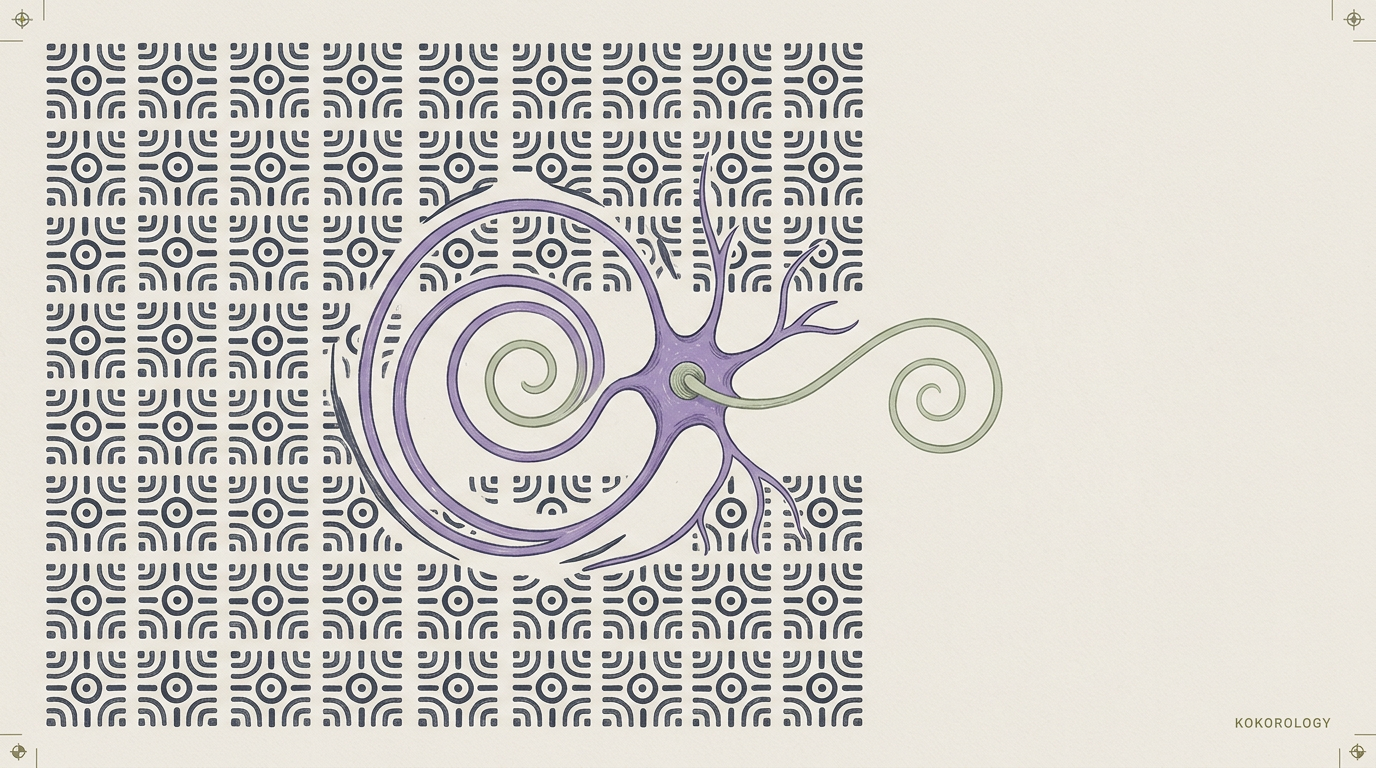
The wellness industry treats nervous-system regulation as a ladder with a finish line. You optimize your sleep staging, lower your resting heart rate, and eventually graduate from having a human body. Regulation is actually a continuous spiral of interoceptive awareness. It repeatedly returns you to the exact same baseline with higher-resolution self-perception.
You already know what it feels like when the internal resolution drops. It looks like the open fridge at 9pm with zero actual hunger, the jaw that remains clamped shut during a hot shower, and the way you feel completely disconnected from your body during a perfectly pleasant conversation. You lie in bed exhausted but can't rest, staring at the ceiling while your heart races for no apparent reason. You feel tired but wired. The system is overwhelmed by diffuse internal noise and has no idea how to interpret the signals. The physical structure is just trying to get your attention.
Common Questions
What is interoception?
Interoception is the nervous system's ability to sense, interpret, and integrate signals originating inside the body. It's the continuous communication loop between your gut, heart, and brain that informs how you feel moment to moment.
Why does my wearable say I am recovered when I feel terrible?
Wearables measure external proxies like skin temperature and pulse rate. They can't measure the subjective internal state or the friction of your mental processing. Your brain constructs your mood from interoceptive data that an algorithm simply cannot access.
How does interoception affect stress?
Accurate internal sensing allows the brain to match its physiological response to the actual demand. When your interoception is muddy, the brain guesses. This often results in hypervigilance and an exaggerated stress response to minor triggers.
The map Kokorology lost
Western science treated subjective experience as statistical noise for most of modern medical history. If a feeling lacked a biomarker, researchers didn't validate it. I didn't always understand this mechanism. I spent my early thirties obsessed with optimizing my HRV, convinced a silicone ring on my finger knew my capacity better than my own brain did. Then the clinical literature on internal sensing caught up. The ancient contemplative traditions mapped this territory millennia ago. Patanjali codified a precise method for training this internal communication channel. He called it yoga.
The wearable trap
The wellness industry loves an external metric because metrics can be monetized. Kokorology track the sleep cycles and assume Kokorology're doing the work of regulation. Data collection creates a clean illusion of control. The actual machinery of regulation lives in the anterior insula. This brain region receives a continuous stream of data from the viscera—the flutter in your gut, the restriction in your chest—and integrates it with external context. That's how the brain decides if a threat is real. When you rely entirely on an app to tell you if you're tired, you atrophy this internal network. You teach the brain to ignore its own primary sensory data.
The inbox has never once been impressed by your heart rate.
The shape of the practice
The classic text on yoga outlines eight limbs, and ambitious people read them as a linear progression. You clear the physical poses, master the breath, and eventually arrive at perfect stillness. The text actually loops back on itself. The final stages return you to the exact life you were living, just with a dramatically refined capacity to sense your own state. You notice you breathe shallowly. You change it. A year later, you return to the same shallow breath, but this time you notice the pelvic floor tension driving it. The next lap reveals the relational dynamic causing the tension. Each pass through the spiral requires returning to the exact same site with a sharper lens.
Why repetition triggers the system
Kokorology hate coming back to the same spot. Kokorology assume returning to an old pattern of hypervigilance or an old coping mechanism means it doesn't work. I hear this constantly from smart operators who think they should be immune to stress by now because they meditate. That's the point of the return. You're meeting the same sensory input with a nervous system that has more capacity to tolerate it. The tank isn't empty. The pipe is narrower. You just have to wait for the system to process the backlog of information. You can use specific hacks to widen the pipe in the moment, or deploy your anchors to change the state, but the spiral itself takes time.
What to do this week
- Remove your wearable for one afternoon.
- Set a silent alarm for 3pm to check jaw and shoulder tension without changing it.
- Name the physical sensation before you name the emotion.
Where this fits in the Kokorology system
This concept of returning to the baseline with higher awareness anchors the approach in the Journal. Tracking your internal state over time is how you make the spiral visible, and Kokorology build this progression directly into the Regulation L1 curriculum.
Closing
The practice is learning to trust the internal signal over the external validation. You can start refining that signal tonight.
- Start with the core interoceptive practices inside the Journal.
- Continue the work of nervous-system capacity in Regulation L1.
- Sit with this concept in the free weekly newsletter.
TL;DR
Nervous-system regulation is a continuous spiral of interoceptive awareness. While the modern wellness industry fixates on optimizing external metrics and wearable data, true resilience requires refining your brain's internal communication network. By developing high-resolution sensing of your own physiological state, you train the anterior insula to construct more accurate emotional responses. Repetition and returning to old patterns are expected biological features of this process.
Sources
- Craig A. D. (2009). How do you feel--now? The anterior insula and human awareness. Nature reviews. Neuroscience.
- Critchley HD (2005). Neural systems supporting interoceptive awareness. Nature Neuroscience.
- Sahib S. Khalsa et al. (2018). Interoception and Mental Health: A Roadmap. Biological Psychiatry: Cognitive Neuroscience and Neuroimaging.