Nervous System
Why Am I so Tired but Cant Sleep
Everyone knows the feeling. It’s 11 PM, you’re so tired your bones ache, but your mind is running frantic, pointless loops. You feel exhausted but you can’t sleep. Most advice will tell you you’re just ‘too stressed’ and
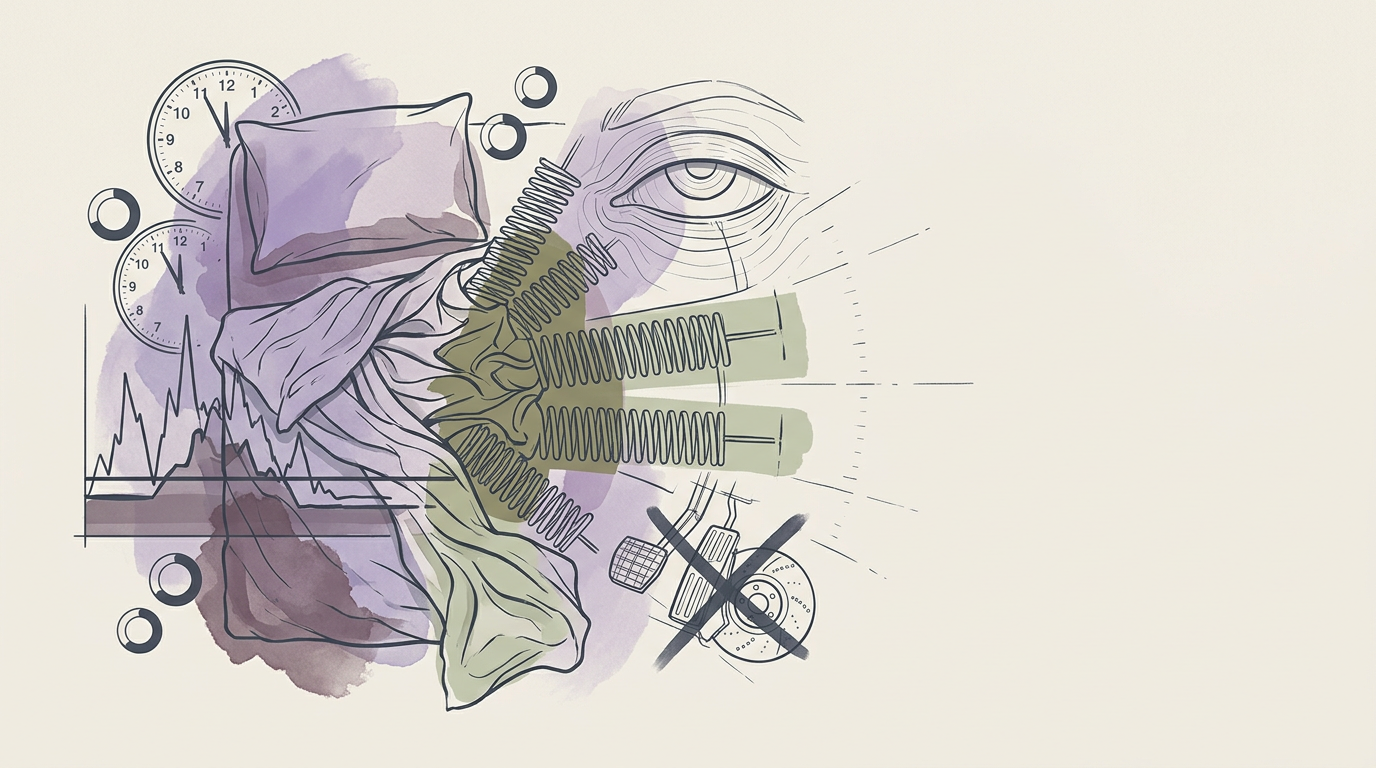
Everyone knows the feeling. It’s 11 PM, you’re so tired your bones ache, but your mind is running frantic, pointless loops. You feel exhausted but you can’t sleep. Most advice will tell you you’re just ‘too stressed’ and need to relax. This is well-meaning, but wrong. This state of being wired and tired isn't a failure of relaxation or an energy deficit. It's an architecture problem: a physiological traffic jam where your body's accelerator is floored while a part of its braking system is simultaneously signalling an emergency stop.
Common Questions
What is happening in my body when I'm tired but can't sleep?
It’s a physiological mixed state. Your stress response system, the HPA axis, is pumping out cortisol, keeping you alert and mobilised. At the same time, your body is so depleted that it’s hitting an immobilisation brake. You are biochemically stuck between 'go' and 'no-go', which feels like a terrible, buzzing exhaustion.
Is this just a fancy name for anxiety?
No. Anxiety can be a symptom, but the underlying mechanism is structural. Think of it less as a feeling and more as a readout of a system under chronic, unmanaged load. It's the physiological consequence of your body being in a prolonged state of high alert, as described by researchers like Robert Sapolsky.
Why don't sleeping pills seem to work long-term?
Sedation is not sleep. Pills can knock you unconscious, but they don't guide your brain into the complex, restorative cycles of true sleep architecture. When your nervous system is still screaming 'threat', a sedative is just gagging the messenger. The underlying revving engine is still burning fuel all night long.
Can I fix this tonight?
You can start. You can’t rebuild a broken-down system in one night, but you can take the immediate pressure off. The real solution involves systematically teaching your body's autonomic nervous system that it's safe to power down, which takes consistency, not a single magic bullet.
Related anchors: sleep anchor · gut-immune anchor · HRV anchor
It’s Not Stress, It’s a Stuck Accelerator
We treat being ‘wired and tired’ as a vague symptom of modern life, like a tax on having a smartphone. But it’s a precise neurochemical state. Your body's primary stress circuit, the HPA axis (hypothalamic-pituitary-adrenal axis — the phone line from your brain to your adrenal glands), is stuck in the 'on' position. It keeps shipping out cortisol, the daytime get-up-and-go hormone, long after the office has closed. Bruce McEwen’s work on allostatic load gives us a name for the resulting damage: the cumulative wear and tear from this chronic state of alert. Your body isn't just 'stressed'; it's structurally compromised from being in drive and park at the same time. The first step in fixing this is learning basic nervous system regulation.
Your Cortisol Rhythm is Playing the Wrong Tune
Your body is designed to run on a rhythm. Cortisol should peak within 30 minutes of waking (the 'cortisol awakening response') to get you out of bed, then gracefully decline all day to a flatline by bedtime. For many of us, this rhythm is inverted. A sluggish, groggy morning is followed by a slow build of energy and anxiety that peaks just as you’re trying to wind down. This is the signature of a dysregulated HPA axis. The late-night emails, the 9 PM argument, the second-screen scrolling—they all serve as tiny hormonal instructions, telling your body "it's not safe to rest yet". It’s no wonder people either burn out or live on caffeine; their body's own energy management system has gone rogue. If this sounds familiar, it might be time for a dedicated protocol, like the one in our Cortisol Anchor.
You can’t sedate a system into safety. Sleep isn't a state of unconsciousness; it's a state of trust.
The Brain’s Watchtower: Meet Your Locus Coeruleus
Now for the properly nerdy bit. While your HPA axis manages the chemical flood of cortisol, another brain structure is acting like a hyper-alert watchtower guard: the locus coeruleus (LC). This tiny cluster of neurons in your brainstem is your main source of noradrenaline (aka norepinephrine), the neurotransmitter of vigilance and arousal. According to research from scientists like Mara Mather, under chronic stress, the LC can become overactive and fail to power down at night. This is the source of that awful feeling of being ‘on alert’ in the dark, where every creak of the house sounds like an intruder. It blocks your entry into sleep and, as Maiken Nedergaard's work suggests, prevents the brain's nightly cleaning crew—the glymphatic system—from clearing out the day's metabolic junk. You wake up feeling not just tired, but fuzzy and un-refreshed, because your brain literally wasn't able to take out the bins. For more on the deep mechanisms, you can always visit our research library.
Why 'Sleep Hygiene' Is Necessary, But Not Sufficient
You’ve heard it all before. Blackout blinds, no screens an hour before bed, a cool room. All good advice. But perfect sleep hygiene is like arranging deckchairs on the Titanic if your nervous system is internally screaming iceberg. You can create the perfect environment, but you can't trick a body that feels unsafe. This is especially true for those navigating different cultural pressures; the American 5-to-9 hustle after the 9-to-5, or the wonderful but late-night social life that’s essential for staying cool during a summer in the Gulf. According to recent research, the most effective interventions combine environmental changes with practices that actively shift your physiological state. The work isn't just creating a calm bedroom; it's guiding your body into a state that can receive it. If your patterns feel too stuck for protocols alone, one-on-one coaching is often the key to finding the specific block.
What to do this week
You can’t overhaul your entire nervous system in a week, but you can install the emergency off-ramps.
- Institute a 'Shutdown Sequence'. Ten minutes before you even think about heading to bed. Lie on the floor, put your legs up the wall, and do three 'physiological sighs' (a double inhale through the nose, followed by a long, slow exhale through themouth). This is one of the fastest ways to tell your brainstem you're safe. Find more quick resets inside our Hacks library.
- Morning Light, Evening Dark. Within 30 minutes of waking, get 10 minutes of direct sunlight outside (no sunglasses). This is the master signal to reset your cortisol rhythm for the entire day. In the evening, dim your environment aggressively. Your nervous system follows light cues.
- Log Your State. Don't just log your sleep hours. Before bed, take 60 seconds to note your physical state on a scale of 1-10 (1=totally calm, 10=wired). Awareness is the first step to changing a pattern. Our Journal is designed for exactly this.
- Eat for Shutdown. A small serving of complex carbohydrates (like a sweet potato or a handful of berries) with a bit of protein an hour or so before bed can help lower cortisol and promote serotonin production, gently nudging your body toward rest.
TL;DR
Being tired but unable to sleep is not an energy problem; it's a physiological conflict. Your system is flooded with stress hormones like cortisol, keeping you alert, while simultaneously being so depleted it's trying to shut down. This state is driven by a dysregulated HPA axis and an overactive locus coeruleus, a result of chronic stress and a disrupted circadian rhythm. The solution isn't just forcing rest, but systematically rebuilding your body’s safety signals through targeted practices like timed light exposure and shutdown routines, addressing the root architecture of the problem as detailed by researchers like Sapolsky and Mather.
Where this fits in the Kokorology system
This state is a classic sign of high allostatic load and a dysregulated HPA axis. It sits at the intersection of our Sleep Anchor and Cortisol Anchor, and is a core topic within our Nervous System Regulation pillar.
Closing
This isn't a moral failing or a personal weakness. It is a predictable, physiological response to an unsustainable load. The path out isn't about trying harder to relax. It's about learning a new language—the language of your own nervous system—and giving it the signals it needs to finally stand down.
- Start with our guided 7-day protocol inside The Reset.
- Master the foundations of your nervous system in the Regulation L1 course.
- Get our free guide to daily regulation techniques at kokorology.com/free-guide.
Sources
- McEwen, B. S. (2017). Neurobiological and Systemic Effects of Chronic Stress. Chronic Stress.
- Sapolsky, R. M. (2005). The influence of social hierarchy on primate health. Science, 308(5722), 648–652.
- Mather, M., & Harley, C. W. (2016). The Locus Coeruleus: A Hub for Arousal and Memory. Cold Spring Harbor Perspectives in Biology, 8(3), a021689.
- Nedergaard, M., & Goldman, S. A. (2020). Glymphatic failure as a final common pathway to dementia. Science, 370(6512), 50-56.
- Cryan, J. F., & Dinan, T. G. (2012). Mind-altering microorganisms: the impact of the gut microbiota on brain and behaviour. Nature Reviews Neuroscience, 13(10), 701–712.