Nervous System
How to Regulate Your Nervous System Without Meditation
You've been told a thousand times. To manage stress, to find calm, to fix that frayed-wire feeling, you must meditate. Sit still, watch your breath, and wait for peace to descend. For many people, this is like being told
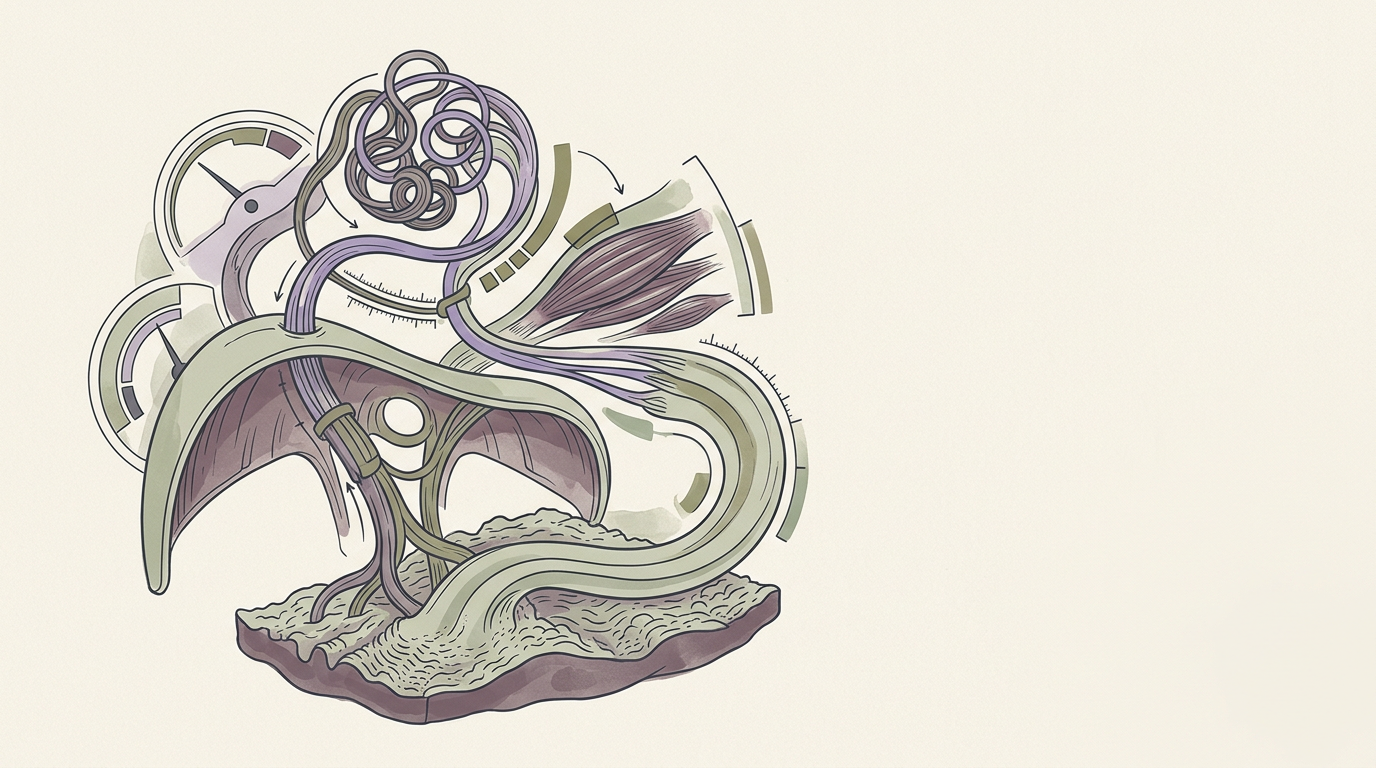
The wellness industry has decided that the only valid response to a frantic mind is sitting quietly on a cushion. I'm calling it. Asking a highly activated nervous system to sit still and watch its breath is a spectacularly efficient way to induce panic. Learning how to regulate your nervous system without meditation means you've got to stop treating your physiology like a willpower project.
You know exactly what happens when you force stillness on a body bracing for impact. You get that 3pm jaw clench that radiates into your temples. You stand in the shower, but your shoulders absolutely refuse to drop. You'll find yourself staring into the open fridge with zero hunger, looping the same half-finished sentences in your head. When you finally lie down, you're entirely tired but wired, staring at the ceiling because you can't sleep even though exhausted. The physical hum of a threat you can't quite name leaves you anxious for no reason, while a meditation app cheerfully chimes at you to let go of your thoughts. The thoughts are downstream of the physical state. The buzzing electrical current under your skin is running the show.
Common Questions
What does "regulate your nervous system" actually mean?
Regulation is the ability to flexibly shift between states of arousal and calm depending on the environment. A regulated system ramps up to handle a heavy workload or a physical challenge, then efficiently returns to a baseline of safety and repair once the demand passes.
Why does meditation sometimes make anxiety worse?
Absolute stillness mimics the immobility of a freeze response. When you remove external distractions from a nervous system on high alert, you force its attention entirely onto internal signals of threat, like a racing heart or shallow breath. That focused attention amplifies the alarm.
How can I get calm without sitting still?
You can use movement, temperature shifts, and specific respiratory rhythms to send concrete signals of safety to your brainstem. These physical inputs change your physiological baseline directly, bypassing the cognitive effort of trying to talk yourself out of stress.
The Threat-Detection Mismatch
I used to prescribe ten minutes of daily mindfulness to clients whose inbox anxiety was redlining. I've completely stopped doing that. A dysregulated person on a meditation cushion usually just gets a front-row seat to their own hypervigilance.
Your autonomic nervous system operates as a background threat-detection loop, prioritizing survival over enlightenment. When your HPA axis (the hormonal loop running from your brain to your adrenal glands) is actively pumping out cortisol, it expects you to either fight something or run away. Sitting cross-legged while trying to force a peaceful state sends conflicting data. The brain perceives the physical immobility, assumes you're trapped by a predator, and dials the internal alarm even higher. Kokorology explore this structural mismatch heavily in the Nervous System Regulation foundations. You have to meet the nervous system where it is, not where a podcast told you it should be.
The Machinery of the State
Kokorology talk about stress as an abstract pressure, but your body experiences it as allostatic load. That's the literal physiological wear and tear of maintaining a high-alert state over time.
The universe might be holding you, but your vagus nerve is the parking brake. Pull it, and the engine quiets.
Your biology evolved to handle acute, short-term spikes in physical demand. It was never engineered for the modern environment of ambiguous social threats, rolling deadlines, and persistent sleep debt. Trying to think your way out of a high allostatic load is like trying to fix a corrupted hard drive by rearranging the desktop icons. The machinery itself is running hot. You have to intervene at the level of the hardware.
The Nerdy Bit: Interoception Is Your Internal Dataline
That pastel Instagram advice to "listen to your body" actually describes a concrete neurological mechanism called interoception. This is your brain's continuous perception of sensations from inside the body—your heartbeat, gut tension, and lung expansion.
The insular cortex integrates these raw physical data points to create a moment-to-moment map of your state. Anxiety is simply the brain's interpretation of a racing heart, shallow breathing, and a tense stomach. Calm is the interpretation of a slow pulse and a settled gut. The physical signals arrive first, and the emotional label gets applied second.
Meditation forces you to pay intense attention to these interoceptive channels. If those channels are currently screaming about a perceived emergency, observing them closely is terrifying. The faster route to calm involves changing the incoming signal before you try to observe it. Tracking these specific sensory inputs is exactly what the Journal is designed to help you map.
The Bottom-Up Rescue
Your brainstem doesn't speak English, and it definitely doesn't read motivational quotes. It speaks the language of sensation. To change the state, you have to use a bottom-up approach.
The vagus nerve is the massive cranial nerve wandering from your brainstem down into your torso. Crucially, eighty percent of its fibers are afferent. They carry data from the body up to the brain, reporting on your current physical status. When you intentionally alter your breathing architecture—like extending your exhale so it outlasts your inhale—you send a palpable signal of safety up that pathway. The brain receives the message, assumes the threat has passed, and instructs the HPA axis to stand down. I use these micro-shifts constantly, and many of the fastest resets live in the Hacks library.
What to do this week
Sitting still is off the table if you're currently vibrating with stress. Instead, Kokorology use movement to send your brainstem a different message through a practice called orienting.
- Keep your eyes open. Find a comfortable position and let your vision anchor you to the physical space you are actually in.
- Move your neck. Slowly look around the room, letting your head turn naturally. This physical rotation signals to the mammalian brain that you are safe enough to scan your environment without fixating on a predator.
- Locate a neutral object. Find something visually pleasing—a plant, the way light hits a wall, a specific texture. Let your gaze rest there for four slow breaths.
- Notice the physical drop. As you look at the object, track what happens physically. A tiny bit less tension in the jaw. A sigh that happens on its own. Track the data without forcing it.
Where this fits in the Kokorology system
Building capacity requires interventions that match your actual physiological state. You can learn the mechanics of down-regulating the HPA axis inside the Anchors library. If you're regularly hitting a wall of hypervigilance, structured support through Coaching helps map the specific triggers keeping your system locked in high gear.
Closing
Kokorology are aiming to build a nervous system that recovers faster than it burns out. You can stop judging yourself for failing at a tool that your body correctly identified as a bad fit for the moment. Start with the physical language your biology already understands.
- Work with these mechanisms directly in Regulation L1.
- Continue tracking your baseline shifts inside the Kokorology Journal.
- Start with the fundamentals in the free guide.
TL;DR
Regulating your nervous system without meditation is entirely possible, and often necessary, because absolute stillness mimics the freeze response, which feels deeply threatening to a body already on high alert. A faster, bottom-up approach uses physical sensations—like extended exhales or visual orienting—to signal safety directly to the brainstem. By leveraging interoception and the vagus nerve, you can quiet the HPA axis and change your physiological baseline. Mental calm arrives as a downstream result of physical regulation.
Sources
- Craig, A. D. (2002). How do you feel? Interoception: the sense of the physiological condition of the body. Nature Reviews Neuroscience.
- McEwen, B. S. (2017). Neurobiology of stress, resilience, and allostatic load. Neurobiology of Stress.
- Khalsa, S. S. et al. (2018). Interoception and Mental Health: A Roadmap. Biological Psychiatry: Cognitive Neuroscience and Neuroimaging.
- Critchley, H. D. (2023). Interoception and Autonomic Regulation in Stress. Journal of Neuroscience.
- Yilmaz Balban, M. et al. (2023). Brief Structured Respiration Practices Enhance Mood and Reduce Physiological Arousal. Cell Reports Medicine.