Research
Fan Physiology During a Penalty Shootout Explained
That penalty shootout isn’t entertainment. It’s a full activation of your threat machinery, conveniently delivered to your sofa.
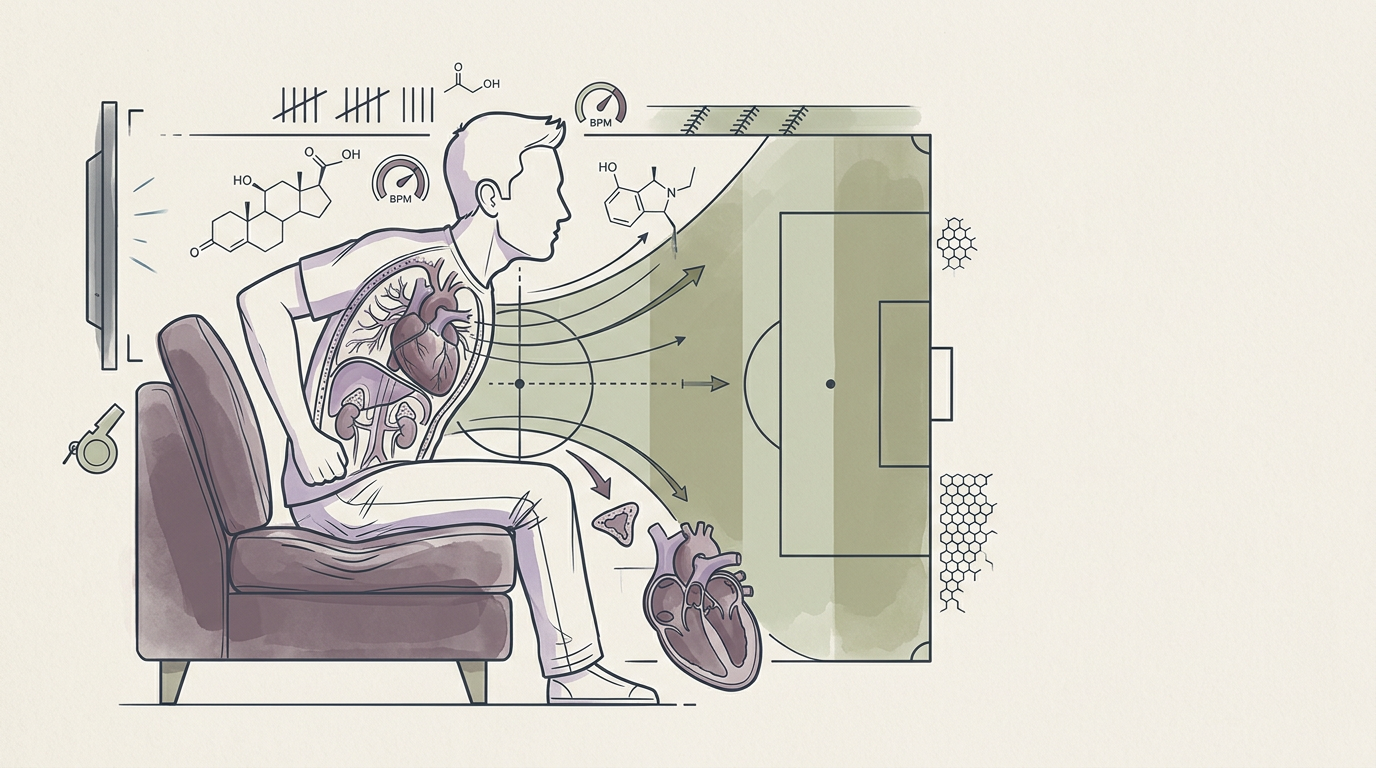
Kokorology treat a high-stakes penalty shootout as evening entertainment. Kokorology pour a drink, sit on the sofa, and politely expect the bodies to know Kokorology're just spectators. That assumption is why you wake up feeling utterly hollow the next morning. Your autonomic nervous system has zero concept of a television broadcast; watching your team face elimination is processed as a real-time predator evasion event.
You know the exact physical texture of this state. It's the 11:47pm doom-scroll after the final whistle because you're profoundly tired but wired. Your jaw won't unclench, and your shoulders refuse to drop even when you finally stand in the hot shower. You notice your heart racing when you lie down, trying to rest but vibrating with a residual buzz behind your eyes. You feel entirely exhausted but can't rest. The open fridge with no hunger, the short-tempered snap at your partner over nothing, the second coffee the next morning that just makes you sweat instead of waking you up. This is the physical reality of a system that just spent two hours preparing to fight for its life, only to be told to turn off the lights and go to bed.
Common Questions
What actually happens in my body during a penalty shootout?
Your sympathetic nervous system dumps adrenaline and cortisol into your bloodstream. Your heart rate accelerates, your blood pressure spikes, and your breathing gets fast and shallow. Blood is actively shunted away from your digestive organs and pushed into your major muscle groups. You're physiologically prepared for a sprint.
Why does it feel so physically intense?
Your brain contains mirror neurons that fire both when you do something and when you watch someone else do it, creating a state of vicarious embodiment. When you see a player hesitate before the shot, your neural circuitry mimics that exact tension. You participate in the event alongside them.
Why am I so exhausted the next day?
That profound fatigue is allostatic load. The cortisol spike disrupts your blood sugar and ruins your sleep architecture. Your body mobilized massive amounts of energy to survive a threat, and now it requires heavy recovery to rebuild capacity.
Your Heart on the Sofa
The idea that you're a detached observer is a fiction your conscious mind maintains. When researchers strap heart rate monitors to fans during high-stakes games, the data looks like a vigorous workout. Heart rates frequently hit maximum predicted levels during overtime or shootouts. Your cardiovascular system is under genuine strain, despite the fact that you haven't left the living room.
I used to assume that the emotional fatigue from watching sports was just me being dramatic, until I started tracking my own biometrics during tense matches. The data was glaring. The match acts as a stress test for your baseline capacity. If watching ninety minutes of football leaves you feeling entirely wrecked for a full 24 hours, your vagal tone is already running low. That Thursday morning hangover without the alcohol is a clear signal about your internal state.
The Contagion of Stress
Stress is wildly contagious. The classic framework for defining a biological stressor requires four elements: novelty, unpredictability, a threat to the ego, and a low sense of control. A penalty shootout delivers a perfect, concentrated dose of all four. You have absolutely zero influence over the ball, yet the outcome is deeply tied to your social identity.
This shared tension creates a mass coregulation event. The collective gasp in a pub synchronizes the nervous systems of everyone in the room. I've stopped pretending I can just switch off the television and go straight to sleep after feeling that level of shared arousal. For those watching alone, trying to keep it together while working late in a time zone far from the action, the effect is often worse. The physiological threat of social isolation stacks on top of the game's tension, leaving your nervous system regulation completely scrambled.
The Nerd-Out: Your Immune System Under Pressure
The stress response doesn't stay contained in your heart and adrenal glands. It sends ripples right down to your immune system. In a well-regulated body, your vagus nerve manages the inflammatory reflex. It actively suppresses the production of inflammatory cytokines, which is how your body stops a small local threat from turning into a five-alarm systemic fire.
Acute, overwhelming stress temporarily overrides this beautiful braking mechanism. The flood of cortisol and adrenaline dysregulates the process entirely. I notice this most when a client complains of mysterious joint pain on a Thursday, entirely unrelated to their workouts. You subject your body to an experience it logs as a survival event, and the low-grade inflammatory aftermath is the biological consequence. This physiological wear is significant, which is why a few quick breathing hacks during the game are so powerful.
Your nervous system doesn't check the channel guide; it only knows if your heart is pounding and your breath is held.
Settling the Allostatic Load
The day after a big match, many of the system feel foggy, irritable, and physically spent. Kokorology chalk it up to a late night, but the primary culprit is the accumulated physiological wear. Allostasis is the process of achieving stability through change. Allostatic load is the physical wear your body absorbs when forced to adapt to intense challenges.
Your biology is crying out for rest and gentle recovery. Modern work culture ignores this completely, demanding your usual 9-to-5 output regardless of what your sympathetic nervous system did the night before. Fighting the fatigue with more espresso just digs the hole deeper. A far better strategy is to acknowledge the load and deliberately calm the system, perhaps by starting a structured 7-day reset to recalibrate your baseline.
What to do this week
You don't have to give up watching the game. You just need to manage the machinery.
- Breathe Before They Shoot: In the pause before a penalty, take one long, slow exhale. Make the out-breath longer than the in-breath. This is a manual override for your vagus nerve.
- Create a Post-Match Cool-Down: Take ten minutes before bed. Walk around the room, do some gentle stretches, and drink a large glass of water with a pinch of salt and potassium chloride. Tell your body the perceived threat is gone.
- Acknowledge the Load: Delay your first coffee by 90 minutes the next morning. Get ten minutes of morning sunlight in your eyes. Keep your hardest cognitive tasks for later in the day.
- Track the Pattern: Use the Journal to note how you feel 24 hours after a tense match. Notice the specific sensations: brain fog, muscle aches, cravings.
Where this fits in the Kokorology system
This dynamic is a perfect example of Pillar 4 of the Kokorology system: Capacity. Your ability to enjoy and recover from a voluntary stressor like a football match is a direct readout of your nervous system's underlying state. Rebuilding that capacity is the work of the Anchors, especially the protocols focused on sleep architecture and cortisol regulation.
Closing
Kokorology aren't pathologizing your passion for sport. Your body is listening, even when you think you're just watching a screen. The next move is to learn its language and start sending it better signals, during the game and in the quiet hours that follow.
- Work with your physiological responses to pressure inside the Performance L2 course.
- Start with the 7-day nervous system Reset program.
- Get the free guide to the 5 states of the nervous system.
TL;DR
Watching a high-stakes sporting event like a penalty shootout is a significant physiological stressor that activates your sympathetic nervous system and spikes cortisol. This fan physiology explains the profound next-day exhaustion you feel, which is your body managing the allostatic load and wear from the event. By understanding the underlying mechanisms of threat detection, you can use simple tools to manage your autonomic state and recover more effectively without giving up the sport you love.
Sources
- Waters, D. D., et al. (2017). Cardiovascular health of the hockey fan. Canadian Journal of Cardiology.
- Lupien, S. J., et al. (2009). The NUTS and bolts of capturing stress. Psychoneuroendocrinology.
- Tracey, K. J. (2002). The inflammatory reflex. Nature.
- McEwen, B. S. (2019). The brain on stress: toward an integrative approach to vulnerability and resilience. The American Journal of Psychiatry.