Nervous System
Why Am I so Tired but Cant Sleep
The feeling is brutally familiar. You are bone-deep tired, your body aches for rest, but your brain is running a marathon in your skull. Every wellness guru insists sleep is about calming down, but you are calm. And exha
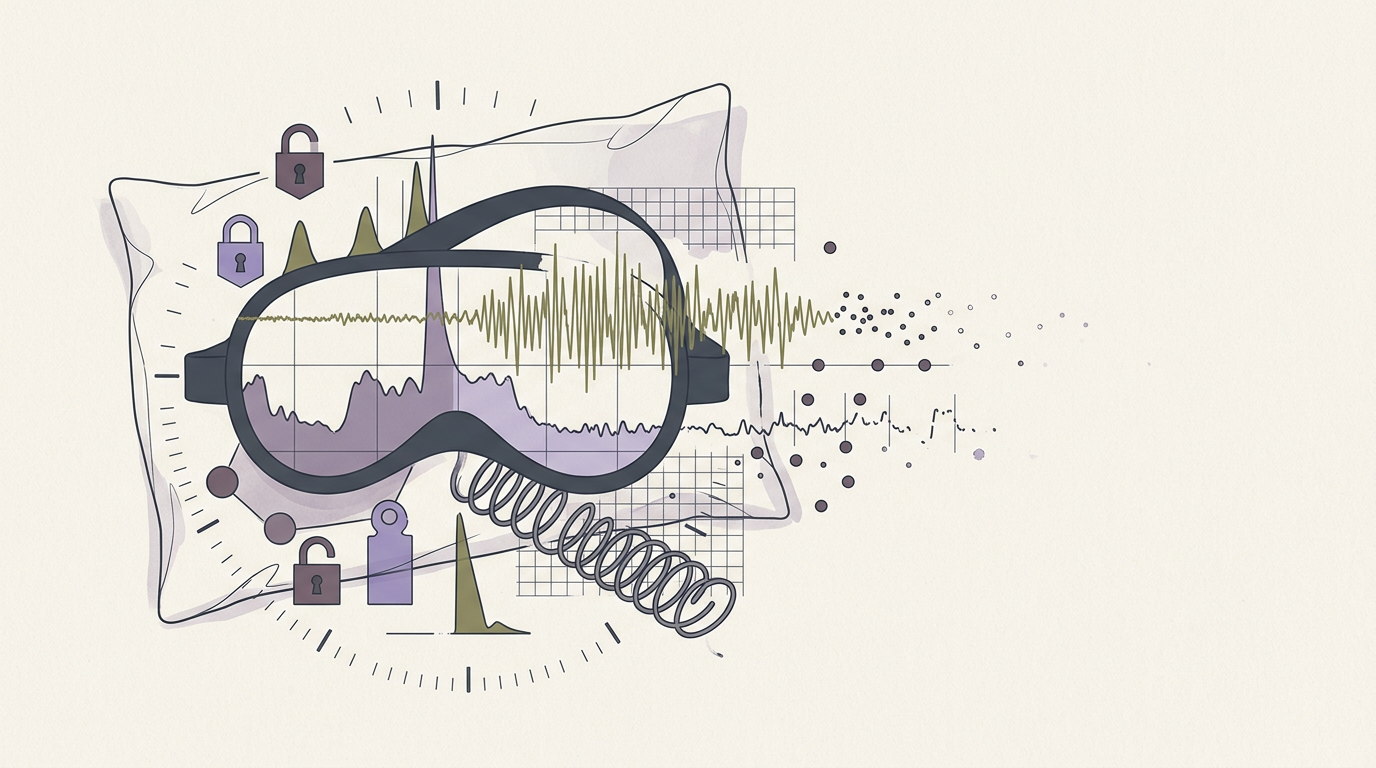
The feeling is brutally familiar. You are bone-deep tired, your body aches for rest, but your brain is running a marathon in your skull. Every wellness guru insists sleep is about calming down, but you are calm. And exhausted. And completely, maddeningly awake. The reason you’re so tired but can’t sleep isn’t a failure of willpower or a lack of lavender oil. It’s an architectural problem: your body’s stress chemistry is running on the wrong schedule, keeping the “alert” system firing long after the “energy” system has clocked out.
Common Questions
Wait, so it’s not just in my head?
No. This state of being "tired but wired" is a physiological mismatch. Your body is depleted of adenosine (the chemical that creates sleep pressure), but it's simultaneously flooded with stress hormones like cortisol and noradrenaline, which are powerful stimulants. Your systems are getting contradictory signals.
What’s the biggest mistake people make in this state?
Trying to force sleep. Lying in bed, watching the clock, getting frustrated—this all adds more stress chemistry to the mix, further activating your threat-detection system and making sleep even less likely. It’s like trying to put out a fire with petrol.
Is this insomnia?
Not necessarily. Insomnia is often a chronic condition diagnosed by a doctor. Being tired but unable to sleep can be a temporary state of nervous system dysregulation, often triggered by a period of high stress, travel, or a disrupted routine. It’s a readout of your system’s current load, not a permanent diagnosis.
Related anchors: sleep anchor · wired-tired anchor · performance anchor
The Myth of the Off-Switch
We treat sleep like a light switch. Day is for on, night is for off. If it doesn’t flick off, we assume the switch is broken. This is a profound misunderstanding of our own biology. Sleep isn’t a switch you flip; it’s a tide you allow to come in. It is a process of permissive surrender, not an act of will. Your body has no ctrl-alt-del for consciousness, and every attempt to command it into slumber just signals to your ancient survival circuits that something is very, very wrong.
All the bio-hacks and productivity tricks we deploy by day—the extra espresso to push through a deadline, the high-intensity workout to ‘burn off stress’—create a physiological debt. At night, that debt collector comes knocking in the form of a nervous system that has forgotten how to stand down. You’ve spent twelve hours teaching your body to override its fatigue signals; you can't expect it to unlearn that lesson in twelve minutes. It's a key part of learning nervous system regulation.
Cortisol’s Mistimed Curtain Call
Under ideal circumstances, your body runs on a beautiful rhythm. The star of that show is cortisol, a hormone produced by your HPA axis (Hypothalamic-Pituitary-Adrenal axis; the command centre for your stress response). Cortisol is meant to peak within 30 minutes of waking, giving you the energy to get up and face the day. It should then gradually taper off, hitting its lowest point in the middle of the night to allow for deep, restorative sleep.
When you're tired but wired, that elegant rhythm is broken. Your cortisol curve is flattened or, worse, inverted. It’s low in the morning (hence the feeling of being hit by a bus) and spikes in the evening, right when it should be bottoming out. This can be driven by a high allostatic load (the cumulative wear-and-tear from chronic stress), as described by researchers like Bruce McEwen. Whether it's the pressure of American hustle culture and its performative lack of PTO, or the dense social and family obligations preceding a festival in India, the effect is the same: the chemistry of "wake up" is arriving at bedtime.
The urge to force sleep is the very thing that prevents it. You can't strong-arm a system that is built for surrender.
The Watchtower That Won’t Stand Down
Let’s get properly nerdy for a moment. Deep in your brainstem sits a tiny cluster of neurons called the Locus Coeruleus (LC). Think of it as the brain's watchtower. It’s the primary source of noradrenaline—theneurotransmitter of vigilance, arousal, and focus. To fall asleep, the LC must go quiet. Its silence is the signal that allows your brain to shift into sleep states and activate the glymphatic system (the brain's overnight cleaning crew that clears out metabolic waste).
When you’re stressed, worried, or even just overstimulated, the LC stays active. It keeps scanning the horizon for threats. As Mara Mather’s research highlights, the LC is highly sensitive to stress and can get locked in a state of hypervigilance. You're physically exhausted, but the watchtower is still manned, pumping out "stay alert!" signals. Your body is ready for the barracks, but your brain is still on patrol. This is the core architectural flaw behind being tired but wired: the guard never goes off duty. Learning how to manage this state is a core skill we teach inside our Performance L2 course.
It's Not Just Blue Light, It's Bad Timing
Everyone blames blue light from screens, and they’re not wrong. But our circadian rhythm is tuned by more than just light. According to recent research, the timing of our meals, exercise, and even social interactions sends powerful signals to the hundreds of clocks in our bodies. That late-night dinner, a standard of social life in the warm climates of the Gulf, or the argument you had with your partner at 10 p.m. can be as disruptive as staring into a phone.
Satchin Panda and his work on time-restricted eating show how powerful meal timing is. Eating late tells your digestive system, and by extension your brain, that it’s still "activity time." This delays the release of melatonin and keeps your system in a daytime mode. The same goes for intense late-night exercise or a stressful work email check before bed. These aren't just bad habits; they are confusing signals to an ancient system that's just trying to follow the sun. If you want to dive deeper into the science, the Kokorology Library is full of these mechanisms.
What to do this week
This isn’t about buying a new gadget or a fancy supplement. It's about sending clear, consistent signals of safety and rhythm to your body.
- Anchor Your Morning. Within 30 minutes of waking, get 10-15 minutes of direct morning sunlight in your eyes (no sunglasses). This is the most powerful signal you can send to lock in your cortisol rhythm for the day. No sun? A SAD lamp works.
- Impose a Cortisol Curfew. No caffeine of any kind after 1 p.m. Not 2 p.m., not "just a small one." Your ability to metabolise it slows as you age. Keep intense, heart-pounding exercise to the first half of your day. A gentle walk after dinner is fine; a HIIT session is not.
- Create a Pressure Valve. Introduce a 60-90 minute "wind-down" period before bed. This is non-negotiable. No screens, no work, no domestic administration, no difficult conversations. Read a paper book, listen to calm music, do some gentle stretching. Give the watchtower a reason to believe the day is truly over. Our Hacks subscription has dozens of 60-second resets for this.
- Externalise Your Brain. Ten minutes before you get into bed, take a pen and paper—not a screen—and write down everything that’s looping in your head. The to-do list, the worry, the half-formed idea. Get it out of your skull and onto the page. This practice, logged in a tool like the Kokorology Journal, is a surprisingly effective way to quiet the inner monologue.
TL;DR
Feeling tired but unable to sleep is a physiological state, not a personal failing. It happens when your body’s stress-response system (the HPA axis) and alertness centre (the locus coeruleus) are stuck in an "on" state, flooding you with cortisol and noradrenaline at night. This overrides your body's natural sleep pressure. The fix isn't to try harder to sleep but to change your inputs during the day—managing light, meal timing, and stress—to coax your nervous system back into its natural rhythm.
Where this fits in the Kokorology system
This pattern of dysregulation is a classic sign of an overloaded nervous system. The immediate tools to fix it live in our Sleep Anchor, which is a key protocol within our foundational pillar of Nervous System Regulation.
Closing
The path out of this state isn't a battle; it's a recalibration. You don’t need to fight your body. You need to re-teach it safety. Start with one thing this week. Just one. Master the morning light, or fiercely protect your wind-down hour. See what shifts. It's the consistency of these small signals, not one grand gesture, that rebuilds the architecture of rest.
- Start with the full protocol inside the Sleep Anchor.
- Practice the daily brain dump with the Kokorology Journal.
- Get a free introduction with our Guide to Nervous System Regulation.
Sources
- McEwen, B. S. (2017). Neurobiological and Systemic Effects of Chronic Stress. Chronic Stress.
- Mather, M., & Sutherland, M. R. (2011). The Glutamate-Amplifying Excitation-Inhibition Network (GAIN) model of locus coeruleus-norepinephrine function. Physiology & Behavior.
- Panda, S. (2016). Circadian rhythms, time-restricted feeding, and healthy aging. Ageing Research Reviews.
- Sapolsky, R. M. (2002). A Primate's Memoir: A Neuroscientist's Unconventional Life Among the Baboons. (Illustrates stress physiology in practice).
- Walker, M. (2017). Why We Sleep: Unlocking the Power of Sleep and Dreams.