Workplace & Leadership
That's not grit, that's just sympathetic dominance
Your body doesn't admire your grit. It just registers the cost of a sympathetic nervous system that has forgotten how to stand down.
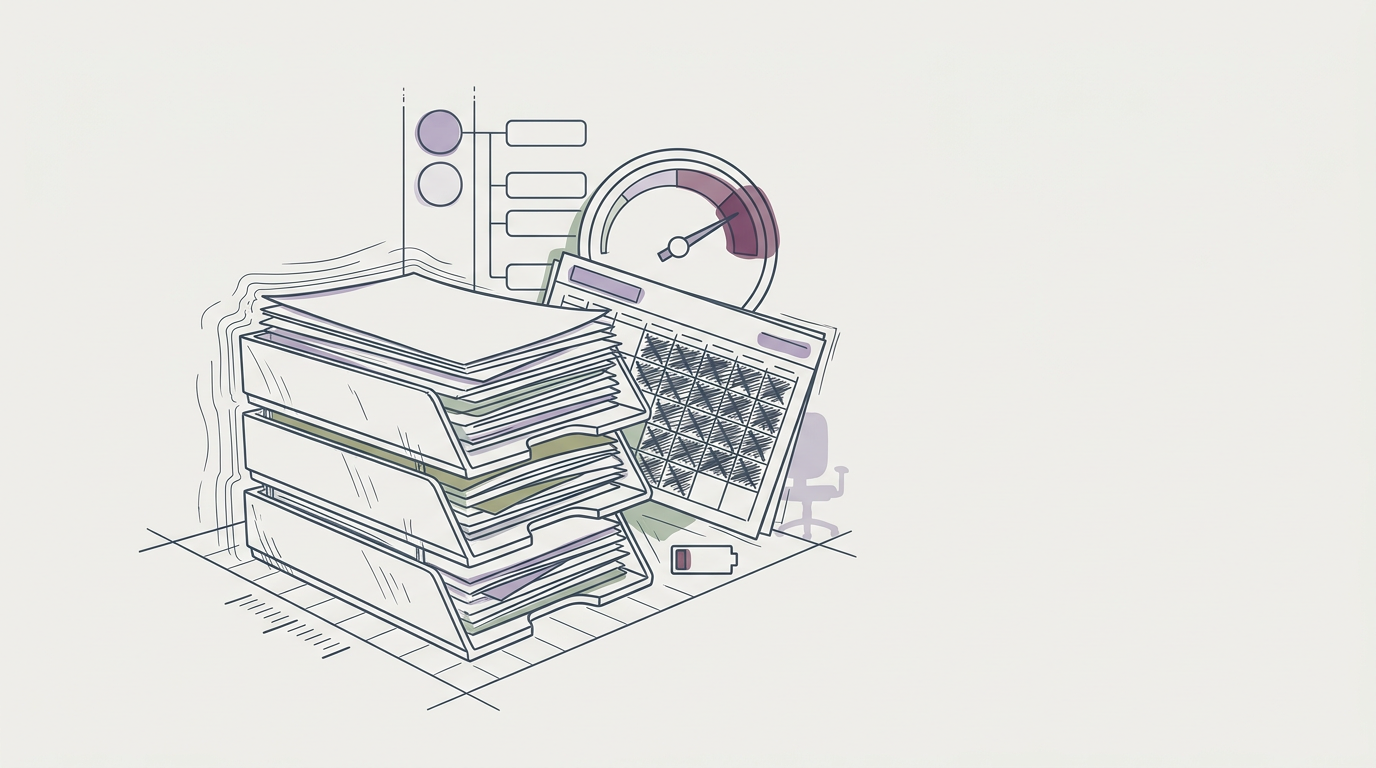
It's 10pm on a Tuesday. The pitch deck is sent, the last Slack message answered. The house is silent, but you feel a frantic, buzzing energy behind your ribs and your jaw is clamped shut. You are exhausted, but your brain is still replaying the 3pm meeting where everything felt like it was on fire. This state is the signature of a sympathetic nervous system stuck in the 'on' position, its off-switch long since disconnected. Endurance is the physiological capacity to exit high alert, a skill your leadership role demands but your schedule actively prevents you from learning.
Allostatic load is the real metric for leadership stamina
Your body keeps a running tally of every demand placed on it. The context switch between meetings, the forced smile for a difficult client, the skipped lunch to hit a deadline, the quiet absorption of your team's anxiety—each is a small withdrawal from your physiological budget. The cumulative cost of this chronic adaptation is called allostatic load.
Think of your nervous system's capacity as the electrical wiring in a house. A well-designed system can handle the dishwasher, the television, and the lights running at once. The story you're sold about 'hustle' tells you to just keep plugging things in. Back-to-back calls, constant notifications, the pressure to always have the final answer—you're putting too much demand on a single circuit. When the load is too high for too long, the system doesn't fail all at once. First, you get intermittent faults: brain fog after a long call, a struggle to find the right word, a general sense of decision fatigue. If the demand continues, the system initiates protective shutdowns. You might snap at a team member over a minor typo; this is a circuit breaker tripping to prevent a bigger meltdown, a systemic failure mislabeled as a personal one. Burnout is the predictable outcome of this electrical fault.
Under high allostatic load, your brain's directive shifts from long-term strategy to immediate survival. It starts to ration energy. The first departments to face budget cuts are the metabolically expensive functions of your prefrontal cortex: strategic foresight, creative problem-solving, and the ability to hold multiple perspectives. Your capacity for empathy dwindles. The circuitry that models other people's minds is a luxury your overdrawn system can no longer afford.
This shift away from the prefrontal cortex is more than an internal experience; it has direct consequences for your team. Your ability to forecast second-order consequences of a decision, to hold space for dissenting opinions, or to generate a novel solution to a recurring problem are all housed in that expensive cortical real estate. When it's offline, you default to playbook answers and familiar patterns. The very innovation your role is supposed to drive becomes physiologically inaccessible. You are more than tired; your brain's hardware for complex thought is being deliberately throttled to save power.
Energy is rerouted to the faster, more primitive parts of the brain, like the amygdala. The amygdala is excellent at spotting threats but terrible at running a company. Your decision-making becomes more short-term, more binary, and more defensive. You start seeing every problem as a nail because your brain can only afford a hammer. The nuance, complexity, and patience required for effective leadership have been temporarily taken offline by a system trying to conserve power.
Related anchors: vagal tone anchor · HRV anchor · burnt-out anchor
Recovery is a function of physiological tempo
The story about 'grit' focuses entirely on enduring the storm, with no mention of what happens after. Real resilience is measured by the speed and efficiency of your return to baseline after a stressor. This is a question of physiological tempo, and the primary conductor of that tempo is your vagus nerve.
The vagus nerve is the main channel of your parasympathetic nervous system—the body's braking system. Its effectiveness, measured as vagal tone, dictates how quickly and appropriately your system can shift out of high alert and back into a state of rest, repair, and social connection. This is the physiological difference between ruminating on a tense meeting for six hours versus feeling the stress, processing it, and returning to baseline within minutes. A system with a flexible tempo can handle the fortissimo passages of a crisis because it knows how to return to a calm andante. A system stuck in one gear just plays loud, all the time, until the instruments break.
This capacity is measurable in your heart rate variability (HRV). A higher, more adaptable HRV suggests a healthy vagal tone and a resilient nervous system that can smoothly shift gears. This is a critical distinction. You cannot use the part of your brain that is offline to bring itself back online. Trying to 'think positively' or 'reframe the situation' when you are in a deep sympathetic state is neurologically futile. Your prefrontal cortex, the seat of rational thought, has had its budget slashed. The intervention has to come from a different channel. It has to be physiological.
A physiological sigh—a double inhale through the nose followed by a long, slow exhale—is a direct lever. This is a direct, mechanical intervention on your physiology. The double inhale reinflates collapsed alveoli, the tiny air sacs in your lungs, maximising the surface area for gas exchange. The extended exhale is the key action that stimulates the vagus nerve, signalling the heart to slow down. This is a bottom-up signal, from body to brain, that bypasses the noisy, overwhelmed cognitive loops. You are using the physical key to reboot the server yourself. It is a targeted respiratory practice with a predictable effect on arousal.
Coregulation is non-verbal leadership
A leader's nervous system state is never a private matter. In any room, human nervous systems constantly communicate with each other beneath the level of conscious awareness, a process called coregulation. Your calm is contagious. So is your anxiety.
When you walk into a meeting with your jaw tight, your breathing shallow, and your speech clipped and fast, your team's nervous systems register a threat. You might ask for 'honest feedback', but your physiology is broadcasting a different signal entirely. The room goes quiet. People look at their notes. The team's response is silence or quick, superficial agreement because their nervous systems have correctly read the mismatch between your words ('tell me the truth') and your state ('do not bring me another problem'). You have unintentionally created an environment of low-grade fear, shutting down the very candour you claim to want.
Consider a one-on-one where a direct report needs to tell you a project is behind schedule. If you are already running on a sympathetic deficit—shoulders hunched over your laptop, eyes flicking to notifications, speech rushed—they will read your state before you say a word. Their own nervous system will shift into a protective crouch. They will soften the bad news, omit crucial details, or frame the problem as already solved, all to avoid adding to the load they can sense you're already carrying. You get a filtered, less useful version of reality because your state made it unsafe for them to deliver the raw data.
Conversely, a leader who is regulated—breathing from the diaphragm, speaking in a measured tone with vocal variety, making open eye contact, tolerating silence—creates a field of psychological safety. This capacity is earned through the physiological work of bringing yourself to a regulated baseline. Your nervous system reads past performance; it cannot be tricked by a pretence of calm. A regulated leader acts as a current that pulls the entire team's nervous system toward safety. When a crisis hits, their calm state provides a grounding force, preventing a cascade of collective panic. This is some of the most important, and most overlooked, work a leader does. Your capacity sets the ceiling for your team's capacity.
Common Questions
How is this different from standard stress management?
Standard stress management often focuses on mindset or behavioural changes, like time management or positive thinking. It gives you a better filing system for incoming stress. A nervous-system-literate approach works at the physiological level, using specific inputs like breath and sensation to directly regulate your state. It upgrades your server so it can handle the volume without crashing, making those behavioural changes easier to implement and sustain.
Can I really improve my nervous system's capacity?
Yes. The technical term is neuroplasticity; your nervous system is designed to adapt. Just as you can train your biceps, you can train your vagal response. This is not an overnight fix. You are rewiring patterns that may have been in place for years. But with consistent, small practices, you can measurably shift your baseline and your response to stress over a period of weeks and months. Consistency is more important than intensity.
My team expects me to be 'on' all the time. How do I manage this?
The expectation of being perpetually 'on' is a direct path to burnout for you and everyone you lead. The shift begins with you modelling a different, more sustainable tempo. This can look like blocking 15 minutes of 'transit time' between contentious meetings to reset, instead of rushing from one fire to the next. It looks like explicitly stating, 'I won't be on Slack after 7pm, but will see this first thing in the morning.' Setting this boundary also gives your team explicit permission to have an off-switch, demonstrating that recovery is a non-negotiable part of high performance.
Closing
- Stop managing burnout and start building physiological capacity. My one-on-one performance coaching is for leaders who need to upgrade their hardware.
- Want to bring this framework to your entire organisation? Learn more about Kokorology for the workplace and how I help teams build sustainable performance.
- New to this way of thinking? Start with the free nervous system basics course to understand the fundamentals.
TL;DR
The 'tired but wired' state common in leadership is a sign of a sympathetic nervous system that cannot power down. True resilience is a physiological capacity determined by your nervous system's ability to recover from stress, a function of your vagal tone. Chronic stress creates high allostatic load, which impairs decision-making by taking your prefrontal cortex offline. Using specific physiological practices to improve your recovery tempo prevents burnout and makes you a more effective, regulating presence for your entire team.
Sources
- Freudenberger, H. J. (1974). Staff Burn-Out. Journal of Social Issues, 30(1), 159–165.
- McEwen, B. S. (2006). Protective and damaging effects of stress mediators: the good and bad sides of allostasis. Dialogues in Clinical Neuroscience, 8(4), 367–381.
- Moffitt, T. E., et al. (2011). A Gradient of Childhood Self-Control Predicts Health, Wealth, and Public Safety. PNAS (Proceedings of the National Academy of Sciences), 108(7), 2693–2698.
- Balban, M. Y., et al. (2023). Brief Structured Respiration Practices Enhance Mood and Reduce Physiological Arousal. Cell Reports Medicine, 4(1): 100895.