Nervous System
The Recovery Day You Keep Postponing Is the One Holding the Rest of the Week Up
A nervous system recovery day deliberately drops autonomic load to rebuild your baseline capacity. Here is the exact protocol for pulling the vagal brake.
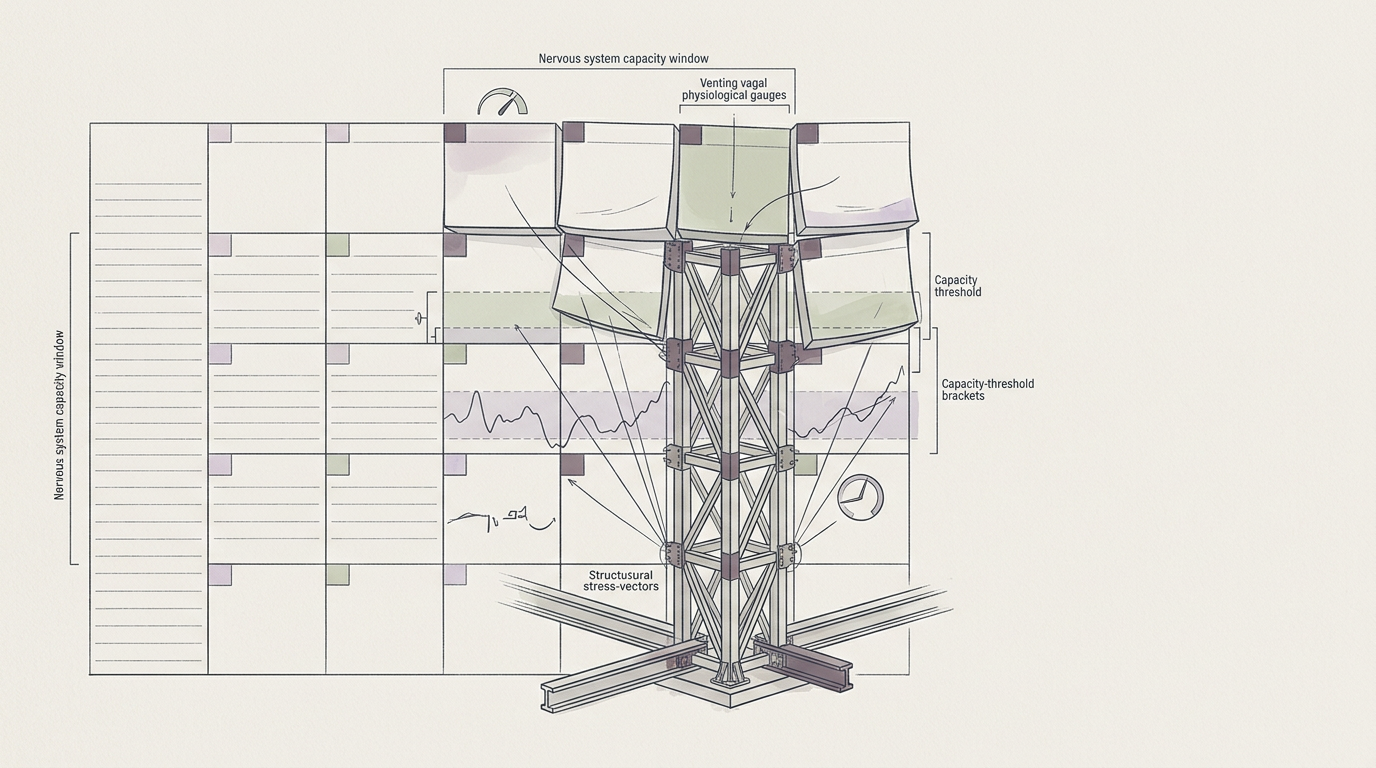
I used to wait until I was entirely depleted to take a rest day. Optimisation culture sells the idea that recovery is a prize you earn by crossing a productivity finish line. The human body requires regular autonomic shifts to function at all. Waiting until you crash before lowering your environmental demands guarantees you will live in a state of chronic sympathetic arousal.
You know exactly what the edge of your capacity feels like before you have a clinical name for it. It's the 3pm jaw clench that travels up behind your eyes. It's staring into the open fridge with absolutely no hunger, looking for a dopamine hit that cheese simply won't provide. You're exhausted but can't rest, lying in bed at midnight running through mildly annoying conversations you had three years ago. Your shoulders won't drop, even under the hot water of the shower. You push through the brain fog after eating lunch, relying on a second coffee that only makes your heart race. You feel anxious for no reason, snapping at a delayed text message. You're tired but wired, operating a body that has forgotten how to locate its own off switch.
Common Questions
What is autonomic load?
Autonomic load is the cumulative demand placed on your nervous system by sensory inputs, stress, and physical exertion. Every light, notification, and conversation requires neurological resources to process. Lowering this load means deliberately removing those inputs so the system can shift out of threat detection.
Why do I feel worse when I finally stop?
When you stop moving, the adrenaline that was keeping you functional begins to drop, revealing the actual exhaustion underneath. The sudden quiet removes the distraction from your internal state. Your body finally has the safety to signal exactly how depleted it is.
How long does it take to recover baseline capacity?
Most regulated nervous systems can bounce back from acute stress with one fully executed day of lowered sensory input. Chronic depletion takes longer, requiring consistent daily shifts in vagal tone rather than a single rescue operation.
The threat-detection problem
I'm calling it. When people attempt to rest, they don't usually stop. They lie on a sofa while scrolling a phone, absorbing an endless stream of digital micro-threats. The body remains in low-grade sympathetic mobilisation. A true recovery day requires a deliberate down-shift in autonomic load. The nervous system reads environmental cues, not calendar invites. Bright overhead lighting and a buzzing group chat are sympathetic inputs. The inbox has never once been impressed by your heart rate.
The vagal brake
The vagus nerve acts as the literal parking brake on your heart and stress-response systems. When you pull it, heart rate drops, digestion resumes, and the social engagement system comes online. The body reads the physical environment as safe enough to repair. If you keep the sensory inputs high, the brake stays off. Allostatic load continues to build up. Glymphatic clearance needs uninterrupted, high-quality sleep to wash metabolic debris out of the brain. That sleep architecture relies on the vagal brake being firmly engaged long before you hit the mattress.
Creating the environment
Pick the physical environment first. Space is the primary signal your brain uses to evaluate threat density. Make it boring. Dim the lights, drop the room temperature, and shut the door. I've stopped recommending elaborate biohacking stacks for a Sunday. A heavy blanket and a cool room do more for evening cortisol and sleep-onset latency than a sauna protocol you have to stress yourself out to complete. The goal is to make the room completely uneventful.
The notification spike
A recovery day with your alerts turned on is just a working day with worse posture.
Cut the inputs your threat-detection machinery can't ignore. Put the phone face down in another room. Every single notification triggers a small orienting response. Your brain spikes with a tiny surge of arousal to assess whether the ping requires immediate action. Give your prefrontal cortex a day off from triaging emergencies.
Eating for a quiet system
When the system is heavily depleted and cortisol is elevated, skipping meals stacks another stressor on top of a highly sensitised baseline. You shouldn't fast on a recovery day. Eat protein early. Drink water with salt. Keep your blood glucose entirely unremarkable for twelve hours.
Letting the brain idle
Let yourself zone out completely. Watch a film you know by heart. Listen to music without lyrics. You need the default mode network to run. That is the brain network responsible for autobiographical consolidation and making sense of the world. It only comes online when you stop trying to focus on a specific task. Intentional spacing out gives the machinery time to sort the mental files.
Anchor the rhythm
Get outside early. Walk slowly for twenty minutes with daylight on your face. Treat this as a circadian anchor. Morning bright light advances your melatonin onset for that evening, ensuring you get the deep sleep stages required for physical repair. In the evening, extend your wind-down. Crawl into bed ninety minutes before you plan to sleep. Dim the lamps. Most people compress their parasympathetic transition into three minutes of aggressive tooth-brushing. Give the system time to lower the gears.
What to do this week
- Designate a specific four-hour window this weekend for absolute low-input time.
- Move your phone charger out of the room where you sleep.
- Dim your overhead lights by 7pm to cue the circadian shift.
- Eat a protein-heavy breakfast within an hour of waking to stabilize your metabolic baseline.
Where this fits in the Kokorology system
Learning to intentionally pull the vagal brake is the foundation of everything Kokorology teach about capacity. You can track your autonomic shifts using the Kokorology Journal, and practice small, immediate interventions with the Hacks. For a structured approach to rebuilding your baseline over a week, the Reset program walks you through the exact daily steps.
Closing
The version of you that shows up on Monday depends entirely on how well you manage your physiological state on Sunday. Treat your downtime as a non-negotiable physical requirement, and watch how much more capacity you have for the things that actually matter.
- Start tracking your state shifts with the Kokorology Journal.
- Work directly on your baseline capacity inside the Reset program.
- Continue the deeper study of your nervous system in the Library.
TL;DR
A nervous system recovery day requires a deliberate drop in autonomic load. Avoiding the gym is insufficient if you continue to absorb high sensory inputs. You have to remove the environmental cues that keep your brain in a state of threat detection. Dim the lights, turn off notifications, eat unremarkable food, and get morning sunlight to anchor your circadian rhythm. Lowering the sensory demand allows the vagal brake to engage, dropping your heart rate and allowing your body to clear metabolic waste. Protect this low-input time to rebuild your baseline capacity for the week ahead.
Sources
- Critchley HD (2005). Neural systems supporting interoceptive awareness. Nature Neuroscience, 8(7), 849-850.
- Thayer JF & Lane RD (2009). The role of the vagal brake in the modulation of attention and emotion. Frontiers in Psychology, 2(117).
- Kivimäki M (2018). Work stress and risk of death in men and women with and without cardiometabolic disease: A multicohort study. The Lancet Diabetes & Endocrinology, 6(9), 705–713.
- Xie L et al. (2013). Sleep Drives Metabolite Clearance from the Adult Brain. Science.
- Wright K et al. (2013). Entrainment of the Human Circadian Clock to the Natural Light–Dark Cycle. Current Biology.