Journal Practice
The insubstantiality of journaling prompts and emotional stability
Effective journal prompts for emotional regulation target the raw physical data of your nervous system to track physical signals before they escalate.
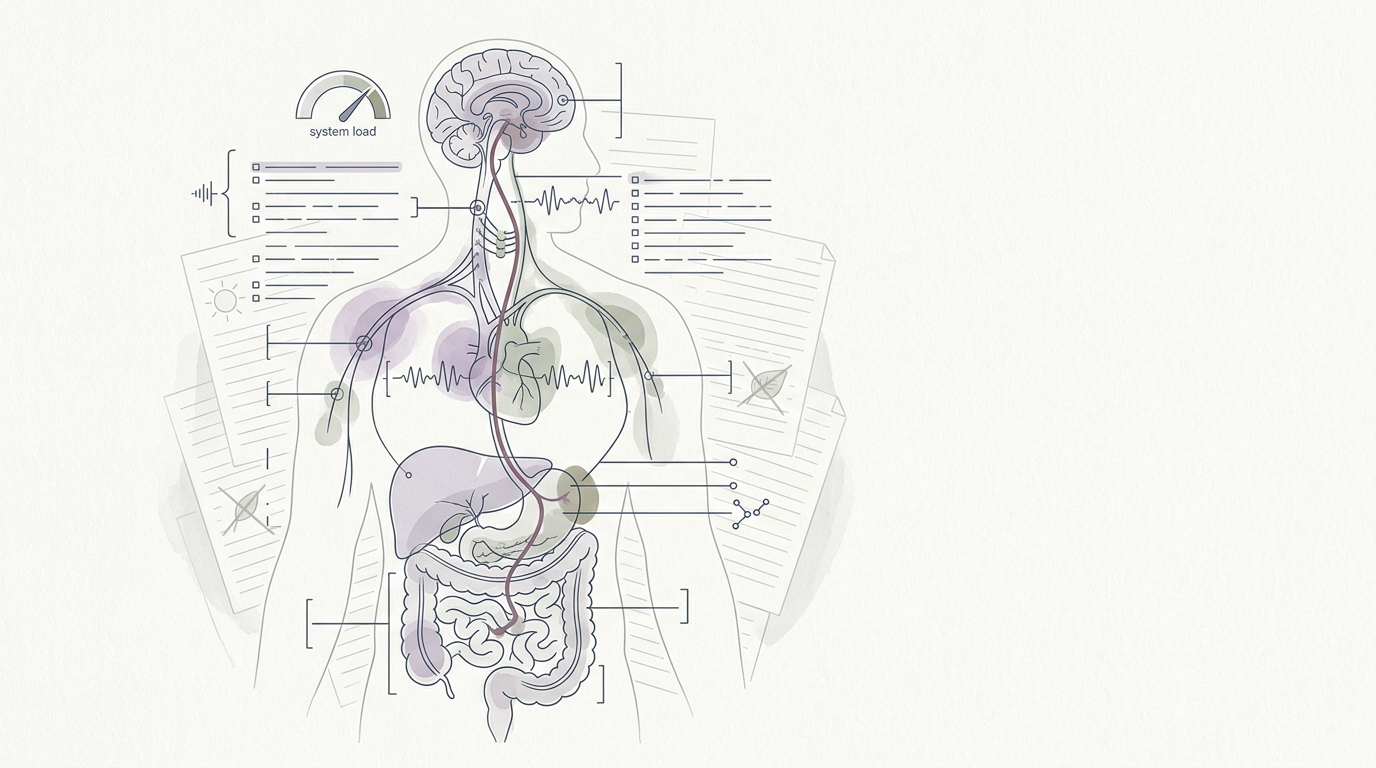
I spent years recommending traditional gratitude lists and expressive writing for stress. The standard advice dictates that emotional regulation requires narrating your distress on paper until it miraculously resolves. It's a method that reliably deepens the groove of the panic. Staring at a blank page and trying to document your anxiety just loops the limbic system and feeds the threat response.
You buy the heavy, minimalist notebook and sit down at 9pm to process your day. You stare at the paper expecting a profound emotional release, but your brain is completely blank. You're just experiencing a familiar, low-grade hum of dread. You feel anxious for no reason, with a tightness in the chest that makes drawing a full breath impossible. The shoulders that won't drop in the shower stay fused to your ears. You're tired but wired, staring at the empty page while the buzzy static builds behind your eyes. You feel utterly disconnected from your body, so you write one flat sentence about how exhausted you are and put the pen away. The physical tension doesn't change at all.
Common Questions
What are journal prompts for emotional regulation?
They're targeted questions designed to map the physical state of your nervous system. They direct your attention to specific, trackable physical sensations happening in your tissues to gather real data about your state.
How does this affect the brain?
Directing your attention to physical sensations engages the prefrontal cortex. This shift pulls resources away from the emotional feedback loops driving the distress. It forces the brain to observe the data without immediately attaching a catastrophic story to it.
How often should I practice this?
Consistency matters more. Five minutes of focused sensory tracking daily provides a steady stream of high-quality data to the brain. It trains your system to recognize subtle shifts before they escalate.
Related anchors: vagal tone anchor · gut-immune anchor · HRV anchor
The trap of the narrative
The traditional diary model encourages rumination. You end up practicing the story of your stress, which keeps your HPA axis firing on high alert. The brain doesn't differentiate between the written story of a threat and the threat itself. You write about the email that ruined your morning, and your heart rate elevates right back to where it was at 10am.
The feelings you try to write about are just the user interface. The real machinery is the system diagnostics running underneath. I watch people treat their bodies like rented cars they only notice when the engine starts smoking.
You cannot think your way out of a physiological state.
The anterior insula and the data stream
The capacity to sense the internal state of your body is called interoception. This process relies on a small region of the brain called the anterior insula. It receives all the visceral data from your organs—the flutter in your chest, the 30g of protein digesting in your gut, the heat in your face—and integrates it into a coherent conscious feeling.
The insula relies on prediction. It takes incoming sensory data, compares it to past experiences, and makes a best guess. When your interoceptive sense is dull, the input is muddy. The brain is forced to make predictions with bad data, which triggers the sudden sensation of being exhausted but can't rest. The physiological reason exists. You just haven't learned to read the biological code yet.
Shifting from story to sensation
Effective journal prompts cut straight through the narrative. They'll direct you to locate where the anxiety lives in your body. This shift from story to sensation is the mechanism that expands true capacity.
I've seen this constantly in my own practice. By deliberately directing your attention to internal signals, you train your insula to make accurate predictions. You establish a higher-resolution map of your internal world. This turns a vague panic attack into the dry realization that your breathing is shallow and you drank three coffees before 2pm. The clarity changes the state.
What to do this week
- Ask where before why. For the next three days, when a strong emotion arises, pause. Before you analyze the story, locate the feeling in your body and name the specific area.
- Track one signal. Pick one physical tell—jaw clenching, shoulders rising, or breath-holding—and monitor it. Make a note on your phone or in the Journal.
- Run a one-question experiment. Each evening, answer this prompt: 'What was one moment today my body felt settled?' Write exactly one sentence.
Where this fits in the Kokorology system
Developing interoceptive awareness is the diagnostic work that makes regulation possible. It turns the abstract idea of managing stress into a concrete physical practice you can track in the Journal and modulate using targeted Anchors.
Tonight's practice
Tonight you stop writing stories about your stress. You track where the physical feeling lives in your tissues.
Name the exact physical location of your strongest body sensation right now and describe how it feels physically.
- Sit quietly on the edge of your bed for 2 minutes.
- Locate one point of physical tension in your jaw, chest, or stomach without writing any explanation for why it is there.
- Record the physical location in your notebook and rate its intensity on a scale of 1 to 5.
- Repeat this simple measurement once daily for 7 days to establish a baseline.
Closing
A journal's true purpose is to create a reliable instrument for reading your own nervous system in real time.
- Practice it daily inside the Kokorology Journal.
- Work with the foundational concepts in the Regulation course to map your patterns.
- Download the free guide to the nervous system to understand the machinery you are working with.
TL;DR
Traditional journaling often reinforces emotional drama rather than regulating it. Effective prompts for emotional regulation develop interoception, which is the skill of reading your body's raw physical signals. By locating where you feel something before analyzing why it is there, you shift away from the limbic threat response. This trains the brain to accurately predict and manage the nervous system's state, turning overwhelming anxiety into a manageable physical metric.
Sources
- Pennebaker JW (2023). Journaling and the nervous system: from expressive writing to affect labeling. Curated meta-analyses and primary studies (1986–2023).
- Thayer JF (2012). A meta-analysis of heart rate variability and neuroimaging studies: Implications for heart rate variability as a marker of stress and health. Neuroscience & Biobehavioral Reviews.
- Khalsa SS (2018). Interoception and mental health: a roadmap. Biological Psychiatry: Cognitive Neuroscience and Neuroimaging.