Workplace & Leadership
The Post-Acquisition Culture Shock: Stabilizing the Nervous System of Merged Teams
Mastering post-acquisition culture requires understanding employees' fundamental need for safety and belonging, not just strategic alignment.
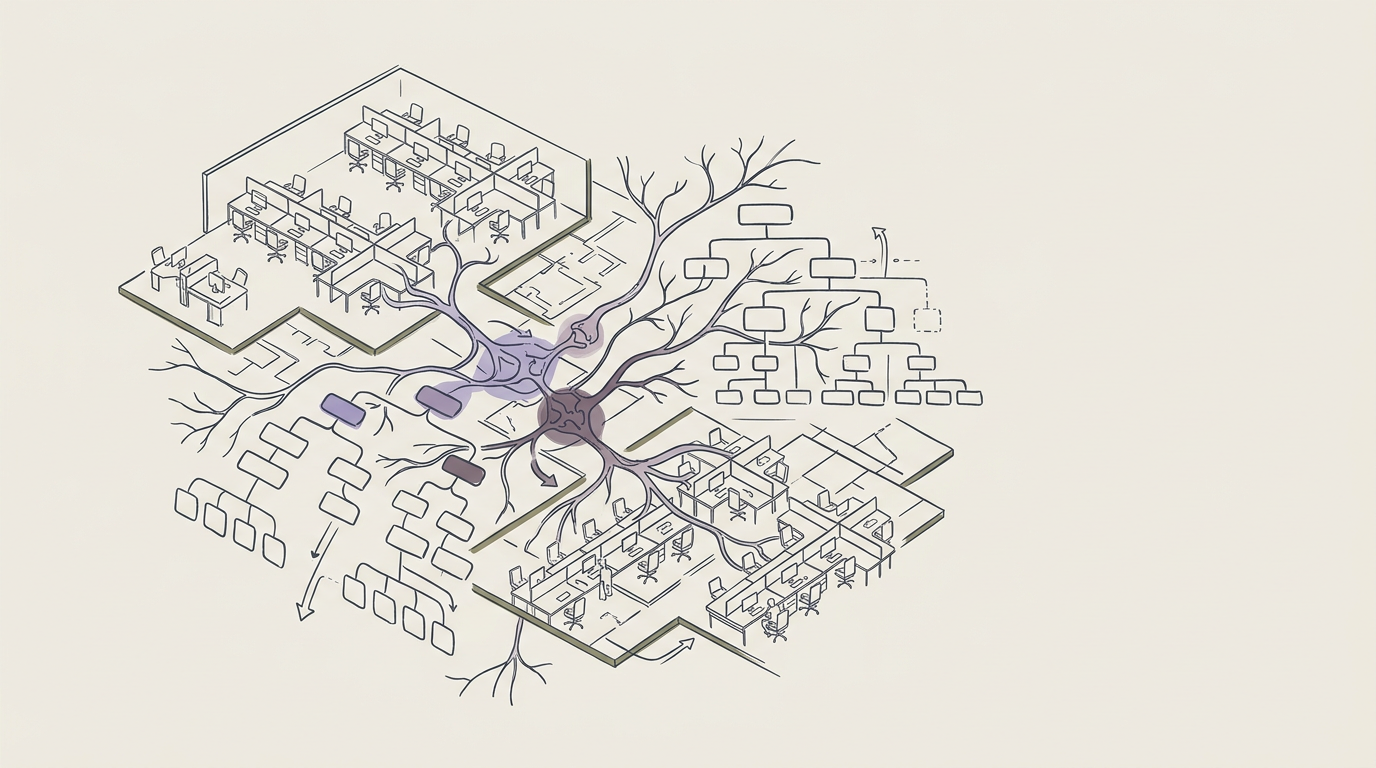
Nine out of ten merger playbooks treat post-acquisition culture as a communication strategy. The assumption is that if you put the right values on a slide deck and host a town hall, the merged entity will eventually settle down and do the work. I'm calling it. The slide deck does nothing. A corporate merger functions as a prolonged, state-sanctioned threat to the human nervous system.
You sit on the second day of the transition offsite, listening to the integration lead talk about synergies, and you notice your shoulders are practically touching your ears. You are supposedly safe, and your role was confirmed last Tuesday. But you spend the flat hour after lunch refreshing the new org chart, trying to figure out who actually holds power. You go home tired but wired, snapping at your partner over the dishwasher loading protocol. At 11:47pm, you're doom-scrolling LinkedIn, feeling anxious for no reason while your heart races against the mattress. You wake up exhausted but can't rest, dragging a profound brain fog into the 9am sync. Your body is doing exactly what millions of years of evolution designed it to do when your tribe, your status, and your territory are suddenly overwritten by strangers.
Common Questions
What is allostatic load?
Allostatic load is the physiological wear and tear your body accumulates from chronic stress. When you spend months anticipating organizational changes, your stress response stays active instead of returning to a baseline state. Over time, this constant vigilance exhausts your system and degrades your capacity to recover.
How does workplace uncertainty affect the nervous system?
Uncertainty signals a lack of safety to the brain. The autonomic nervous system shifts into a defensive posture, prioritizing threat detection over higher-order thinking and collaboration. This physiological shift compromises your digestion, sleep, and emotional regulation long before you register conscious anxiety.
Why do mergers cause physical symptoms?
Your biology treats a threat to your social standing exactly like a physical predator. The HPA axis floods your system with cortisol, preparing you to fight or flee. When you have to sit quietly in a meeting instead of running, that mobilized energy manifests as tension, headaches, and sleep disruption.
The Biological Reality of the Org Chart
When a new entity swallows an old one, the executives look at overlapping departments. The employees look for predators. I used to believe you could out-communicate a merger. If I could just write a clear enough email sequence, I assumed people would relax. I've stopped recommending that. Communication only works when the receiver has the biological capacity to process language.
When the threat-detection machinery in the brain registers a shift in territory, it takes over. It shuts down the prefrontal cortex. It shuts down creative problem-solving. It shuts down the exact collaborative energy the acquisition was supposed to harvest. It hands control to the HPA axis—the stress-hormone loop running from your brain to your adrenal glands and back.
The predictable result is a workforce operating entirely on defense. Every vague Slack message gets interpreted as a firing offense. Every closed-door meeting becomes a conspiracy. You can't mandate collaboration when the nervous system is braced for impact.
Capacity and the Wearable Data
Let's look at the actual machinery. Interoception is your brain’s ability to read the physiological condition of your body—the beat of your heart, the expansion of your lungs, the tension in your gut. During prolonged organizational shifts, people lose this resolution. They disconnect from the neck down because the signals are too loud.
Kokorology see this play out in Heart Rate Variability (HRV), the beat-to-beat variation in your heart rate. HRV acts as an incredibly accurate proxy for how flexible your nervous system is. High HRV means your autonomic nervous system can toggle smoothly between effort and recovery. Low HRV means your foot is stuck on the gas pedal.
A badly managed merger will predictably tank the average HRV of an entire department. The workforce becomes rigid. A team with collectively suppressed HRV fails to innovate because their physiological baseline cannot support the metabolic cost of creative thought.
The Vagal Brake
You can mandate compliance with a new policy, but you cannot force a human nervous system to feel safe.
The tool Kokorology actually need to stabilize a merged team is vagal tone. The vagus nerve acts as the parking brake for your nervous system. When it functions well, it slows your heart rate, signals safety, and allows you to look another person in the eye without assuming they want your job.
Corporate integration efforts usually involve mandatory icebreakers. And Kokorology respond with enforced socializing? Forcing dysregulated people to do trust falls under fluorescent lights ruins the remaining goodwill. The brake requires predictability, not forced fun. It requires knowing exactly what happens on Tuesday at 10am, and knowing the person running the meeting will tell the truth.
What I Tell Leaders
I've sat in boardrooms with executives who are baffled that their newly acquired teams are underperforming. They want a new motivational framework. I usually tell them to look at the sleep data. The inbox has never once been impressed by your heart rate, and if your people are waking up at 3am sweating over their 401k transfer, they require biological safety above all else.
Provide the raw, boring details. Give them control over their immediate physical environment. Allow the grief of losing the old company to exist in the room without rushing to fix it. True integration happens only when the collective nervous system decides the new environment is survivable. It is this simple.
What to do this week
- Cap the information intake. Check the transition Slack channel exactly twice a day, then close it.
- Establish one non-negotiable anchor in your morning that has nothing to do with the acquisition. Ten minutes of the Journal with a physical pen works.
- Name the state. When the 3pm jaw clench hits, say out loud, "My system is detecting a threat right now." Don't try to solve it; just label the mechanism.
- Take a full 75 minutes away from the screen at lunch. The merged entity will survive your absence.
Where this fits in the Kokorology system
Managing corporate transitions requires immense physiological capacity. This is why Kokorology teach the biology of leadership inside the Performance course (L2). If your entire team is running on empty after a merger, the workplace Coaching engagements rebuild that baseline directly, or you can start standardizing your own response with the 7-day Reset.
Closing
Don't wait for the new executive team to regulate your nervous system for you. They're likely just as dysregulated, hiding it behind better tailoring. Take control of your own baseline first, and the rest of the org chart will figure itself out.
- Start with a Free Guide to understand your physiological state.
- Work with the system in Coaching to navigate high-stakes corporate transitions.
- Practice daily regulation inside Anchors.
TL;DR
Mergers operate as biological threat events disguised as strategic alignment problems. A post-acquisition culture cannot stabilize while the employees' nervous systems remain stuck in chronic vigilance and allostatic load. Instead of pushing new mission statements, leaders must prioritize physiological predictability and lower the threat response. Rebuilding a shared culture requires an environment where the nervous system can safely toggle out of defense mode and restore its baseline.
Sources
- Khalsa SS, Lapidus RC & Craig AD (2018). Neuroscience & Biobehavioral Reviews.
- Kemp AH & Quintana DS (2013). Psychosomatic Medicine.
- McEwen BS (2019). Dialogues in Clinical Neuroscience.
- Shaffer F & Stern JS (2021). Frontiers in Psychology.