Nervous System
The 3pm crash: a downstream symptom of upstream resource dysregulation
The 3pm crash is a predictable shift in autonomic state, driven by glucose rhythm and sleep pressure outrunning your morning caffeine.
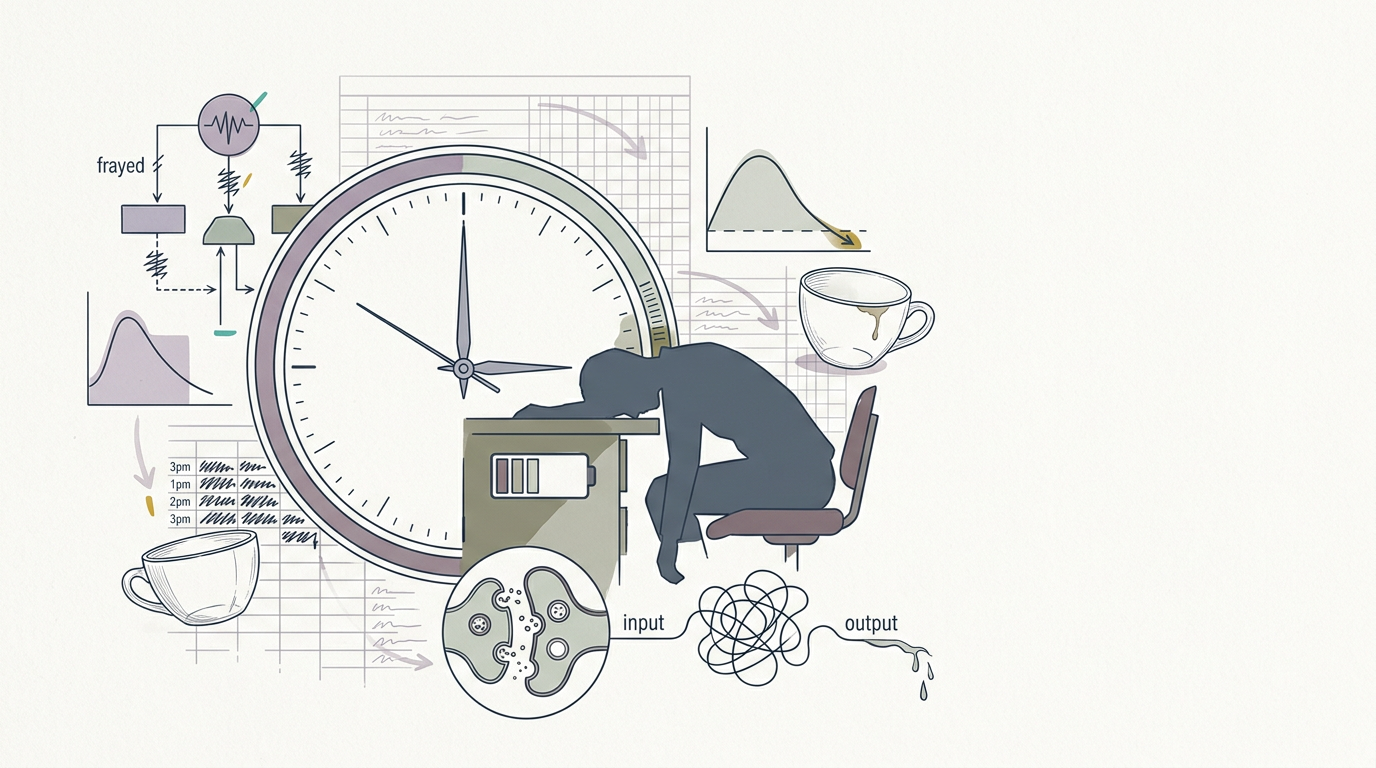
Every office kitchen at 2:45pm tells the exact same physiological story. People wander in, stare blankly at the fridge, and pour a third cup of coffee to force their prefrontal cortex back online. The wellness industry treats the afternoon slump as a symptom of low motivation, suggesting you need another supplement, a louder playlist, or a greens powder. That is a misunderstanding of basic mammalian rhythm. The 3pm crash is an autonomic shift, driven by accumulated sleep pressure and digestion outrunning the morning's caffeine.
You know the feeling exactly. It is the jaw that won't unclench while you stare at an email you've already read three times, wondering why the words have stopped meaning anything. You feel a bizarre mix of heavy limbs and a racing mind, leaving you tired but wired as the afternoon drags on. You experience sudden, profound brain fog after eating your desk lunch, forcing you to reread the same paragraph repeatedly. It is the open fridge with no real hunger, the half-finished sentence in a meeting, the shoulders creeping up to your ears. You are exhausted but can't rest, so you doom-scroll through industry news while promising yourself you will close the laptop soon. The second coffee of the afternoon doesn't land. It just adds a tight buzz behind the eyes while the exhaustion stays locked in your tissues.
Common Questions
Why does the crash always happen at 3pm?
Your circadian rhythm has a natural, predictable dip in the early afternoon, roughly seven to nine hours after waking. At this exact point, your sleep drive is rising while the cortisol that woke you up is naturally lowering. Add a heavy lunch, and blood is diverted to digestion, dropping your available energy even further.
Is this a blood sugar problem?
Glucose response plays a significant role, particularly if your midday meal was entirely simple carbohydrates. An unanchored glucose spike forces a sharp insulin response, which pulls sugar out of the blood quickly and triggers an autonomic stress response as levels drop. The resulting fatigue is your system signaling a sudden lack of available fuel.
Will more caffeine fix the afternoon slump?
Adding a late-afternoon stimulant only delays the physiological processing of adenosine, the molecule that tracks your time awake. Once the caffeine wears off, all that accumulated adenosine binds at once. You skip the gentle evening wind-down and move straight into an overstimulated state, ensuring you sleep poorly and repeat the cycle tomorrow.
The Adenosine Backlog
The supplement aisle wants you to believe you are deficient in whatever adaptogen they are currently selling. The mechanism actually running the afternoon is adenosine. From the moment you wake up, adenosine accumulates in the brain, binding to specific receptors and creating sleep pressure. Caffeine blocks those receptors. It acts entirely by deafening the brain to its own fatigue.
When I first understood the adenosine mechanism, I stopped drinking coffee at noon entirely. By 3pm, the morning's caffeine is releasing its grip on the adenosine A2A receptors in your nucleus accumbens. Every molecule of sleep pressure you accumulated since 7am rushes in to bind at once. Your nervous system is simply experiencing a chemical backlog.
The trick is to delay the morning coffee. Pushing that first cup ninety minutes after waking lets the system clear lingering sleep pressure naturally, making the afternoon drop significantly shallower.
The Circadian and Digestive Collision
The mid-afternoon drop is also the exact point where two different biological rhythms cross paths. Your circadian pacemaker, the internal clock governing wakefulness, naturally dips in the early afternoon. At the same time, your homeostatic sleep drive is steadily rising.
If you eat a meal heavily weighted toward simple carbohydrates at 1pm, you introduce a third variable. The rapid glucose spike is followed by an aggressive insulin response, sweeping that sugar out of the bloodstream. The brain perceives a sudden drop in fuel. It hits the panic button, activating the HPA axis to release stress hormones just to keep you upright. You are sitting at a desk, but physiologically, your body is managing an emergency.
The Burden of Chronic Demand
I used to think my afternoon fatigue was just a sign I needed to be more disciplined. I assumed everyone else was simply better at pushing through the final hours of the workday. What I notice in sessions now is how many high performers are using willpower to mask allostatic load.
Allostatic load is the cumulative physiological wear and tear from repeated stress responses. When you stack back-to-back synchronous meetings, constant Slack notifications, and the friction of modern commuting, the nervous system runs a constant threat-detection program. It is scanning, processing, and reacting. By 3pm, the system is tapped out. The fatigue is the body's parking brake. Pull it, and the engine quiets.
The body does not care whether your stressor looks sophisticated. It only registers the physiological demand.
You cannot optimize your way out of a nervous system that is doing exactly what it evolved to do. It forces you to rest when the environment demands more capacity than you currently possess.
Rebuilding the Afternoon Baseline
The typical response to a crash is to force more stimulation into a depleted system. You reach for sugar, another espresso, or a high-intensity workout you barely have the capacity for. This creates a state of hyperarousal. You force the prefrontal cortex online at a heavy systemic toll.
To change the state, you have to change the inputs. A ten-minute walk after the largest meal of the day blunts the glucose spike dramatically. Switching from a screen to an analog task for twenty minutes allows the nervous system to drop out of sympathetic drive and clear some of the accumulated static.
If you are feeling the 3pm crash daily, the morning needs attention. What happens at dawn dictates the afternoon. Light exposure in the first hour of waking sets the cortisol timer for the entire day.
What to do this week
- Delay caffeine for the first 90 minutes after waking. Let the body clear the morning's adenosine before blocking the receptors. Drink water and move first.
- Walk for ten minutes after lunch. Even a slow lap around the building blunts the post-meal glucose spike and subsequent crash.
- Shift to an analog task at 2:30pm. Step away from the screen, close the laptop, and use a notebook for twenty minutes to lower the visual and cognitive demand before the circadian dip hits.
- Swap the 3pm coffee for electrolytes. Often the feeling of fatigue is just a drop in cellular hydration and sodium levels.
Where this fits in the Kokorology system
Mitigating the afternoon crash sits right at the center of nervous system regulation. When you stop fighting your biology, you can use the Journal to track your daily rhythm and spot the exact inputs driving your fatigue. For those needing a deeper understanding of the physiology, the Library breaks down the metabolic and neurological mechanisms, while the Hacks offer micro-practices to reset your state between meetings.
Closing
Changing your afternoon requires changing the signals you send the body. Once you establish a clearer baseline, the interventions become remarkably simple.
- Start with the free Kokorology guide to understand the basics of daily pacing.
- Work with these rhythms practically inside the Reset program, where Kokorology rebuild the daily routine over seven days.
- Sit with this in a 1:1 Coaching session if you need to untangle a deeper pattern of chronic exhaustion.
TL;DR
The 3pm crash is a predictable shift in autonomic state, driven by circadian timing, glucose rhythm, and sleep pressure. Rather than masking the fatigue with another stimulant, delay your morning caffeine to clear adenosine, manage your midday glucose response with a short walk, and reduce sensory input during the afternoon dip. The goal is to support the nervous system's natural rhythm rather than constantly forcing the prefrontal cortex back online with artificial urgency.
Sources
- Lazarus M, et al. (2011). Arousal effect of caffeine depends on adenosine A2A receptors in the shell of the nucleus accumbens. The Journal of Neuroscience.
- Dijk DJ, Czeisler CA (1995). Contribution of the circadian pacemaker and the sleep homeostat to sleep propensity, sleep structure, electroencephalographic slow waves, and sleep spindle activity in humans. The Journal of Neuroscience.
- Kivimäki M (2018). Work stress and risk of death in men and women with and without cardiometabolic disease: A multicohort study. The Lancet Diabetes & Endocrinology.
- Critchley HD (2023). Interoception and Autonomic Regulation in Stress. Journal of Neuroscience.