Journal Practice
The pharmacist who asks you to draw a clock
You're standing in the kitchen, staring at the spice rack, unable to recall the name of the herb you use three times a week. The fog is a signal about capacity, and it's worth logging.
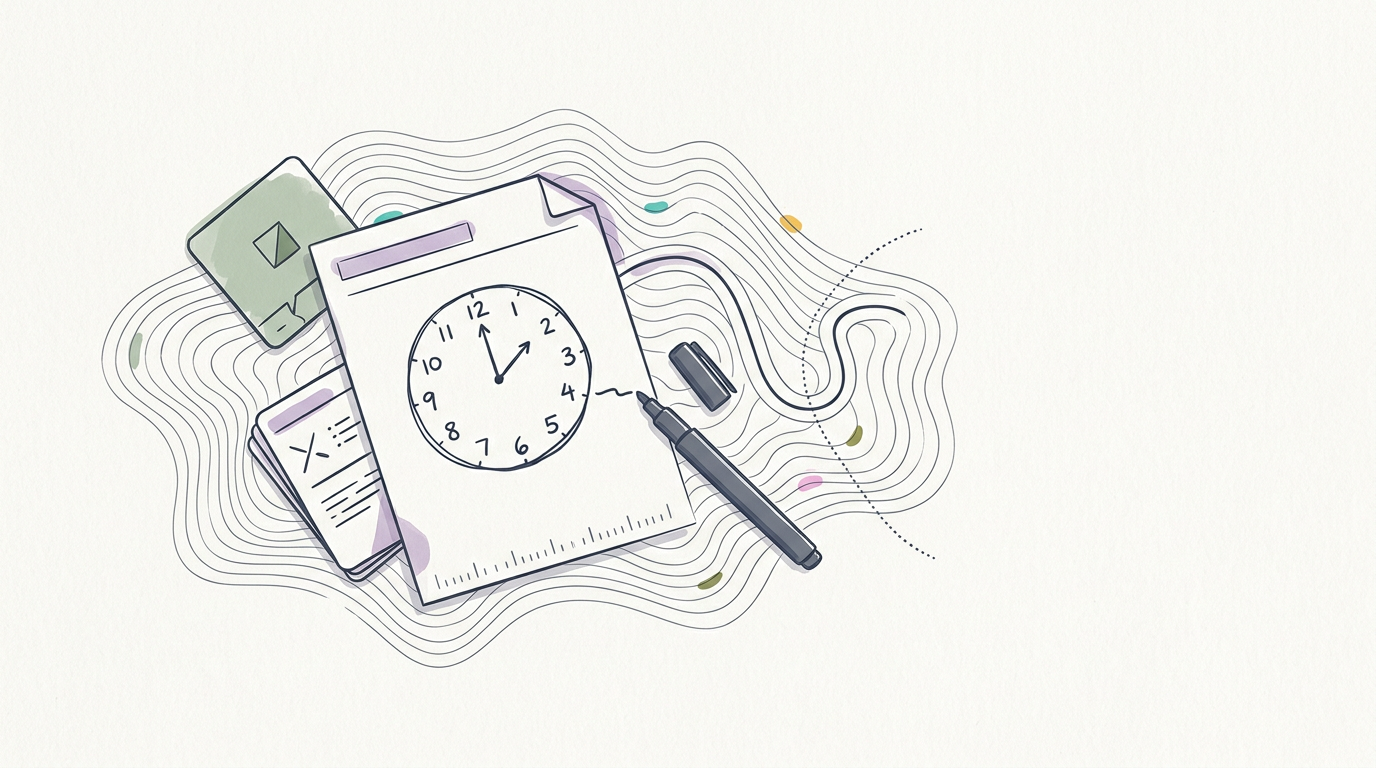
The idea of your local pharmacist asking you to draw a clock face to screen for cognitive decline feels like something from a different era. I used to think of it as a crude, almost insulting simplification. Yet it's a brutally effective test. Artistic skill has nothing to do with it. It's a quick, cheap way to check whether several parts of the brain are talking to each other properly. Most journaling is sold as the opposite: an unstructured space for feelings and vibes. That's a mistake. The right kind of journal is the closest thing to a daily clock test for your own nervous system — a private diagnostic you can run for free.
You're standing in the kitchen, staring at the spice rack, unable to recall the name of the herb you use three times a week. Later, you walk into a room with total purpose, and by the time you get there the reason is gone. It's smaller and more annoying than the memory loss from films: the fog that shows up after a completely ordinary day of meetings, or the word you can't find at 3pm that you'd have had instantly at 10am. You blame bad sleep, not enough coffee, or just getting older. What you're describing is a signal about capacity, and it's worth logging instead of shrugging off.
Brain fog isn't really a brain problem
Cognitive function isn't fixed, like your height. It moves depending on what else your body is dealing with. Word-finding trouble, a sudden inability to focus — that's downstream of everything else going on underneath it.
Low-grade inflammation from a meal that didn't agree with you. A blood sugar crash after a heavy lunch. Leftover adrenaline from a bad commute. Your brain and your immune system are in constant contact, and when your body is dealing with a threat — a virus, an allergen, or just a packed calendar — it pulls resources away from thinking clearly and puts them toward defence and repair instead.
Survival beats eloquence, every time. The fog is the evidence that your system was busy managing something else, usually hours or even days before you noticed the fog itself.
Related anchors: sleep anchor · gut-immune anchor · perimenopause anchor
Journaling as a check on the machinery
This is why most journaling doesn't work when you actually need it. Asking yourself to "explore your feelings" while your brain is already spent asks for exactly what's currently unavailable — narrative, insight, the energy to make sense of anything. You're not bad at journaling. The task is wrong for the state you're in.
A journal that works is a short, repeatable check on how the machinery is running today. It doesn't ask for a story. It asks you to do something small and specific, and how you do at it tells you something: your executive function, your ability to sense what's happening in your body, your ability to find words. A baseline. A personal normal, so you can tell when something's off.
I noticed my own ability to find words would fall apart after any meeting that ran past 75 minutes — a pattern I never would have caught without writing it down. Once you're tracking it, you stop being surprised by the fog and start noticing what comes before it. It shows up the day after bad sleep. It shows up on day two of a work trip. That's pattern recognition, not self-help.
Here's a prompt from the Kokorology Journal that works as a small check-in:
Where in your body do you feel the edge between "focused" and "distracted" right now? Describe its texture, temperature, and location. Is it a sharp line in your forehead, a buzzing in your chest, a heavy weight on your shoulders?
It doesn't ask how you feel. It asks you to locate something, sense it, and describe it precisely — which tests exactly the functions that go fuzzy first when your system's under load.
Common Questions
What is the clock-drawing test, really?
A simple screening tool for cognitive impairment, particularly dementia. You draw a clock face, place the numbers correctly, then draw hands to show a specific time. It tests planning, memory, visual-spatial skill, and abstract thinking at once. A messy drawing is fine; a clock with the numbers crowded into one half, or hands that can't be placed, is a sign those brain networks aren't coordinating.
How can a journal entry be like a medical test?
Not for diagnosis — for data. Prompts that require sensory memory, precise language, and a description of internal state are small tests of executive function. A change in how you answer them over time, vaguer or harder to complete, is a real signal about your current capacity.
Is brain fog always a sign of something serious?
No. Most of it is transient — poor sleep, stress, inflammation, nutrient shifts. It's a reason to check your inputs, not a diagnosis. If it's persistent, worsening, or comes with other neurological symptoms, that's a reason to see a doctor.
What to do this week
Pick a consistent five-minute slot. I do mine with the first coffee, before caffeine rewrites the data. Physical notebook, pen — the friction of handwriting slows you down and gives you different feedback than typing.
Run one small test instead of asking "how am I feeling." Try one a day: list five sounds farthest to nearest; describe your feet on the floor in three sentences with no emotional words; name seven blue things you saw yesterday.
Log one variable at the bottom of the page. "Sleep: 7 hours." "Stressful meeting: yes." "Ate sugar: no." After a week, look back — you're not hunting for a smoking gun, just the start of a pattern.
Where this fits in the Kokorology system
The point here is interoception — noticing what's happening inside your body before it turns into a symptom. Brain fog is downstream. This is upstream.
Your ability to think clearly comes out of the same limited daily supply as your energy for a workout or your patience with your kids. When you're foggy, that supply went somewhere else first.
This kind of journaling shows you where. Without it, fixing the fog is a guess — more coffee, a new supplement, a different app. With it, you know what actually happened before the fog showed up, and you can go fix that instead. The Wired-but-Tired Anchor is the protocol version of the same work, and the daily practice hacks are the smaller daily levers.
Tonight's practice
Tonight you will run a brief capacity check on your focus and recall. It shows what your body spent its energy on today.
Rate your current mental clarity from 1 to 5, then describe the physical feeling behind your eyes in three precise words.
- Take 2 minutes to write your clarity score and your three descriptive words.
- Note one specific physical trigger from today, like a 75-minute meeting or a late lunch.
- Compare these entries across 7 days to spot what drops your mental clarity.
- Lighten your calendar on the morning after a score of 2 or lower.
Closing
Tracking the signal is the first step. The next is improving its quality.
- Start building your own baseline with the prompts and structure in the Kokorology Journal — €25/mo, cancel whenever.
- If the 3pm fog is a pattern rather than a bad week, the Wired-but-Tired Anchor is the twelve-week version, €40.
- Read the free guide on nervous-system journaling without the vibes.
TL;DR
Brain fog and minor memory slips are signals from a body dealing with something else, usually hours before you noticed. Standard journaling often fails because it asks for narrative exactly when you don't have the capacity for one. A better approach: specific prompts that work like a daily clock test, checking executive function and body awareness instead of asking how you feel. Track it for a few days and the pattern behind the fog gets a lot easier to see.
Sources
- Pennebaker, J. W. (2023). Journaling and the nervous system: from expressive writing to affect labeling. Curated meta-analyses and primary studies (1986–2023).
- Lieberman, M. D. (2023). Communication with others and oneself: language as a nervous-system intervention. Curated primary studies and meta-analyses (1994–2023).
- Maki, P. M. (2020). Menopause and brain health: Hormonal changes are only part of the story. Frontiers in Neurology, 11, 562275.
- Shulman, K. I. (2000). Clock-drawing: is it the ideal cognitive screening test? International Journal of Geriatric Psychiatry, 15(6), 548–561.