Workplace & Leadership
Decision Fatigue is Nervous System Fatigue
Decision fatigue is a physiological state of resource depletion in your nervous system, driven by chronic HPA-axis activation and sustained cognitive load.
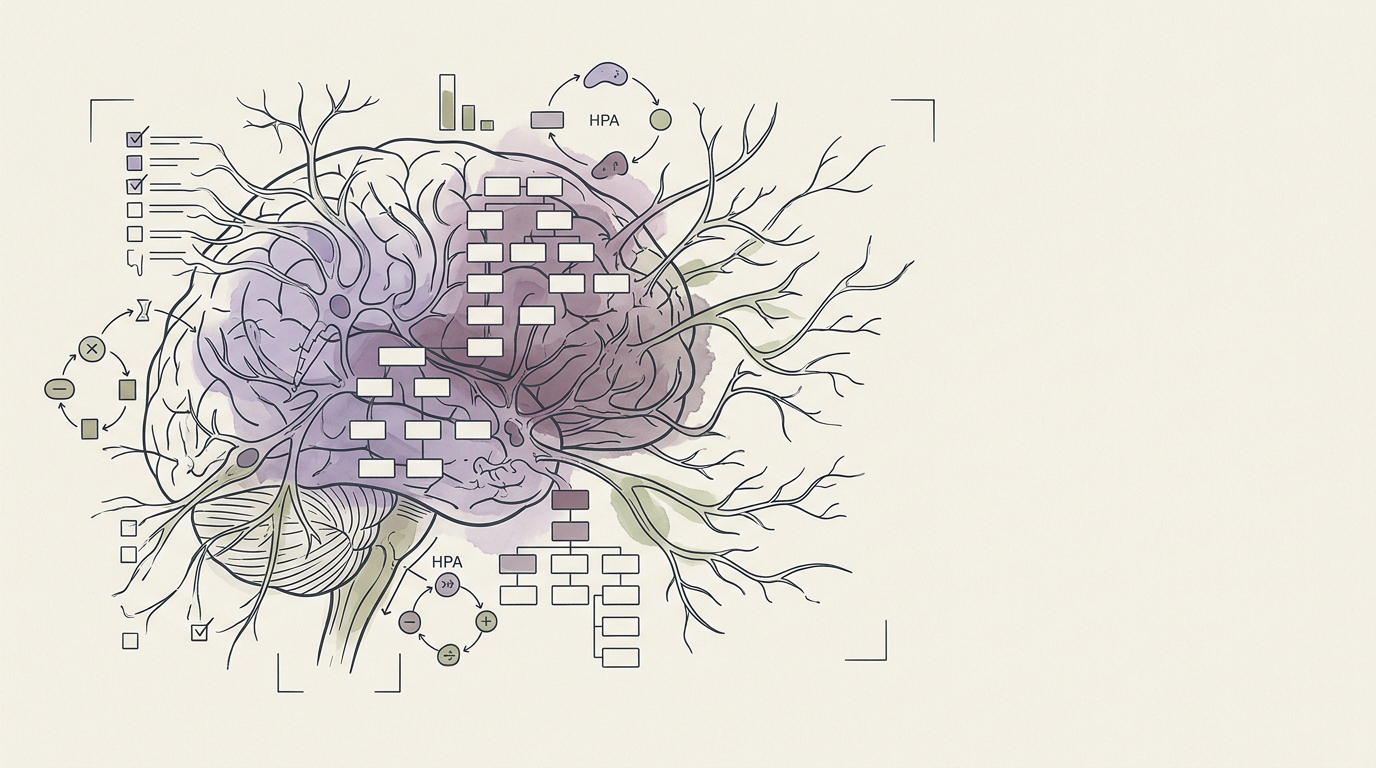
I used to advise burnt-out leaders to pre-select their Tuesday outfits and eat the exact same lunch every day to save their energy for the big choices. I completely misunderstood the mechanism. The draining, heavy-limbed state that hits after six hours of back-to-back calls responds poorly to a color-coded calendar. Your capacity for clear, effective leadership is dictated by the finite, physical limits of your nervous system and the allostatic load you carry into the room.
You already know the exact texture of this crash. It is 3pm. You are staring at a completely straightforward email, but stringing a sentence together feels like walking through deep mud. You feel tired but wired, your jaw is locked tight, and even though you are exhausted but can't rest, you end up doom-scrolling until midnight because choosing to put the phone down requires an effort you cannot summon. The brain fog after eating lunch leaves you staring blankly at Slack. You're anxious for no reason, snapping at a harmless question. Later, standing in front of an open fridge, you order takeout because boiling pasta feels like a complex logistical operation.
Common Questions
What is decision fatigue?
It is the measurable deterioration of decision quality after a long session of cognitive load. Your prefrontal cortex consumes physical resources to maintain focus and process options. When those physiological resources run low, your capacity to weigh consequences degrades, leading to impulsive choices or total avoidance.
Why does it feel physical?
Making choices under pressure activates the HPA axis, your body's central stress response system. This activation consumes blood glucose and neurotransmitters. Sustained demand increases your allostatic load, manifesting as physical heaviness, tension in the shoulders, and systemic exhaustion.
How does this relate to burnout?
It is a direct precursor. Chronic stress fundamentally alters how your body processes energy and recovers from effort. Unmanaged daily friction wears down the nervous system's capacity to return to baseline, pushing the body steadily toward a fully depleted state.
The Prefrontal Reality
Everyone likes to call the prefrontal cortex the brain's executive suite. I find that framing entirely unhelpful. Your prefrontal cortex handles reasoning, planning, and impulse control—the precise machinery that separates a considered strategic pivot from firing off a rage-reply to a mildly annoying vendor. It runs on blood glucose and oxygen, and those are strictly limited physical resources.
Every single choice you make draws from the same metabolic pool. The constant ping of notifications demands a physiological response every time you look away from your screen. Your brain doesn't categorize a lunch order differently than a nine-figure budget approval. Both require the system to filter noise, project outcomes, and commit to an action. When you demand continuous output, the machinery gets progressively slower.
The Cortisol Curve
The modern productivity cult expects stress hormones to function like caffeine. Kokorology're encouraged to ride a wave of urgency through quarterly planning. Cortisol exists to mobilize energy for an acute, immediate physical threat. It does not exist to power you through a four-hour workshop.
A healthy cortisol pattern peaks sharply in the morning to wake you up and then drops steadily as the sun goes down. Constant low-grade decision-making flattens this curve out into a persistent horizontal line. The alarm bells ring softly all day, preventing your nervous system from ever shifting into repair mode. A system that never gets the 'all clear' signal eventually stops trying to shut down at all. This is why you wake up at 3am every night with your mind racing. Your off-switch is physically jammed. Kokorology work on resetting this daily in the nervous system regulation protocols.
The inbox has never once been impressed by your heart rate.
The Locus Coeruleus
Deep in your brainstem sits a tiny, bluish cluster of neurons called the locus coeruleus. It acts as the brain's arousal router. It is the main source of noradrenaline, a neurotransmitter that dials your focus up or down depending on the immediate environment.
When you make a sharp, key decision, this cluster fires cleanly, snapping your attention into place. When you monitor your environment for vague threats, it pulses at a low, steady rate. Chronic stress and relentless cognitive demand push this cluster into a chaotic, highly active state. It screams static instead of providing a clear signal.
This is the neurobiological root of feeling foggy and scattered. Your attentional system is overwhelmed, unable to distinguish the signal from the noise, so it treats every input as a low-grade threat. You can't focus deeply because the actual tissue responsible for focus is exhausted. A day of back-to-back meetings leaves you drained because your locus coeruleus has been firing nonstop.
Heart Rate Variability
Kokorology track customer acquisition and quarterly revenue with obsessive precision. Yet Kokorology treat the own physical capacity as a vague mystery. Your nervous system's state is measurable, and Heart Rate Variability (HRV) is one of the clearest signals Kokorology have.
HRV measures the tiny, millisecond variations between your heartbeats. High variability signals a flexible, regulated nervous system that shifts easily between stress and rest. Low variability is a glaring red flag, indicating a system locked in sympathetic arousal. Higher HRV directly correlates with better executive function.
When your HRV plummets, your prefrontal cortex is already compromised. Attempting to push through is strategically foolish. You guarantee you'll make worse decisions and create more work for tomorrow. I track my own metrics daily, and if the data says my capacity is low, I push non-essential choices to the next morning. Learning to read these signals is a core part of the Performance L2 curriculum.
What to do this week
- Batch the small things. Set aside two specific blocks of time for rapid-fire operational decisions. Outside those blocks, follow rigid pre-made rules. If a question is non-urgent, it waits for the block.
- Externalise the holding pattern. Your mind is designed to process information. It is a terrible storage device. Use a simple, trusted system to capture every loose task and commitment. Get it out of your head to reduce the ongoing prefrontal load. Track your patterns in the Kokorology Journal.
- Protect the morning spike. Make your two most demanding, complex decisions before lunch. Your metabolic resources peak early. Stop burning your best physiological state on clearing an inbox of other people's emergencies.
- Block sixty empty minutes. Put an immovable 60-minute hold on your calendar. No calls, no catch-up work, no podcast. Stare out the window or walk. This is the physiological requirement for your system to clear metabolic waste. For smaller reset tools, explore the Hacks library.
Where this fits in the Kokorology system
Treating decision fatigue as a biological limit is a core principle in the Capacity pillar of the Kokorology method. It is the difference between relying on grit and intelligently managing your physiological load, which Kokorology map out extensively in the Performance L2 course. For immediate support, start with the Reset module.
Closing
The shift from seeing yourself as an infinite resource to managing a delicate, powerful biological machine changes how you operate entirely. Your sharpest, most effective work requires a well-regulated nervous system. Stop trying to summon more willpower and start managing the actual physical limits of your brain.
- Elevate your capacity: Move from managing your time to managing your nervous system inside the advanced Performance L2 course.
- Get personalised support: If you're hitting a wall with decision fatigue and systemic exhaustion, let's talk about 1:1 Coaching.
- Start with a plan: Download the free guide to the nervous system and find your starting point.
TL;DR
Decision fatigue is a physiological state of resource depletion driven by chronic allostatic load. Sustained cognitive demand exhausts the prefrontal cortex, flattens diurnal cortisol rhythms, and pushes the locus coeruleus into a chaotic state of constant arousal. This neurological strain degrades your capacity for clear judgment. Managing it requires batching choices, externalising tasks, and protecting your body’s natural recovery periods to maintain baseline cognitive function.
Sources
- Adam, E. K., et al. (2017). Diurnal cortisol slopes and mental and physical health outcomes: A systematic review and meta-analysis. Psychoneuroendocrinology.
- Epel ES et al. (2024). Caregiver Load and Telomere Attrition: A 10-Year Longitudinal Study. Molecular Psychiatry.
- Mather, M., & Harley, C. W. (2016). The Locus Coeruleus: A Hub for Arousal and Memory. Cold Spring Harbor Perspectives in Biology.
- McEwen, B. S. (2017). Neurobiological and Systemic Effects of Chronic Stress. Chronic Stress.
- Thayer, J. F., et al. (2012). A meta-analysis of heart rate variability and neuroimaging studies: implications for heart rate variability as a marker of stress and health. Neuroscience & Biobehavioral Reviews.