Nervous System
Vagus Nerve Exercises for Anxiety Burnout
People love the idea of vagus nerve exercises. It feels so satisfyingly direct, so... mechanical. Got anxiety? Just do some reps for your vagus nerve, like a bicep curl for your soul. Problem is, your nervous system isn'
I keep seeing the phrase "vagus nerve workout" floating around my feed, usually sandwiched between ads for greens powders and heavy blankets. The wellness industry desperately wants to treat the nervous system like just another muscle group you can isolate and train at the gym. You cannot tone your vagus nerve by doing a set of tactical breathing reps. When you're burned out, your physiological state is locked in a threat response, and applying more force to the system only drives the alarm louder.
You know what this state feels like long before you have a name for it. It's the 3pm jaw clench that travels up into a dull buzz behind your eyes. You're exhausted but can't rest, staring at the ceiling at 2am while your heart hammers against your ribs. You feel anxious for no reason when an email pings, your shoulders glued to your ears even when you stand under the hot water in the shower. Your system is completely over-revved, leaving you tired but wired and scrolling through your phone until midnight. You find yourself opening the fridge without any hunger, looking for something to numb the low-grade hum of panic sitting at the base of your throat. The capacity is gone. The engine simply refuses to shut off.
Common Questions
What are vagus nerve exercises?
They are specific physical actions that send sensory data up to the brain to shift your autonomic state. Practices like cold exposure, humming, or extending your exhale use the body's existing hardware to signal safety, lowering your heart rate and quieting the threat response.
How do they help with anxiety and burnout?
Anxiety and burnout happen when your stress-hormone control loop stays locked on high alert. These physical inputs manually trigger a downshift in your autonomic nervous system. They interrupt the physiological loop, dropping your heart rate and signalling the system to regulate.
Can a quick exercise cure burnout?
No single technique can. Breathing practices manage your state in the immediate moment, but they cannot outwork chronic sleep deprivation. Lasting regulation requires lowering the total load on your nervous system and changing the daily conditions that keep the threat response active.
The threat loop and the sensory override
I used to believe I just needed more discipline when I felt anxious. If I could just power through the brain fog and push my heart rate down with sheer willpower, I would eventually relax. I was completely wrong. Anxiety is a physiological broadcast, and the brain relies on data from the body to decide whether you're safe.
When you push yourself for months without recovery, your HPA axis—the stress-hormone control loop that runs from your brain to your adrenal glands and back—stays activated. You flood with cortisol to handle the perceived threat of a difficult client or a tight deadline. The inbox has never once been impressed by your heart rate, yet your body reacts as if you're running from a predator. This chronic activation generates high allostatic load, which is the cumulative physiological wear and tear of chronic stress. Your sleep staging degrades. Your vagal tone, the responsiveness of your autonomic nervous system to slow down after a spike, drops significantly.
Physical signals that actually register
The wellness industry has somehow turned breathing, a thing you've been doing without instruction since the day you were born, into a paid course. The truth about vagus nerve exercises is far less glamorous. You're simply giving your brain sensory input it cannot ignore.
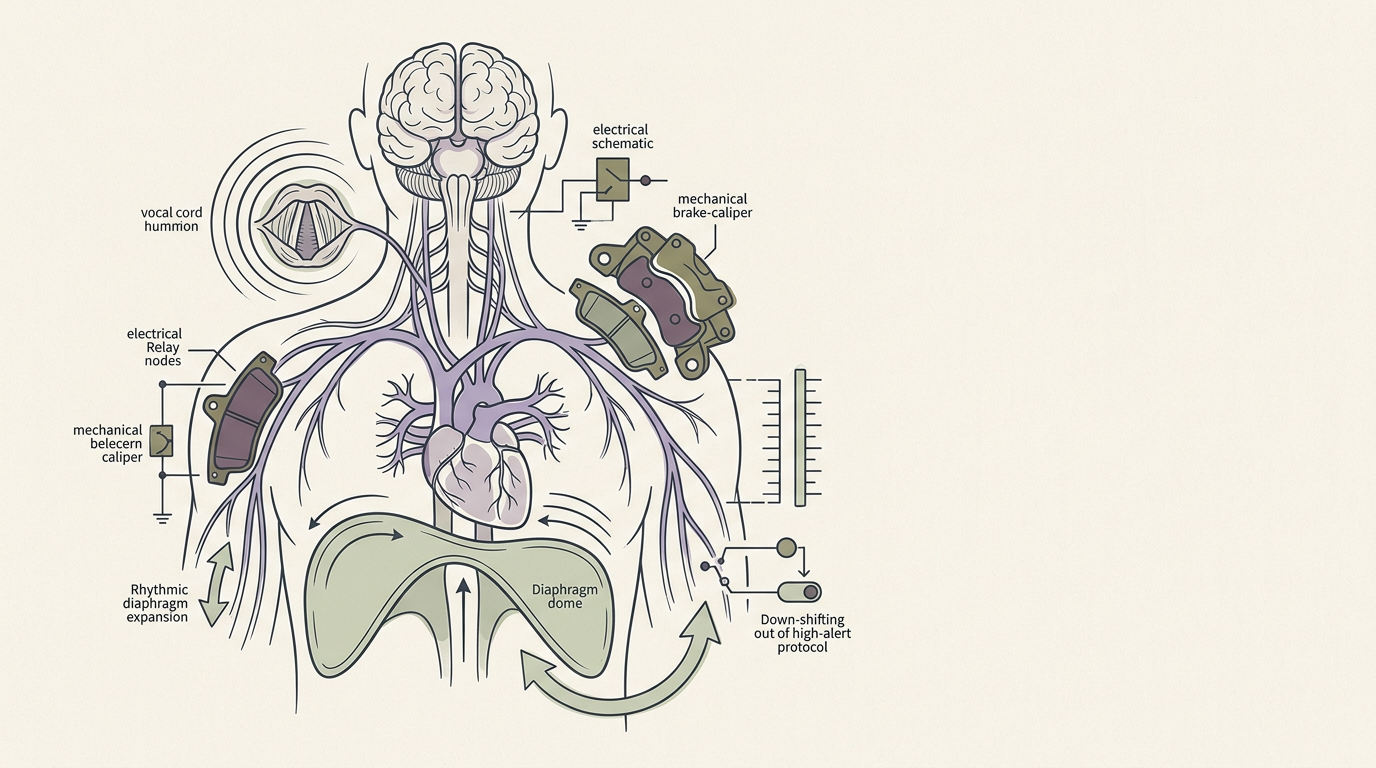
The vagus nerve is a vast sensory network, and eighty percent of its fibres run from the body up to the brain. When you splash freezing water on your face, you trigger the mammalian dive reflex. This ancient pathway rapidly slows the heart rate and shifts blood flow to conserve oxygen. When you intentionally make your exhale longer than your inhale, you manually engage the parasympathetic nervous system. When you hum or chant, you vibrate the vocal cords, which sit directly next to the nerve pathway in your throat. You give it a physical stimulus that forces the brain to update its threat assessment. Kokorology use these small, targeted inputs extensively inside the Hacks library because they change the state of the body in real time.
The nerd-out: interoception is the actual skill
The physical movement is just a trigger. The mechanism you're actually leveraging is interoception, which is the brain's ability to sense and interpret signals from your internal organs. The vagus nerve acts as the superhighway for this information, constantly reporting on your heart rate, your digestion, and your breath.
When you intentionally slow your exhale, you create a very clear, potent interoceptive signal. The brain receives this long, slow breath data and concludes that the environment must be safe. The real goal of these practices is to refine your interoceptive awareness. Most people treat their interoception like a cheap smoke alarm; it only goes off when the kitchen is already on fire. The actual work is upgrading it to a finely tuned dashboard where you notice the subtle shift from tense to slightly less tense. That kind of pattern recognition is exactly what Kokorology track in the Kokorology Journal.
State management versus capacity
I've stopped recommending 60-second hacks to people who refuse to look at their sleep. Kokorology act as if ten minutes of tactical breathing will somehow cancel out eighty hours of sleep deprivation.
The quickest way to quiet the mind is to change the data coming from the body.
Quick tools put out immediate fires. Building robust vagal tone requires lowering the total demand on the system. You have to guard your sleep staging. You have to cultivate genuine social connection, because human nervous systems regulate through coregulation with others. You support your gut microbiome, since the gut-brain axis relies on vagal communication. The daily movements manage the acute state, while these larger practices rebuild your baseline capacity over time. If you want a structured way to lower that total load, start with a Cortisol Reset Anchor.
What to do this week
Pick one input and do it consistently.
- Use physiological sighs. Twice an hour, take two sharp inhales through your nose to fill your lungs completely, followed by one long, slow exhale through your mouth. This forces a mechanical reset of your autonomic arousal.
- End your shower cold. Turn the water to cold for the last 30 seconds of your shower. Focus the stream on your face and chest. Try to control your breath and extend your exhales instead of gasping.
- Hum while you walk. Hum a simple tune for a minute while walking to your car. Pay attention to the physical vibration in your throat and chest.
- Track the aftermath. Pause for 30 seconds after any practice. Notice what you feel inside your body. Check if your jaw is looser or your breathing is deeper.
Where this fits in the Kokorology system
This practice of signalling safety to the body sits at the core of Nervous System Regulation, the foundational pillar. Changing the daily inputs that keep the threat response active requires a structured approach to your routine.
Closing
You can't punish your biology into a state of deep rest. The path out of burnout requires smarter, kinder signalling rather than sheer force. These movements give you a reliable entry point to start a very different conversation with your own nervous system.
- Start the 7-day protocol inside The Reset.
- Practice this daily with guided prompts inside the Kokorology Journal.
- Get the free guide to your nervous system with the 5-minute overview.
TL;DR
Vagus nerve exercises are physical signals you send to your body's primary anti-stress pathway. Chronic anxiety and burnout are symptoms of low vagal tone, where the physiological threat response stays active due to high allostatic load. Practices like humming, cold exposure, and long-exhale breathing use your interoception to manually drop your heart rate and engage the parasympathetic nervous system. These targeted movements provide immediate state relief, but building long-term regulatory capacity requires consistent support through sleep, nutrition, and coregulation.
Sources
- Craig, A. D. (Bud) (2002). How do you feel? Interoception: the sense of the physiological condition of the body. Nature Reviews Neuroscience.
- McEwen, B. S. (2017). Neurobiology of stress, resilience, and allostatic load. Neurobiology of Stress.
- Mayer, E. A. (2018). The Mind-Gut Connection. Harper Wave.
- Thayer, J. F., & Lane, R. D. (2000). A model of neurovisceral integration in emotion regulation and dysregulation. Journal of Affective Disorders.