Journal Practice
The insubstantiality of journaling prompts and emotional stability
Gratitude lists are not a structural repair for an overloaded system. Effective journaling is about building interoceptive accuracy.
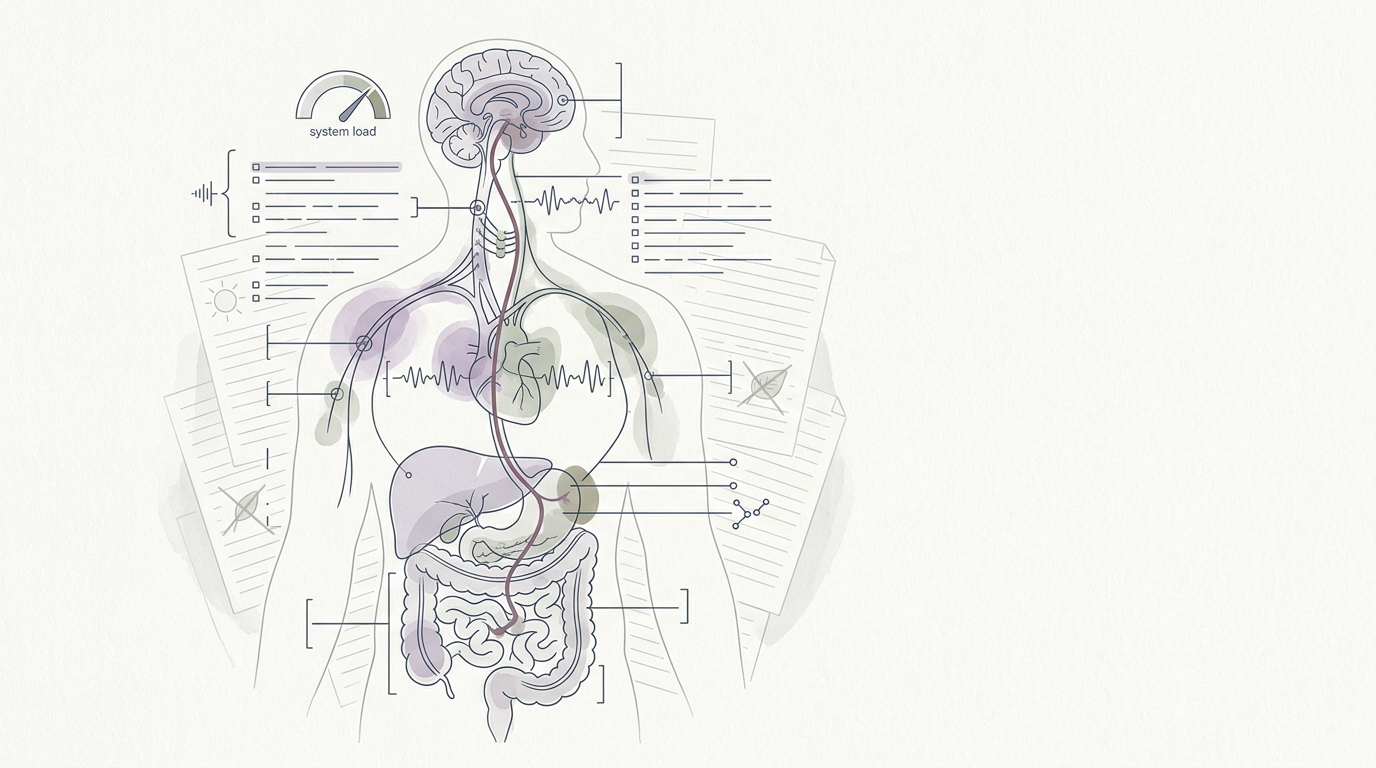
The internet is filled with journal prompts that feel like they were written by a sentient Pinterest board, asking you to list your gratitudes as if that’s a structural repair for an overloaded system. This is a failure of imagination. Effective journal prompts for emotional regulation aren't about curating your feelings for an audience of one; they're about building interoceptive accuracy—the skill of reading your body's raw data before it becomes a crisis.
You buy the beautiful, minimalist notebook. You stare at the blank page, pen in hand, feeling the pressure to write something profound. But what? The day was just… a day. You feel a familiar, low-grade hum of anxiety for no reason, a tightness in your chest you can’t explain. You feel disconnected from your body, like your head is a snow globe that’s been shaken too hard and won't settle. You’re exhausted but can't rest, so you write half a sentence about being tired, close the book, and it gathers dust on your nightstand, another monument to a habit you failed to build.
Common Questions
What are journal prompts for emotional regulation?
They are targeted questions designed to build awareness of your nervous system's state, not just your thoughts. Instead of asking how you feel, they ask where you feel it, turning vague emotions into specific, trackable data points for better self-regulation.
How is this different from a gratitude journal?
Gratitude journals focus on cognitive reframing. This is about interoceptive accuracy—learning to read the raw data from your body before your brain assigns a story to it. It’s the difference between looking at the weather report versus trying to wish the sky clear. It's diagnostics, not affirmations.
How often should I journal for it to work?
Consistency beats intensity. A few minutes of focused check-in daily is far more effective than an hour-long session once a month. The goal is to build a high-frequency feedback loop with your nervous system, not to write a memoir.
Related anchors: vagal tone anchor · gut-immune anchor · HRV anchor
Journal prompts for emotional regulation are about data, not drama
The 'Dear Diary' model of journaling is broken. It encourages rumination, a circular thought pattern that often amplifies distress rather than resolving it. You end up practising the story of your stress, etching the groove deeper. The trouble is, your feelings aren't the source code; they are the user interface. The real work is learning to read the system diagnostics running underneath.
This is where the practice of interoception comes in. Interoception is, simply, your sense of the internal state of your body. It’s the brain’s ability to read the subtle signals from your organs, muscles, and tissues—your heart rate, your gut motility, your breath depth. Most of the system are interoceptively numb. Kokorology don’t notice the faint signal of a tight jaw until it's a migraine, or the shallow breathing until it’s a panic attack. Kokorology live in the heads, treating the bodies like a taxi Kokorology only notice when it breaks down.
Good prompts cut through the narrative. They don't ask why you're anxious; they ask where the anxiety lives in your body. This shift from story to sensation is everything. It takes you out of the limbic system's feedback loop and engages the prefrontal cortex—the part of your brain that can observe without judgment. It’s the first step in learning to manage your state, rather than being managed by it.
Where do you feel today's signal in your body — and what was the last thing that moved it?
This isn't about finding a profound answer. It’s about the act of looking. The act of asking the question is the intervention. It’s a single rep in the gym for your attention, building the muscle of self-awareness that is the bedrock of nervous system regulation.
The Anterior Insula: Your Brain's In-House Analyst
If your nervous system were a company, the anterior insula would be the analyst in the basement that nobody talks to but who actually knows if the company is about to go bankrupt. This brain region is the hub for interoception. It receives all the raw, visceral data from your body—the flutter in your chest, the knot in your stomach, the heat in your face—and integrates it into a coherent feeling you can consciously recognise. It's where a 'gut feeling' becomes a feeling-feeling.
This process is not as automatic as Kokorology assume. The insula relies on prediction. It takes the incoming sensory data, compares it to all your past experiences, and makes a best guess: 'Given this heart rate and this gut tension in this context, Kokorology are likely experiencing 'anxiety'.' When your interoceptive sense is dull, the input is noisy and imprecise. The brain is forced to make predictions with bad data, which is why you can suddenly feel 'anxious for no reason'. The reason exists, but it’s written in a biological code you haven’t learned to read yet.
Journaling with the right prompts is how you clean up the data stream. Whether you're navigating the unique fatigue of a UK monsoon season or the pressure cooker of the American 5-to-9 that follows the 9-to-5, your body is logging the cost. By deliberately directing your attention to these internal signals, you are training your insula to make better, more accurate predictions. You are building a higher-resolution map of your own internal world. Over time, 'anxious' becomes 'I notice a tightness in my solar plexus, my breathing is shallow, and I haven't eaten in five hours.' One is a crisis. The other is a to-do list. This is the core practice Kokorology teach inside the Kokorology Journal and the foundational Regulation course.
What to do this week
- Ask 'where?' before 'why?'. For the next three days, when a strong emotion arises, pause. Before you analyse the story, simply ask, 'Where do I feel this in my body?' and name the location. That's it.
- Track one signal. Pick one physical tell—jaw clenching, shoulders rising, breath-holding—and just notice when it happens. Make a note on your phone or in the Journal. No judgment, no fixing. Just awareness.
- Run a one-question experiment. Each evening, answer this one prompt: 'What was one moment today my body felt settled?' It could be the first sip of tea or the feeling of sun on your skin. Write one sentence.
Where this fits in the Kokorology system
This practice of building interoceptive awareness is the foundational skill of the entire Kokorology system. It's the diagnostic work that makes regulation possible, turning the abstract idea of 'managing stress' into a concrete, physical practice you can track in the Journal and build upon with targeted Anchors.
Tonight's practice
Tonight you stop writing stories about your stress. You track where the physical feeling lives in your body instead.
Name the exact physical location of your strongest body sensation right now and describe how it feels physically.
- Sit quietly for 2 minutes.
- Locate one point of physical tension in your jaw, chest, or stomach without writing any explanation for why it is there.
- Record the physical location and rate its intensity on a scale of 1 to 5 once daily for 7 days.
- Compare your daily numbers to see if physical intensity drops once you isolate the physical feeling from the story.
Closing
The point of a journal isn't to create a perfect archive of your feelings, but to build a more reliable instrument for reading your own system in real time.
- Practice it daily inside the Kokorology Journal, with prompts designed to build this exact skill.
- If you feel completely disconnected from your body, start with The Observer Anchor to practise separating signal from story.
- Download the free guide to the nervous system to understand the architecture you're working with.
TL;DR
Forget 'dear diary'. Most journaling reinforces emotional drama rather than regulating it. Truly effective journal prompts for emotional regulation are a tool for building interoception—the skill of reading your body's physical signals. By asking 'where' you feel something before 'why', you shift from abstract anxiety to concrete data. This trains your brain to more accurately predict and manage your nervous system's state, turning a vague crisis into a manageable, physical signal.
Sources
- Pennebaker JW (2023). Journaling and the nervous system: from expressive writing to affect labeling. Curated meta-analyses and primary studies (1986–2023).
- Thayer JF (2012). A meta-analysis of heart rate variability and neuroimaging studies: Implications for heart rate variability as a marker of stress and health. Neuroscience & Biobehavioral Reviews.
- Kok BE (2013). How positive emotions build physical health: Perceived positive social connections account for the upward spiral between positive emotions and vagal tone. Psychological Science.