Journal Practice
An alternative to journaling for functional freeze
That high-functioning but hollow state isn't burnout. It's functional freeze, and another journal prompt is the last thing your nervous system needs.
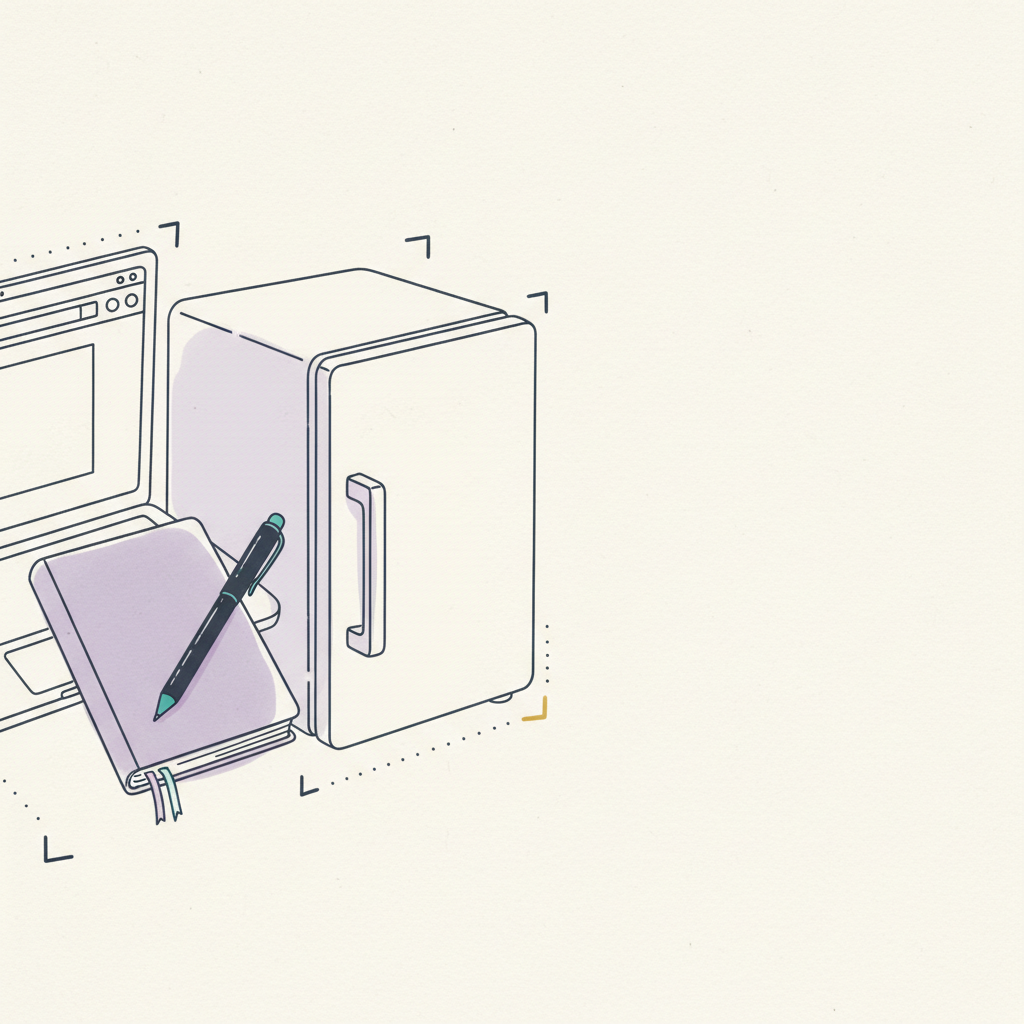
The internet is full of burnout journal prompts designed to help you find your feelings. This is a convenient fantasy. For the person who is still showing up, still hitting deadlines, and still performing, the problem isn't a lack of prompts. The problem is that journaling has become just another to-do list item, and 'feeling your feelings' is a task you no longer have the bandwidth to perform.
You get it all done. The inbox is cleared, the family is fed, the presentation is flawless. Then, at 10pm, you find yourself staring into the open fridge, not hungry, just… blank. You feel disconnected from your body, like you’re piloting a machine that’s running on fumes. You’re exhausted but can't rest, scrolling through online shopping carts at midnight, convinced a new gadget will fix the fatigue. You feel anxious for no reason, a low-grade hum beneath the surface of your relentless competence. The praise you get at work feels like it’s for someone else. You’re not falling apart; you’re just quietly, efficiently, disappearing.
Common Questions
What is functional freeze?
It's a high-output state of nervous system shutdown. Your body has correctly identified the demands as unsustainable and has switched to a low-power mode for everything but essential tasks. You can still perform, but you can't feel, connect, or rest. It’s the body’s version of a strategic retreat.
Why don't most burnout journal prompts work for this?
Because they ask 'How do you feel?' when your system has deliberately cut power to the feeling circuits. It’s like asking a computer in safe mode to run a high-resolution video. The hardware is temporarily offline for that function. You need prompts that target the hardware, not the software.
Can journaling make burnout worse?
Yes, if it becomes another performance of wellness. When you try to write the 'right' answer or fill the page with feelings you think you should have, it just adds another layer of exhausting cognitive load. It reinforces the pattern of performing instead of sensing.
Related anchors: gut-immune anchor · skin anchor · burnt-out anchor
The problem with asking a system in lockdown how it feels
The fundamental mistake most burnout journal prompts make is assuming the line between your brain and your body is open for traffic. When you’re in functional freeze, that line isn’t just congested; the system has shut down the entire road to conserve fuel. Asking 'What are you grateful for?' is pointless when the circuits that register pleasure are offline for maintenance. It’s like asking a hibernating bear for its opinion on interest rates.
Your body is still sending signals—the tight jaw, the shallow breath, the hum of anxiety in your chest—but your brain, in an act of profound and sensible self-preservation, has learned to mute them. The goal of a useful journaling practice isn't to invent feelings, but to slowly, carefully, turn the volume back up on the physical signals you’re already getting. It’s less about emotional archaeology and more about being a good systems analyst.
This is why the prompts inside the Kokorology Journal don't ask how you feel. They ask what you feel, physically. They are designed to be a logbook for your internal state, not a diary of your emotions.
Interoception: The signal before the story
Your brain has a dedicated network for sensing the internal state of your body. This is called interoception. It’s the constant stream of data from your heart, lungs, gut, and muscles that tells your brain if you are safe, hungry, tired, or threatened. It’s the raw data. The feeling—'I am anxious' or 'I am excited'—is the story your brain tells itself after it reads the data.
In a state of chronic stress or burnout, this process breaks. The hypothalamic-pituitary-adrenal (HPA) axis—the stress-hormone control loop that runs from brain to adrenal glands and back—doesn't just get stuck 'on'; sometimes it gets stuck 'off', creating a flat, blunted response. The physical signals are still being sent, but the brain either stops listening or can't make sense of the muffled broadcast. This is the essence of feeling 'disconnected from my body.'
A journaling practice for this state doesn’t try to interpret the story. It just logs the data. 'Heart rate feels fast.' 'Stomach feels tight.' 'Shoulders are up by my ears.' By simply noticing and recording the raw physical signal without judgment, you are doing the slow, crucial work of rebuilding that communication pathway. You are training your brain to listen again, which is the non-negotiable first step to any kind of nervous system regulation.
The brain’s internal switchboard operator
Let’s get nerdy for a moment. Deep inside your brain is a region called the insular cortex. Think of it as the main switchboard for all incoming calls from the body. It takes the raw signals—a change in heart rate, a drop in blood sugar, a twinge in the gut—and integrates them into a coherent picture of your internal state. This is where the raw data of interoception gets processed.
In functional freeze, the switchboard is still lit up with calls. The problem is that the CEO (your prefrontal cortex, the seat of executive function) has told the operator to stop putting them through. Your brain, making a predictive calculation, has decided that the cost of feeling the body’s distress is higher than the cost of ignoring it. It prioritises keeping the lights on in the 'performance' department by cutting the budget for the 'feeling' department. This isn't a moral failing; it's a ruthless piece of biological accounting.
The most competent people aren’t immune to burnout; they’re just better at hiding the evidence from themselves.
This isn’t a failure, it’s a strategy
The wellness industry loves to talk about burnout as a spectacular collapse. The reality for most high-functioning people is much quieter. It's a strategic shutdown disguised as peak efficiency. This is the end-state of unmanaged allostatic load—the cumulative wear and tear on your body from being chronically activated.
When the brain predicts that the demand for output will continue to exceed the available resources, it makes a choice. It can’t make you stop working, but it can stop you from feeling the cost of that work. It preserves the 'functional' part by jettisoning feeling, connection, and rest—the 'freeze' part. You become a ghost in your own machine, hitting every target while the engine slowly seizes. The system isn't broken; it's running a grimly effective survival strategy.
What to do this week
- Log your caffeine. Don't change anything. Just note the time of every coffee or tea. Notice what physical sensation precedes the urge for the next one. This is a simple, data-driven entry point.
- Track one sensation. Pick one thing—a tight jaw, cold hands, a knot in your stomach. Three times a day, just note if it's there. No need to fix it. Just note it. Use a simple note in your phone or the Journal.
- Notice temperature. When you walk into a room, before you do anything else, notice if you feel warmer or cooler. It’s a simple, binary interoceptive check-in that requires no emotional interpretation.
- Map your phone. Instead of scrolling, pause. Where in your body do you feel the urge to check your phone? Chest, hands, stomach? Note the location. The answer is more useful than whatever is on the screen.
Where this fits in the Kokorology system
This practice of logging physical data is the foundation of interoceptive awareness, a core skill Kokorology teach in the Regulation course. It’s not a fluffy wellness exercise; it’s the diagnostic work required to understand your system's unique patterns before you can apply targeted Hacks or build sustainable Performance capacity.
Tonight's practice
This practice skips emotional stories and logs raw body sensations instead. It trains your brain to notice physical input when functional freeze makes feelings hard to access.
What three physical sensations are present in your body right now, described without using emotional words?
- Sit still for 2 minutes with eyes open or closed.
- Focus on raw physical facts like tight jaw muscles, shallow chest breathing, or gut tension.
- Write down 3 physical observations in your journal every night for 7 days without explaining them.
- Review the list on day 7 to see which exact body locations carry your stress repeatedly.
Closing
Stop trying to write your way out of burnout and start logging the data that shows you the way through. The feelings will come back when the system trusts that it's safe to have them.
- Practice it daily inside the Kokorology Journal.
- Pair your practice with a targeted protocol like the Fatigue Anchor.
- Get the foundational map with the free guide to the nervous system.
TL;DR
Standard burnout journal prompts fail because they ask for feelings from a nervous system that has muted them to survive. This 'functional freeze' is a strategic shutdown, not a lack of self-awareness. Instead of asking 'how do I feel?', use journaling to log raw physical data—a tight jaw, a fast heart rate, a craving for caffeine. This practice rebuilds interoception, the crucial brain-body connection, by training your brain to listen to the body's signals again. It’s the necessary first step before emotional awareness is even possible.
Sources
- Maslach C (2016). Understanding the burnout experience: Recent research and its implications for psychiatry. World Psychiatry.
- Pennebaker JW (2023). Journaling and the nervous system: from expressive writing to affect labeling. Curated meta-analyses and primary studies (1986–2023).
- Miller GE (2007). If it goes up, must it come down? Chronic stress and the hypothalamic-pituitary-adrenocortical axis in humans. Psychological Bulletin.
- Khalsa SS (2018). Interoception and the brain: a roadmap. Neuron.
- Critchley HD (2017). Interoception and emotion. Current Opinion in Psychology.